Abhinav Roy

Other Schools
Researcher

Biography

I am a passionate researcher and teacher in the field of physics and applied mathematics. I have significant teaching experience in tutoring high school students preparing for engineering programs. I love to solve problems and help students get the joy of discovering solutions to challanging problems!

Education

BS Metallurgical and Materials Engineering
Other Schools

Educator Statistics

Numerade tutor for 5 years
42 Students Helped

Topics Covered

Mastering Motion: Achieving Efficiency Along a Straight Line
Mastering Newton's Laws: Tips for Applying Them Effectively
Find Your Dream Job: Discover the Best Work Opportunities
Unlock the Power of Kinetic Energy: Boost Your Efficiency Today
Unlocking the Power of Potential Energy: Discover the Benefits
Motion in 2d or 3d
Understanding Equilibrium and Elasticity: A Comprehensive Guide
Understanding Structure and Bonding: A Comprehensive Guide
Exploring the Wonders of Atomic Physics: A Comprehensive Guide
Understanding Chemical Bonding: The Key to Molecular Structure
Condensed Matter Physics

Abhinav's Textbook Answer Videos

03:41
University Physics with Modern Physics

A juggler throws a bowling pin straight up with an initial speed of 8.20 m/s. How much time elapses until the bowling pin returns to the juggler's hand?

Chapter 2: Motion Along a Straight Line
Section 5: Freely Falling Bodies
Abhinav Roy
03:38
Materials Science and Engineering: An Introduction

Allowed values for the quantum numbers of electrons are as follows:
\[
\begin{aligned}
n &=1,2,3, \ldots \\
l &=0,1,2,3, \ldots, n-1 \\
m_{l} &=0,\pm 1,\pm 2,\pm 3, \ldots, \pm l \\
m_{s} &=\pm \frac{1}{2}
\end{aligned}
\] The relationships between $n$ and the shell designations are noted in Table $2.1 .$ Relative to the subshells,
$l=0$ corresponds to an $s$ subshell $l=1$ corresponds to a $p$ subshell $l=2$ corresponds to a $d$ subshell $l=3$ corresponds to an $f$ subshell
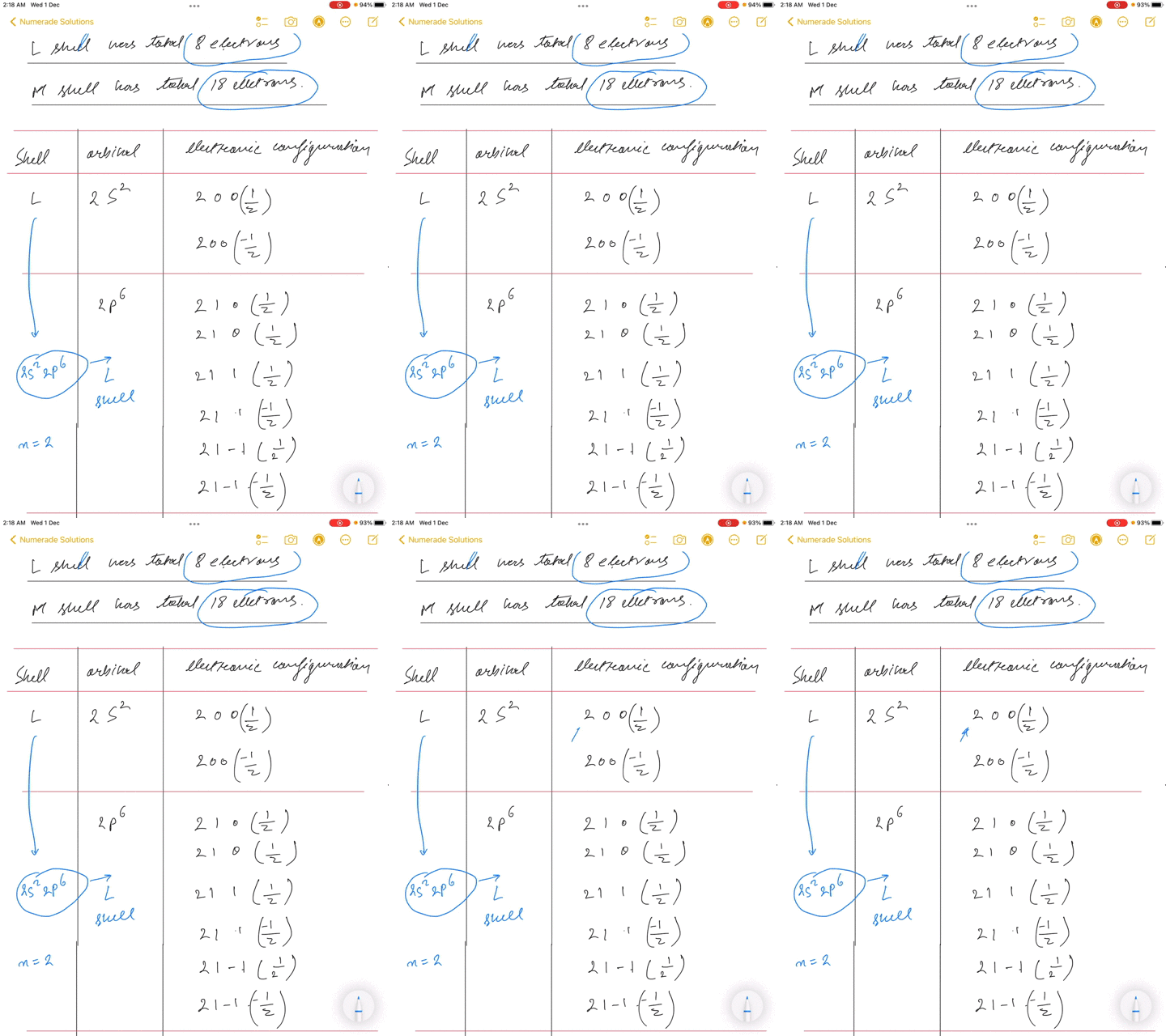
For the $K$ shell, the four quantum numbers for each of the two electrons in the 1 s state in the order of $n l m_{l} m_{s},$ are $100\left(\frac{1}{2}\right)$ and $100\left(-\frac{1}{2}\right) .$ Write the four quantum numbers for all of the electrons in the $L$ and $M$ shells, and note which correspond to the $s, p,$ and $d$ subshells.

Chapter 2: Atomic Structure and Interatomic Bonding
Abhinav Roy
07:03
Materials Science and Engineering: An Introduction

Consider a hypothetical $X^{+}-Y^{-}$ ion pair for which the equilibrium interionic spacing and bonding energy values are $0.38 \mathrm{nm}$ and $-5.37 \mathrm{eV},$ respectively. If it is known that $n$ in Equation 2.11 has a value of $8,$ using the results of Problem 2.14 , determine explicit expressions for attractive and repulsive energies $E_{A}$ and $E_{R}$ of Equations 2.8 and 2.9

Chapter 2: Atomic Structure and Interatomic Bonding
Abhinav Roy
04:14
Materials Science and Engineering: An Introduction

The net potential energy $E_{N}$ between two adjacent ions is sometimes represented by the expression $$E_{N}=-\frac{C}{r}+D \exp \left(-\frac{r}{\rho}\right)$$ in which $r$ is the interionic separation and $C$
$D,$ and $\rho$ are constants whose values depend on the specific material.
(a) Derive an expression for the bonding energy $E_{0}$ in terms of the equilibrium interionic separation $r_{0}$ and the constants $D$ and $\rho$ using the following procedure:
1. Differentiate $E_{N}$ with respect to $r$ and set the resulting expression equal to zero
2. Solve for $C$ in terms of $D, \rho,$ and $r_{0}$
3. Determine the expression for $E_{0}$ by substitution for $C$ in Equation 2.12
(b) Derive another expression for $E_{0}$ in terms of $r_{0}, C,$ and $\rho$ using a procedure analogous to the one outlined in part (a).

Chapter 2: Atomic Structure and Interatomic Bonding
Abhinav Roy
02:15
Materials Science and Engineering: An Introduction

What type(s) of bonding would be expected for each of the following materials: solid xenon, calcium fluoride $\left(\mathrm{CaF}_{2}\right),$ bronze, cadmium tel luride (CdTe), rubber, and tungsten?

Chapter 2: Atomic Structure and Interatomic Bonding
Abhinav Roy
04:41
Materials Science and Engineering: An Introduction

For the HCP crystal structure, show that the ideal $c / a$ ratio is 1.633.

Chapter 3: The Structure of Crystalline Solids
Abhinav Roy
1 2 3 4 5 ... 7

Abhinav's Quick Ask Videos

01:54
Physics 101 Mechanics

Imagine that the CD on the right side is rotating with a constant
angular velocity of w=6 rad/s between t=0 and t=3 s. Then, at t=3 s,
it is suddenly subjected to a constant angular acceleration of ?=6
rad/s2 for 2 seconds. Determine the number of turns for the total
time interval from t=0 to t=5 s. (Diameter of the CD is 12 cm)

Abhinav Roy
1