Myself Akshaya, I have completed B. Tech. I have been online tutoring for past 5 years. I have good experience of teaching physics and mathematics. I am interested to share my knowledge with students and help them with their studies.
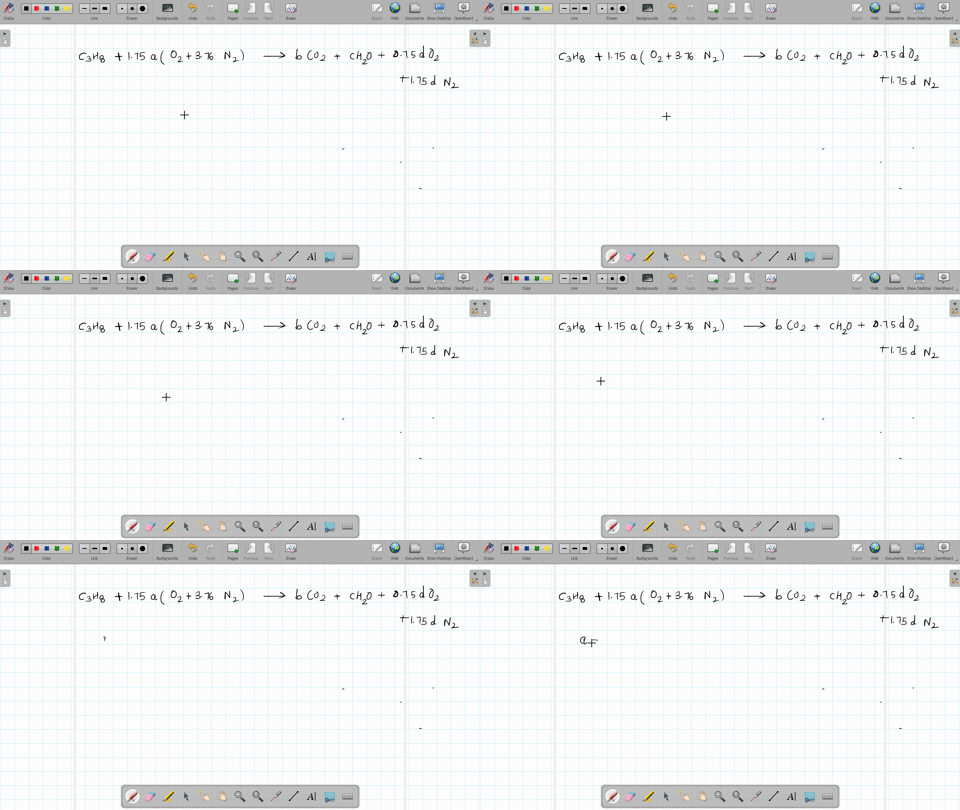
Propane $\left(\mathrm{C}_{3} \mathrm{H}_{8}\right)$ is burned with 75 percent excess air during a combustion process. Assuming complete combustion, determine the air-fuel ratio.
Propane fuel $\left(\mathrm{C}_{3} \mathrm{H}_{8}\right)$ is burned with 30 percent excess air. Determine the mole fractions of each of the products. Also, calculate the mass of water in the products per unit mass of the fuel and the air-fuel ratio.
Ethane $\left(C_{2} H_{6}\right)$ is burned with 20 percent excess air during a combustion process. Assuming complete combustion and a total pressure of $100 \mathrm{kPa}$, determine $(a)$ the air-fuel ratio and $(b)$ the dew-point temperature of the products.
Octane $\left(C_{8} H_{18}\right)$ is burned with 250 percent theoretical air, which enters the combustion chamber at $25^{\circ} \mathrm{C}$. Assuming complete combustion and a total pressure of 1 atm, determine(a) the air-fuel ratio and ( $b$ ) the dew-point temperature of the products.
Butane $\left(C_{4} H_{10}\right)$ is burned in 200 percent theoretical air. For complete combustion, how many $\mathrm{kmol}$ of water must be sprayed into the combustion chamber per $\mathrm{kmol}$ of fuel if the products of combustion are to have a dew-point temperature of $60^{\circ} \mathrm{C}$ when the product pressure is $100 \mathrm{kPa} ?$
For the following exercises, construct a sinusoidal function with the provided information, and then solve the equation for the requested values.
Outside temperatures over the course of a day can be modeled as a sinusoidal function. Suppose the high temperature of 84°F occurs at 6 PM and the average temperature for the day is 70°F. Find the temperature, to the nearest degree, at 7 AM.
Find the center of mass coordinates of a lamina (i.e., a plate) in the form of a vertical triangle (0, 0), (0, 1), (0, 0) if the density is directly proportional to the distance from the point of origin at any point.
Reduce the following given equation to a canonical form quadratic surface by performing a suitable change of coordinates. x² + y² + z² + 4xy – 4xz + 4yz – 2x + y - 3z = 0
What is the magnitude of the net gravitational force Fgrav on the mass at the origin due to the other two masses? Take the gravitational constant to be G = 6.67*10^-11 N m^2 /kg^2. Express your answer in newtons to three significant figures.
Part BWhat is the direction of the net gravitational force on the mass at the origin due to the other two masses?+X direction-X direction