AL

Alan Larson

Michigan Technological University
N/A

Biography

I'm getting a double major in Physics and Applied Mathematics this summer from Michigan Technological University. I've always been passionate about tutoring friends in both physics and mathematics, and I seem to have a knack for it. In high school, the school counselor often referred other kids to me to help them in their math classes and I always happily obliged. Furthermore, as a fifth year at Michigan Tech I tend to hang out in the physics lounge, and so have quite a bit of experience of helping first years with their physics one problems.

As for actually solving and explaining problems, its second nature to me to write down every step, along with explaining the process and the critical points of the problems. I know to be thorough and not skip steps, no matter how simple they actually might be.

Education

BS Physics
Michigan Technological University
BS Applied Mathematics
Michigan Technological University

Educator Statistics

Numerade tutor for 5 years
4 Students Helped

Topics Covered

Understanding Temperature and Heat: A Comprehensive Guide
Mastering Motion: Achieving Efficiency Along a Straight Line
Exploring the World of Derivatives: A Comprehensive Guide
Applications of the Derivative
Integration
Applications of Integration: Exploring Real-World Solutions

Alan's Textbook Answer Videos

02:27
University Physics with Modern Physics

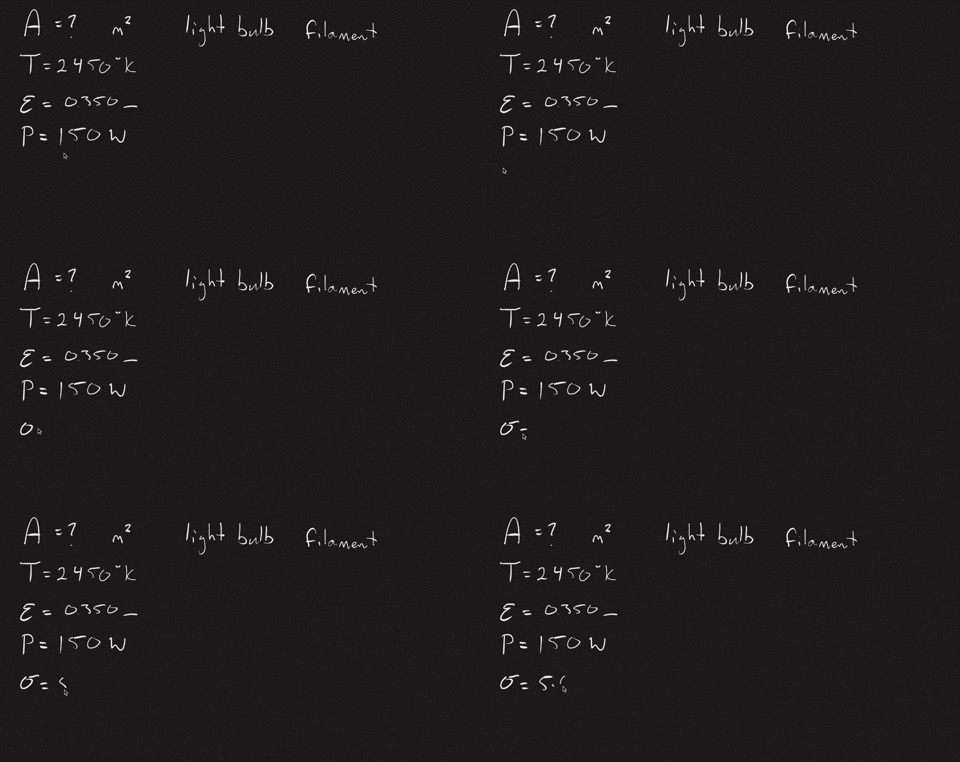
Size of a Light-Bulb Filament. The operating temperature of a tungsten filament in an incandescent light bulb is 2450 $\mathrm{K}$ , and its emissivity is $0.350 .$ Find the surface area of the filament of a $150-\mathrm{W}$ bulb if all the electrical energy consumed by the bulb is radiated by the filament as electromagnetic waves. (Only a fraction of the radiation appears as visible light.)

Chapter 17: Temperature and Heat
Alan Larson
02:22
Calculus

$57-60$ Sketch the graph of a function that satisfies all of the
given conditions.
$$\begin{array}{l}{g(0)=0, \quad g^{\prime \prime}(x)<0 \text { for } x \neq 0, \quad \lim _{x \rightarrow-\infty} g(x)=\infty,} \\ {\lim _{x \rightarrow \infty} g(x)=-\infty, \lim _{x \rightarrow 0^{-}} g^{\prime}(x)=-\infty} \\ {\lim _{x \rightarrow 0^{+}} g^{\prime}(x)=\infty}\end{array}$$

Chapter 3: Applications of Differentiation
Section 4: Limits at Infinity Horizontal Asymptotes
Alan Larson
02:37
Calculus

Use the method of cylindrical shells to find the volume generated by rotating the region bounded by the given curves about the $y$ -axis.
$$y=x^{2}, \quad 0 \leqslant x \leqslant 2, \quad y=4, \quad x=0$$

Chapter 5: Applications of Integration
Section 3: Volumes by Cylindrical Shells
Alan Larson
05:01
College Physics

You are driving slowly in the right lane of a straight country road. For a while, a car to your left has lagged $50.0 \mathrm{~m}$ behind you at the same speed of $25.0 \mathrm{mi} / \mathrm{h}$ Suddenly that car speeds up and passes you, traveling at a constant acceleration until it is $40.0 \mathrm{~m}$ in front of you 7.00 s later. (a) Qualitatively sketch the location-versustime graphs for both cars on the same axes, letting $t=0$ be the start of the acceleration, and $x=0$ be the location of the other car at that time. (b) Determine the other car's acceleration. (c) How far did each of you travel during the passing procedure? (d) What is the other car's speed at the end of the passing procedure?

Chapter 2: Kinematics: Description of Motion
Alan Larson
1