I am teaching physics since 2015.
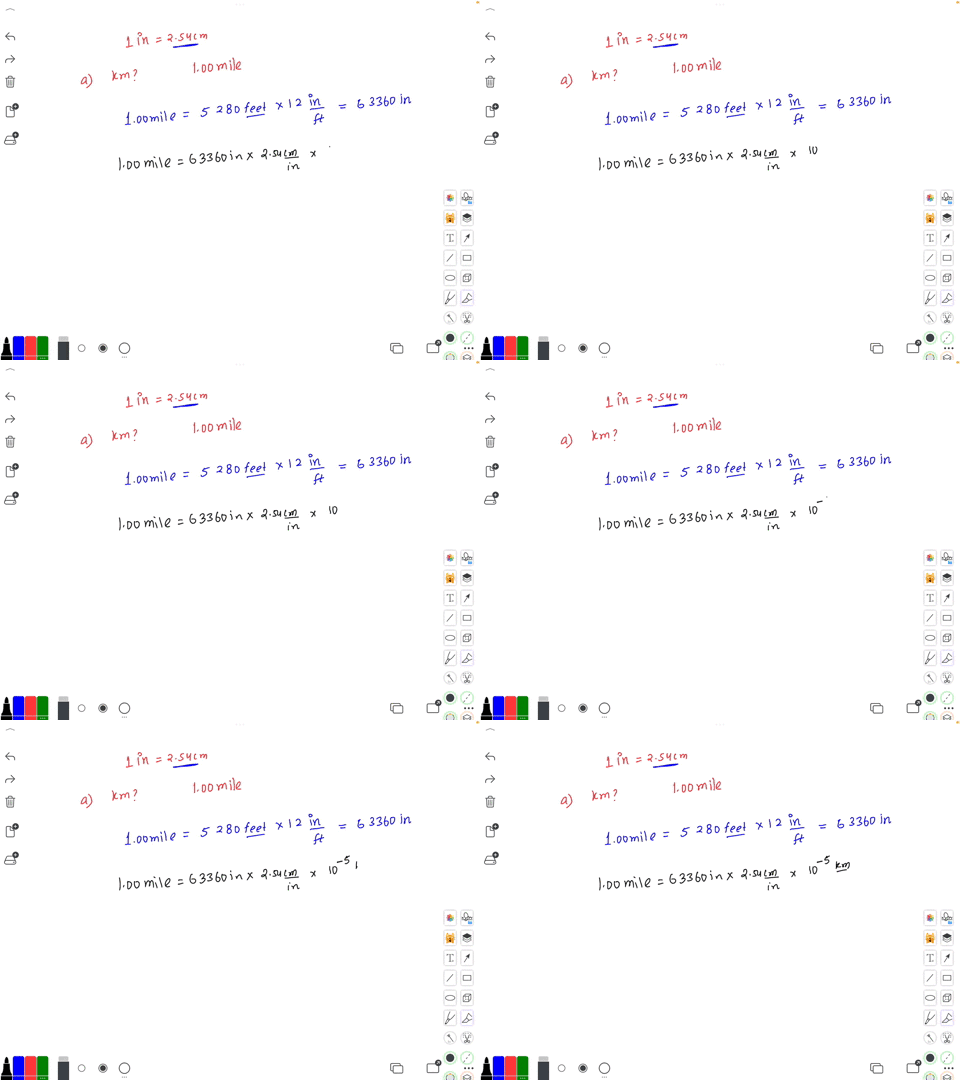
Starting with the definition 1 in. = 2.54 cm, find the number of (a) kilometers in 1.00 mile and (b) feet in 1.00 km.
A nylon rope used by mountaineers elongates 1.10 m under the weight of a 65.0-kg climber. If the rope is 45.0 m in length and 7.0 mm in diameter, what is Young's modulus for nylon?
You measure an electric field of 1.25 $\times$ 10$^6$ N/C at a distance of 0.150 m from a point charge. There is no other source of electric field in the region other than this point charge. (a) What is the electric flux through the surface of a sphere that has this charge at its center and that has radius 0.150 m? (b) What is the magnitude of this charge?
(II) A typical atom has a diameter of about 1.0 $\times$ 10$^{-10}$ m. ($a$) What is this in inches? ($b$) Approximately how many atoms are along a 1.0-cm line, assuming they just touch?
A small circular hole 2.36 mm in diameter is cut in the side of a large water tank. The top of the tank is open to the air. The water is escaping from the hole at a speed of 13.77 m/s. How far below the water surface is the hole? Express answers in meter
See photo below.
The image represents a marble is attached to a string and is swung in a clockwise horizontal circle with a constant speed.