Ameryr Rawa

Central Michigan University
MAC

Biography

PhD student in Central Michigan university. I have eight years of experience in teaching mathematics in high schools .

Education

Phd Mathematics
Central Michigan University
MS Mathematics
Other Schools

Educator Statistics

Numerade tutor for 6 years
12 Students Helped

Topics Covered

Breaking Limits: Unlock Your Potential with Our Expert Solutions
Unlock the Power of Sequences: Boost Your Productivity
Discover the Best Series to Binge-Watch | Your Ultimate Guide

Ameryr's Textbook Answer Videos

03:49
Calculus of a Single Variable

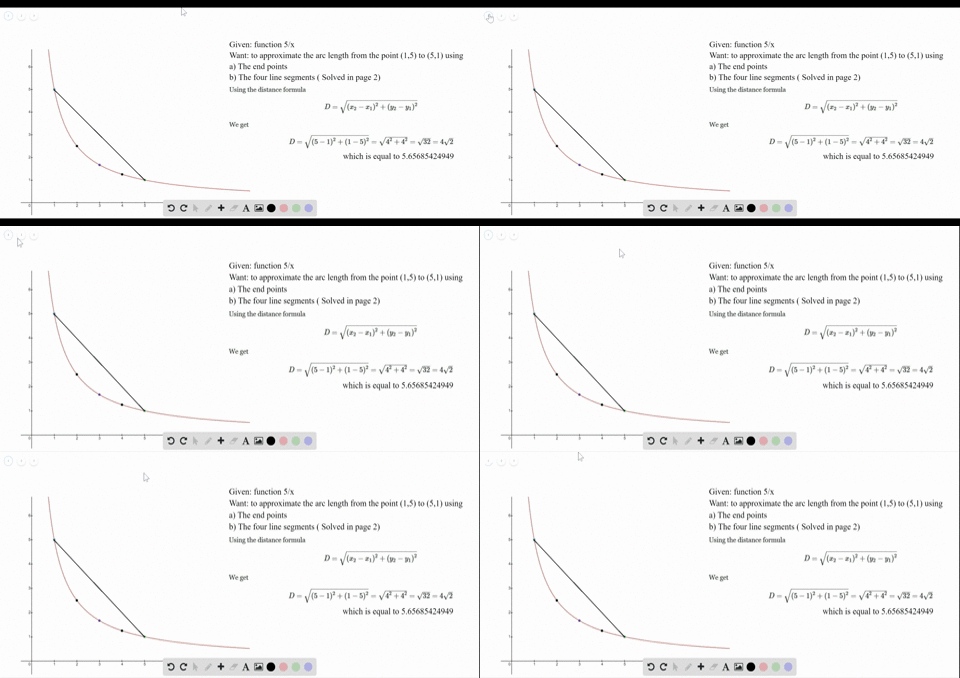
Length of a Curve Consider the length of the graph of $f(x)=5 / x$ from $(1,5)$ to $(5,1)

(a) Approximate the length of the curve by finding the distance between its two endpoints, as shown in the first figure.
(b) Approximate the length of the curve by finding the sum of the lengths of four line segments, as shown
in the second figure.
(c) Describe how you could continue this process to obtain a more accurate approximation of the length
of the curve.

Chapter 1: Limits and Their Properties
Section 1: A Preview of Calculus
Ameryr Rawa
03:42
Calculus

Use the Integral Test to determine if the series in Exercises $1-10$ con- verge or diverge. Be sure to check that the conditions of the Integral Test are satisfied.
$$\sum_{n=1}^{\infty} \frac{1}{n^{2}}$$

Chapter 10: Infinite Sequences and Series
Section 3: The Integral Test
Ameryr Rawa
04:26
Calculus

Use the Integral Test to determine if the series in Exercises $1-10$ con- verge or diverge. Be sure to check that the conditions of the Integral Test are satisfied.
$$\sum_{n=1}^{\infty} \frac{1}{n^{0.2}}$$

Chapter 10: Infinite Sequences and Series
Section 3: The Integral Test
Ameryr Rawa
07:47
Calculus

Use the Integral Test to determine if the series in Exercises $1-10$ con- verge or diverge. Be sure to check that the conditions of the Integral Test are satisfied.
$$\sum_{n=1}^{\infty} \frac{1}{n^{2}+4}$$

Chapter 10: Infinite Sequences and Series
Section 3: The Integral Test
Ameryr Rawa
03:22
Calculus

Use the Integral Test to determine if the series in Exercises $1-10$ con- verge or diverge. Be sure to check that the conditions of the Integral Test are satisfied.
$$\sum_{n=1}^{\infty} \frac{1}{n+4}$$

Chapter 10: Infinite Sequences and Series
Section 3: The Integral Test
Ameryr Rawa
03:18
Calculus

Use the Integral Test to determine if the series in Exercises $1-10$ con- verge or diverge. Be sure to check that the conditions of the Integral Test are satisfied.
$$\sum_{n=1}^{\infty} e^{-2 n}$$

Chapter 10: Infinite Sequences and Series
Section 3: The Integral Test
Ameryr Rawa
1 2

Ameryr's Quick Ask Videos

09:05
Algebra

Discrete Structures.
1- Prove that 9n + 5 is even if and only if 3n + 2 is
odd.
2- Show that between any two rational numbers a and b, where a
< b, there exists another rational number closer to b than to
a.
Show full work, please!

Ameryr Rawa
00:01
Calculus 1 / AB

Cavalieri's principle $A$ solid lies between planes perpendicular to the $x$ -axis at $x=0$ and $x=12$ . The cross-sections by planes perpendicular to the $x$ -axis are circular disks whose diameters run
from the line $y=x / 2$ to the line $y=x$ as shown in the accompanying figure. Explain why the solid has the same volume as a right circular cone with base radius 3 and height $12 .$

Ameryr Rawa
08:36
Calculus 1 / AB

(a) If $f$ is a one-to-one, twice differentiable function with inverse function $g,$ show that
$$g^{\prime \prime}(x)=-\frac{f^{\prime \prime}(g(x))}{\left[f^{\prime}(g(x))\right]^{3}}$$
(b) Deduce that if $f$ is increasing and concave upward, then its inverse function is concave downward.

Ameryr Rawa
1