Andrew Contreras

Baylor University
TA

Biography

I help tutor and teach the physics labs by explaining concepts and the corresponding math in simple yet accurate ways. I also explain how the results of their experiment verify the concepts learned in their class.

Education

BS Astrophysics
Baylor University

Educator Statistics

Numerade tutor for 6 years
3 Students Helped

Topics Covered

Understanding Gauss's Law: A Comprehensive Guide
Master the Fundamentals of Physics: Learn Physics Basics
Mastering Motion: Achieving Efficiency Along a Straight Line
Motion in 2d or 3d
Discovering the Fundamentals: Newton's Laws of Motion Explained

Andrew's Textbook Answer Videos

04:06
Physics for Scientists and Engineers with Modern Physics

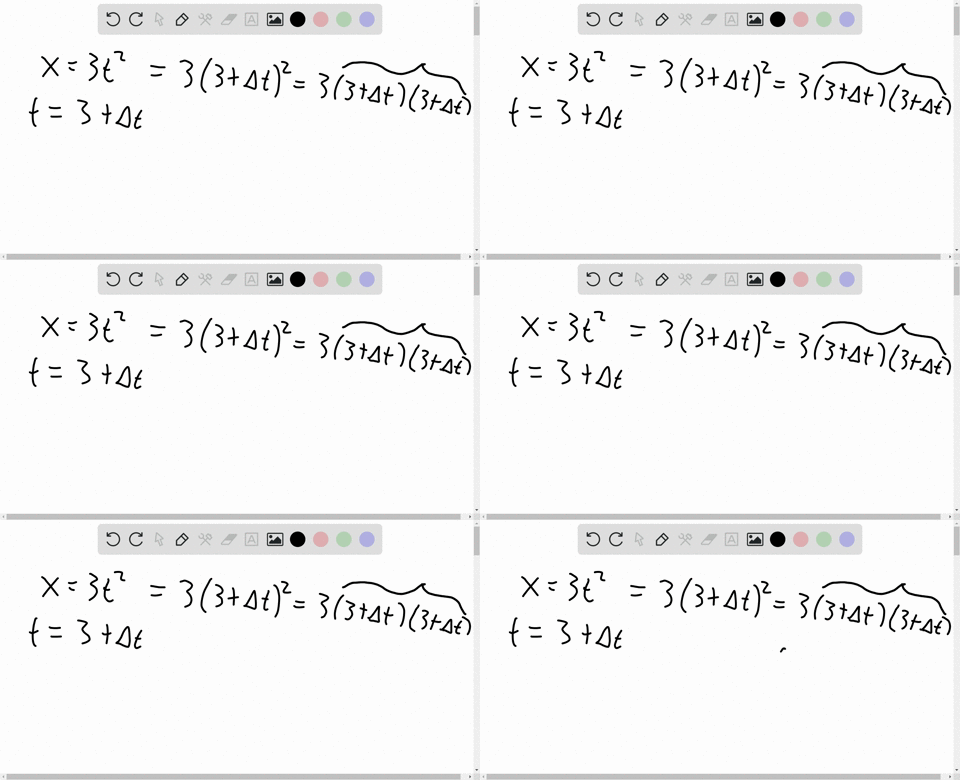
The position of a particle moving along the $x$ axis varies in time according to the expression $x=3 t^{2},$ where $x$ is in meters and $t$ is in seconds. Evaluate its position (a) at $t=$
3.00 $\mathrm{s}$ and $(\mathrm{b})$ at $3.00 \mathrm{s}+\Delta t .$ (c) Evaluate the limit of $\Delta x / \Delta t$ as $\Delta t$ approaches zero to find the velocity at $t=3.00 \mathrm{s}$ .

Chapter 2: Motion in One Dimension
Andrew Contreras
06:46
Physics for Scientists and Engineers with Modern Physics

A car travels along a straight line at a constant speed of 60.0 $\mathrm{mi} / \mathrm{h}$ for a distance $d$ and then another distance $d$ in the same direction at another constant speed. The average velocity for the entire trip is 30.0 $\mathrm{mi} / \mathrm{h}$ . (a) What is the constant speed with which the car moved during the second distance $d ?$ (b) What If? Suppose the second distance $d$ were traveled in the opposite direction; you forgot something and had to return home at the same constant speed as found in part (a). What is the average velocity for this
trip? (c) What is the average speed for this new trip?

Chapter 2: Motion in One Dimension
Andrew Contreras
15:08
Physics for Scientists and Engineers with Modern Physics

Review. As soon as a traffic light turns green, a car speeds up from rest to 50.0 $\mathrm{mi} / \mathrm{h}$ with constant acceleration 9.00 $\mathrm{mi} / \mathrm{h} / \mathrm{s}$ . In the adjoining bicycle lane, a cyclist speeds up from rest to 20.0 $\mathrm{mi} / \mathrm{h}$ with constant acceleration 13.0 $\mathrm{mi} / \mathrm{h} / \mathrm{s}$ . Each vehicle maintains constant velocity after reaching its cruising speed. (a) For what time interval is the bicycle ahead of the car? (b) By what maximum distance does the bicycle lead the car?

Chapter 2: Motion in One Dimension
Andrew Contreras
1