Carli Tucci

Case Western Reserve University
Peer Tutor

Biography

I'm a rising sophomore at CWRU pursuing a B.S. in Neuroscience. I've been tutoring peers for the past 3 years and typically focus on chemistry, math, and biology. I love helping others feel confident about their academics and tutoring has always been a great way for me to give back to others. I hope I can help as much as possible on this platform!

Education

BS Neuroscience
Case Western Reserve University

Educator Statistics

Numerade tutor for 6 years
52 Students Helped

Topics Covered

Atoms, Molecules, and Ions: Understanding the Building Blocks of Matter
Unlocking the Power of Periodic Table Properties | Boost Your Knowledge
Discover the Power of Liquids: Boost Your Health and Wellness Today!
Discover the Power of Solids for Your Everyday Needs
Transition Metals
Exploring the Fascinating World of Transition Metals and Coordination Chemistry

Carli's Textbook Answer Videos

01:41
Chemistry Matter and Change

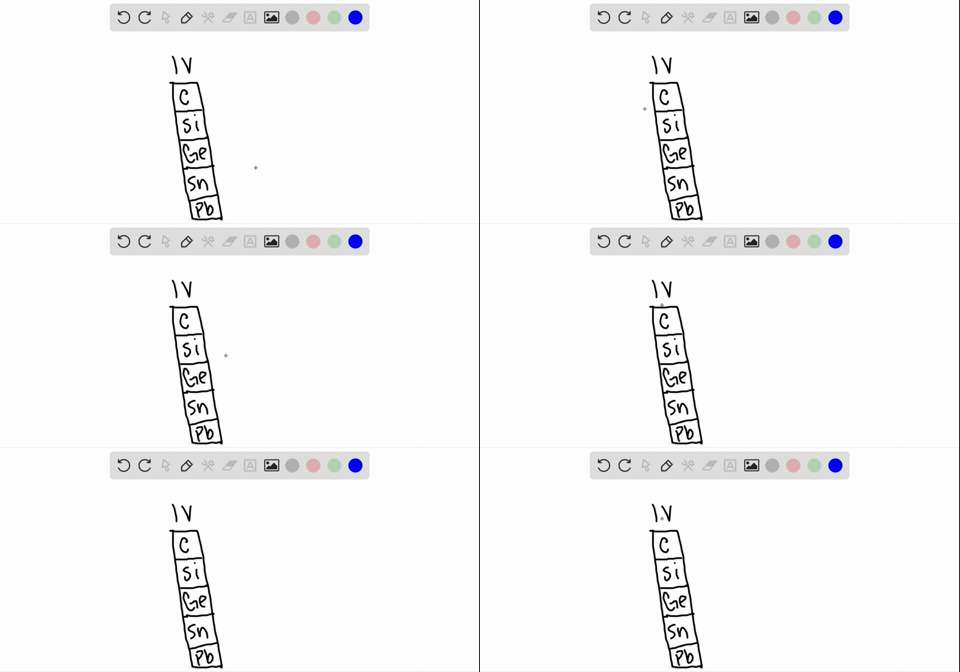
Interpret Data A company plans to make an electronic device. They need to use an element that has chemical behavior similar to that of silicon (Si) and lead (Pb). The element must have an atomic mass greater than that of sulfur (S), but less than that of cadmium (Cd). Use the periodic table to determine which element the company could use.

Chapter 6: The Periodic Table and Periodic Law
Carli Tucci
01:22
Introductory Chemistry

Gases have (higher/lower) densities than liquids or solids.

Chapter 14: Liquids and Solids
Section 1: Water and Its Phase Changes
Carli Tucci
01:21
Introductory Chemistry

Liquids and solids are (more/less) compressible than are gases.

Chapter 14: Liquids and Solids
Section 1: Water and Its Phase Changes
Carli Tucci
01:07
Introductory Chemistry

What evidence do we have that the solid form of water is less dense than the liquid form of water at its
freezing/melting point?

Chapter 14: Liquids and Solids
Section 1: Water and Its Phase Changes
Carli Tucci
02:29
Introductory Chemistry

The enthalpy $(\Delta H)$ of vaporization of water is about seven times larger than water's enthalpy of fusion $(41 \mathrm{kJ} / \mathrm{mol} \text { versus } 6 \mathrm{kJ} / \mathrm{mol}) .$ What does this tell us about the relative similarities among the solid, liquid, and gaseous states of water?

Chapter 14: Liquids and Solids
Section 1: Water and Its Phase Changes
Carli Tucci
01:09
Introductory Chemistry

Consider a sample of ice being heated from $-5^{\circ} \mathrm{C}$ to $+5^{\circ} \mathrm{C}$ . Describe on both a macroscopic and a microscopic basis what happens to the ice as the temperature reaches $0^{\circ} \mathrm{C}$ .

Chapter 14: Liquids and Solids
Section 1: Water and Its Phase Changes
Carli Tucci
1 2 3 4 5 ... 9