Hi there! I'm Chelsi - I have spent the last few years researching elephants - specifically their hormones! I am passionate about wildlife and I hope to someday teach and research in the field of ecological physiology.
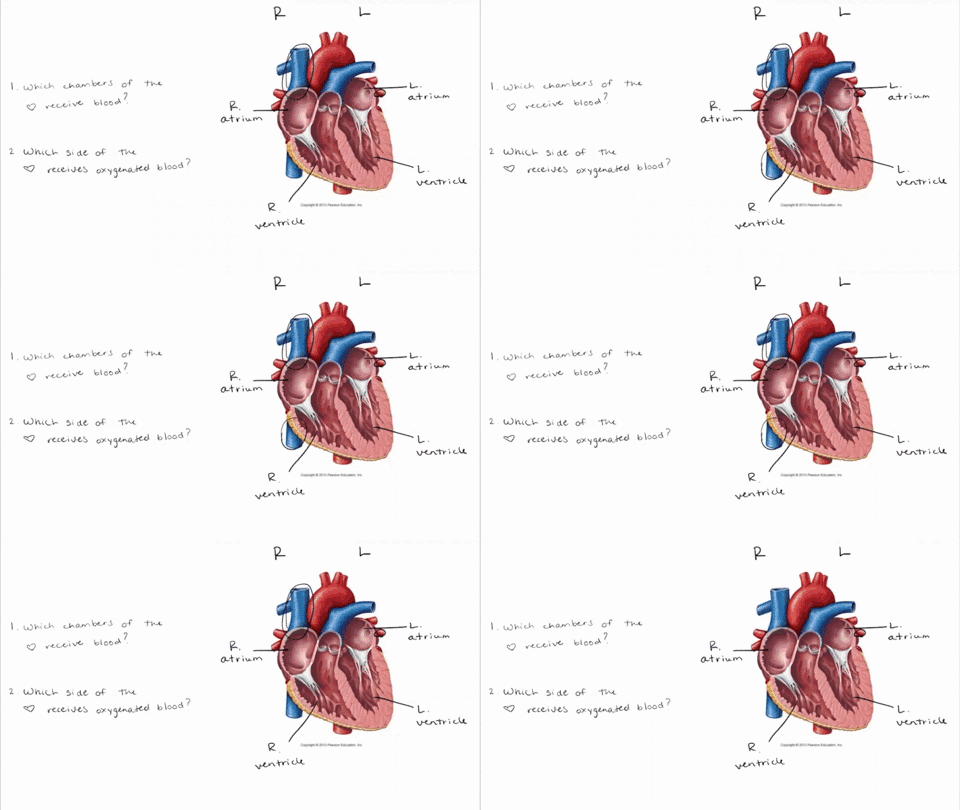
Freshly oxygenated blood is first received by the (a) right atrium, (b) left atrium, (c) right ventricle, (d) left ventricle.
In studies of how traits are inherited, what makes certain species candidates for model organisms?a. They are the first organisms to be used in a particular type of experiment, so they are a historical "model" of what researchers expect to find.b. They are easy to study because a great deal is already known about them.c. They are the best or most fit of their type.d. They are easy to maintain, have a short life cycle, produce many offspring, and yield data that are relevant to many other organisms.
Why is the allele for wrinkled seed shape in garden peas considered recessive?a. It "recedes" in the $\mathrm{F}_{2}$ generation when homozygous parents are crossed.b. The trait associated with the allele is not expressed in heterozygotes.c. Individuals with the allele have lower fitness than that of individuals with the dominant allele.d. The allele is less common than the dominant allele. (The wrinkled allele is a rare mutant.
The alleles found in haploid organisms cannot be dominant or recessive. Why?a. Dominance and recessiveness describe which allele is expressed in phenotype when different alleles occur in the same individual.b. Because only one allele is present, alleles in haploid organisms are always dominant.c. Alleles in haploid individuals are transmitted like mitochondrial DNA or chloroplast DNA.d. Most haploid individuals are bacteria, and bacterial genetics is completely different from eukaryotic genetics.
Why can you infer that individuals that are "pure line" are homozygous for the gene in question?a. Because they are highly inbred.b. Because only two alleles are present at each gene in the populations to which these individuals belong.c. Because in a pure line, phenotypes are not affected by environmental conditions or gene interactions.d. Because no other phenotype is ever observed in a pure-line population, this implies that only one allele is present.
The genes for the traits that Mendel worked with are either located on different chromosomes or so far apart on the same chromosome that crossing over almost always occurs between them. How did this circumstance help Mendel recognize the principle of independent assortment?a. Otherwise, his dihybrid crosses would not have produced a 9: 3: 3: 1 ratio of $\mathrm{F}_{2}$ phenotypesb. The occurrence of individuals with unexpected phenotypes led him to the discovery of recombination.c. It led him to the realization that the behavior of chromosomes during meiosis explained his results.d. It meant that the alleles involved were either dominant or recessive, which gave 3: 1 ratios in the $F_{1}$ generation.