CS

Connor Siggins

Numerade Educator
ESL Mathematics Tutor

Biography

I'm a fourth year pre-med biochemistry major at UVA. During the school year I work as a research assistant at UVA hospital. Our current research focuses on correlating the number of fibrocytes in the blood with incidence of cardiac sarcoidosis, an autoimmune disease characterized by inflammation and the build up of scar tissue in the myocardium. With regard to instructional experience, I tutored English Second Language students in math and science while I was in high school. Although not directly academic, during my second year of college, I coached an after-school youth cross country program call Hero Boys.

Education

Connor has not yet added their education credentials.

Educator Statistics

Numerade tutor for 6 years
16 Students Helped

Topics Covered

Understanding Chemical Bonding: The Key to Molecular Structure
Mastering Chemical Reactions and Stoichiometry for Optimal Results
Aqueous Equilibria: Understanding the Balance of Solutions

CONNOR's Textbook Answer Videos

07:14
Chemistry A Molecular Approach

Write orbital diagrams (boxes with arrows in them) to represent the electron configuration of carbon before and after $s p^{3}$ hybridization.

Chapter 10: Chemical Bonding ll: Molecular Shapes, Valence Bond Theory, and Molecular Orbital Theory
Connor Siggins
07:19
Chemistry and Chemical Reactivity

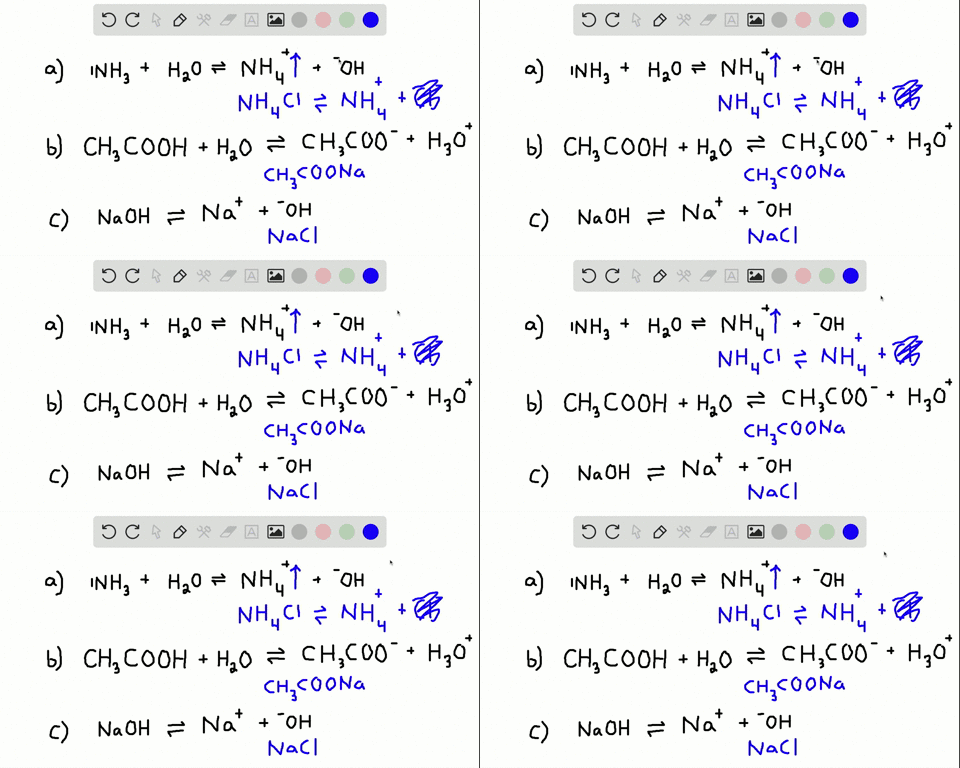
Does the pH of the solution increase, decrease, or stay the same when you
(a) Add solid ammonium chloride to a dilute aqueous solution of $\mathrm{NH}_{3} ?$
(b) Add solid sodium acetate to a dilute aqueous solution of acetic acid?
(c) Add solid NaCl to a dilute aqueous solution of NaOH?

Chapter 18: Principles of Reactivity: Other Aspects of Aqueous Equilibria
Connor Siggins
05:42
Chemistry and Chemical Reactivity

What is the pH of a solution that consists of $0.20 \mathrm{M}$ ammonia, $\mathrm{NH}_{3},$ and $0.20 \mathrm{M}$ ammonium chloride, $\mathrm{NH}_{4} \mathrm{Cl}$ ?

Chapter 18: Principles of Reactivity: Other Aspects of Aqueous Equilibria
Connor Siggins
09:19
Chemistry and Chemical Reactivity

What is the pH of the buffer solution that contains $2.2 \mathrm{g}$ of $\mathrm{NH}_{4} \mathrm{Cl}$ in $250 \mathrm{mL}$ of $0.12 \mathrm{M} \mathrm{NH}_{3} ?$ Is the final pH lower or higher than the $\mathrm{pH}$ of the original ammonia solution?

Chapter 18: Principles of Reactivity: Other Aspects of Aqueous Equilibria
Connor Siggins
10:36
Chemistry and Chemical Reactivity

Calculate the pH of a solution that has an acetic acid concentration of $0.050 \mathrm{M}$ and a sodium acetate concentration of $0.075 \mathrm{M}.$

Chapter 18: Principles of Reactivity: Other Aspects of Aqueous Equilibria
Connor Siggins
08:43
Chemistry and Chemical Reactivity

A buffer is composed of formic acid and its conjugate base, the formate ion.
(a) What is the pH of a solution that has a formic acid concentration of $0.050 \mathrm{M}$ and a sodium formate concentration of $0.035 \mathrm{M} ?$
(b) What must the ratio of acid to conjugate base be to increase the pH by 0.5 unit?

Chapter 18: Principles of Reactivity: Other Aspects of Aqueous Equilibria
Connor Siggins
1 2 3