Darren Wilson

Colorado Technical University
Science Department Lead Teacher

Biography

I ended my career as an Air Force pilot with the wonderful opportunity to teach Electrical Engineering at the US Air Force Academy. After retiring at the end of 2010, I began teaching high school physics and math in 2011.

I have taught a number of different courses, including AP Physics C, AP Physics 1, AP Statistics, and AP Calculus AB.

Education

Phd Computer Science
Colorado Technical University
MS Computer Engineering
University of Idaho

Educator Statistics

Numerade tutor for 6 years
124 Students Helped

Topics Covered

Motion in 2d or 3d
Master the Fundamentals of Physics: Learn Physics Basics
Unlock the Power of Kinetic Energy: Boost Your Efficiency Today
Unlocking the Power of Potential Energy: Discover the Benefits
Save Energy and Money with Effective Conservation Techniques
Computer Science Overview
Arrays
Loops

Darren's Textbook Answer Videos

07:12
University Physics with Modern Physics

City A lies directly west of city $B$ . When there is no wind, an airliner makes the 5550 -kmround-trip fight between them in 6.60 $\mathrm{h}$ of flying time while traveling at the same speed in both directions. When a strong, steady $225-\mathrm{km} / \mathrm{h}$ wind is blowing from west to east
and the airliner has the same airspeed as before, how long will the trip take?

Chapter 3: Motion in Two or Three Dimensions
Darren Wilson
03:47
Physics for Scientists and Engineers with Modern Physics

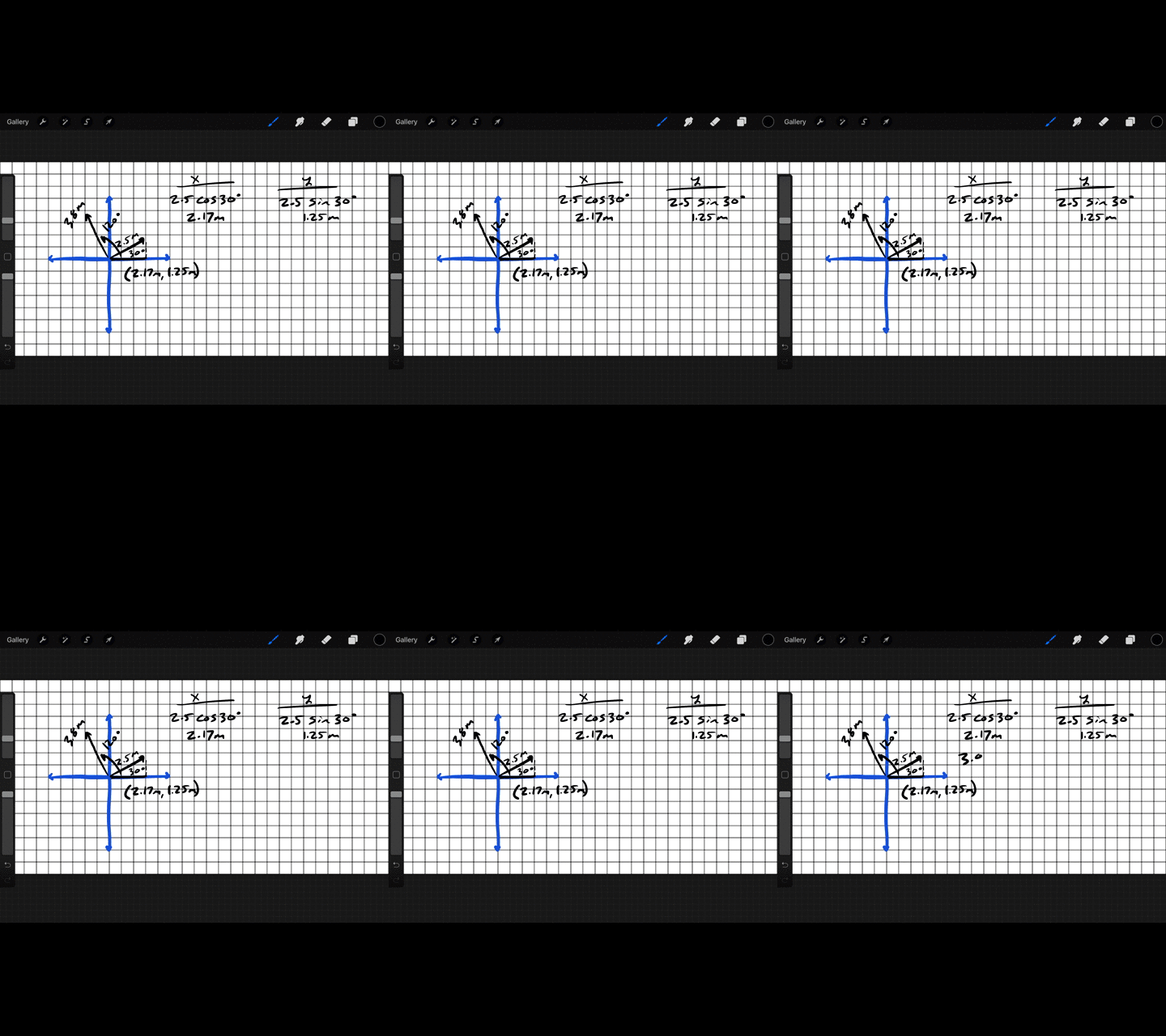
Two points in a plane have polar coordinates $(2.50 \mathrm{m},30.0^{\circ} )$ and $\left(3.80 \mathrm{m}, 120.0^{\circ}\right) .$ Determine (a) the Cartesian coordinates of these points and (b) the distance between them.

Chapter 3: Vectors
Darren Wilson
02:03
Physics for Scientists and Engineers with Modern Physics

The rectangular coordinates of a point are given by $(2, y),$ and its polar coordinates are $(r, 30°).$ Determine (a) the value of $y$ and (b) the value of $r.$

Chapter 3: Vectors
Darren Wilson
03:11
Physics for Scientists and Engineers with Modern Physics

Let the polar coordinates of the point $(x, y)$ be $(r, \theta)$ Determine the polar coordinates for the points (a) $(-x, y),$ (b) $(-2 x,-2 y),$ and $(c)(3 x,-3 y)$ .

Chapter 3: Vectors
Darren Wilson
01:12
Physics for Scientists and Engineers with Modern Physics

Vector $\overrightarrow{\mathbf{A}}$ has a magnitude of 29 units and points in the positive $y$ direction. When vector $\overrightarrow{\mathbf{B}}$ is added to $\overrightarrow{\mathbf{A}},$ the resultant vector $\overrightarrow{\mathbf{A}}+\overrightarrow{\mathbf{B}}$ points in the negative $y$ direction with a magnitude of 14 units. Find the magnitude and direction of $\overrightarrow{\mathbf{B}}$ .

Chapter 3: Vectors
Darren Wilson
04:00
Physics for Scientists and Engineers with Modern Physics

A force $\overrightarrow{\mathbf{F}}_{1}$ of magnitude 6.00 units acts on an object at the origin in a direction $\theta=30.0^{\circ}$ above the positive $x$ axis (Fig. P3.10). A second force $\overrightarrow{\mathbf{F}}_{2}$ of magnitude 5.00 units acts on the object in the direction of the positive $y$ axis. Find graphically the magnitude and direction of the resultant force $\overrightarrow{\mathbf{F}}_{1}+\overrightarrow{\mathbf{F}}_{2}.$

Chapter 3: Vectors
Darren Wilson
1 2 3 4 5 ... 20