Evelyn Clay

Hanover College
none

Biography

I am a recent graduate with a Bachelor's of Science in Chemistry, and a minor in Philosophy. I love learning about the nature of the universe, and talking about why things work.

Education

BS Chemistry
Hanover College
MS Chemistry and Innovation
École Nationale Supérieure de Chimie de Paris

Educator Statistics

Numerade tutor for 6 years
198 Students Helped

Topics Covered

Unlock the Secrets of Organic Chemistry: Essential Guide
Understanding Chemical Bonding: The Key to Molecular Structure
Understanding Structure and Bonding: A Comprehensive Guide
Explore the Fascinating World of Molecular Geometry - Discover More!
Discover the Wonders of Chemistry: Your Introductory Guide
Discover the Power of Solids for Your Everyday Needs
Explore the Fascinating World of Nuclear Chemistry
Atoms, Molecules, and Ions: Understanding the Building Blocks of Matter
Unlocking the Power of Composition: Tips and Techniques
Understanding Electronic Structure: A Comprehensive Guide
Electromagnetic Waves
Periodic Table

Evelyn's Textbook Answer Videos

04:41
Chemistry A Molecular Approach

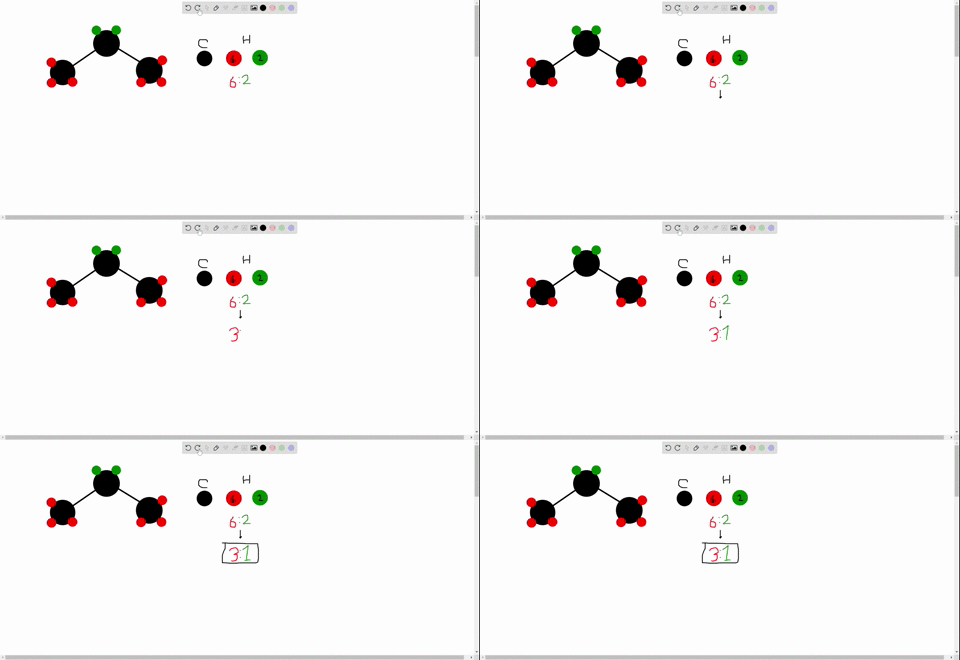
For the chlorination of propane, the two isomers shown here are possible. Propane has six hydrogen atoms on terminal carbon atoms-called primary $\left(1^{\circ}\right)$ hydrogen atoms-and two hydrogen atoms on the interior carbon atom-called secondary $\left(2^{\circ}\right)$ hydrogen atoms.
a. If the two different types of hydrogen atoms were equally reactive, what ratio of 1-chloropropane to 2-chloropropane would we expect as monochlorination products?
b. The result of a reaction yields 55$\% 2$-chloropropane and 45$\%$ 1-chloropropane. What can we conclude about the relative reactivity of the two different kinds of hydrogen atoms? Determine a ratio of the reactivity of one type of hydrogen atom to the other.

Chapter 21: Organic Chemistry
Evelyn Clay
07:09
Chemistry

Use values of $A_{\mathrm{r}}$ from the front inside cover of the book.
Kinetic energy is given by the equation: $E=\frac{1}{2} m v^{2}$ By going back to the base SI units, show that the units on the left-and right-hand sides of this equation are compatible.

Chapter 1: Some basic concepts
Evelyn Clay
10:45
Chemistry

Use values of $A_{\mathrm{r}}$ from the front inside cover of the book.
The mass spectrum of molecular bromine shows three lines for the parent ion, $\mathrm{Br}_{2}^{+} .$ The isotopes for bromine are $\frac{79}{35} \mathrm{Br}(50 \%)$ and $\frac{81}{35} \mathrm{Br}(50 \%) .$ Explain why there are three lines and predict their mass values and relative intensities. Predict what the mass spectrum of HBr would look like; isotopes of hydrogen are given in Section 1.7. (Ignore fragmentation; see Chapter $10 .$ )

Chapter 1: Some basic concepts
Evelyn Clay
04:09
Chemistry

Use values of $A_{\mathrm{r}}$ from the front inside cover of the book.
The partial pressure of helium in a $50.0 \mathrm{dm}^{3}$ gas mixture at $285 \mathrm{K}$ and $10^{5} \mathrm{Pa}$ is $4.0 \times 10^{4} \mathrm{Pa}$. How many moles of helium are present?

Chapter 1: Some basic concepts
Evelyn Clay
06:03
Chemistry

Use values of $A_{\mathrm{r}}$ from the front inside cover of the book.
A $20.0 \mathrm{dm}^{3}$ sample of gas at $273 \mathrm{K}$ and 2.0 bar pressure contains 0.50 moles $\mathrm{N}_{2}$ and 0.70 moles $\mathrm{Ar}$. What is the partial pressure of each gas, and are there any other gases in the sample? (Volume of one mole of ideal gas at $273 \mathrm{K}, 1.00 \times 10^{5} \mathrm{Pa}(1 \mathrm{bar})=$
$\left.22.7 \mathrm{dm}^{3} .\right)$

Chapter 1: Some basic concepts
Evelyn Clay
09:09
Chemistry

Use values of $A_{\mathrm{r}}$ from the front inside cover of the book.
Determine the amount (in moles) present in each of the following: (a) $0.44 \mathrm{g} \mathrm{PF}_{3} ;$ (b) $1.00 \mathrm{dm}^{3}$ gaseous $\mathrm{PF}_{3}$ at $293 \mathrm{K}$ and $2.00 \times 10^{5} \mathrm{Pa} ;(\mathrm{c}) 3.480 \mathrm{g} \mathrm{MnO}_{2}$
(d) $0.0420 \mathrm{g} \mathrm{MgCO}_{3} .$ (Volume of 1 mole of ideal gas
at $\left.273 \mathrm{K}, 10^{5} \mathrm{Pa}=22.7 \mathrm{dm}^{3} .\right)$

Chapter 1: Some basic concepts
Evelyn Clay
1 2 3 4 5 ... 16

Evelyn's Quick Ask Videos

07:18
Intro Stats / AP Statistics

What is the smallest possible value for the mean of this data?

Find the smallest number that is guaranteed to be larger than the mean of the this data.

Evelyn Clay
08:19
Chemistry 102

Draw a Lewis structure for each of the following molecules or ions

Evelyn Clay
04:16
Physics 101 Mechanics

A horizontal spring constant 85 N/m extends outward from a wall just above floor level. A 1.5kg box sliding across a frictionless floor hits the end of the spring and compresses it 6.5cm before the spring expands and shoots the box back out. How fast was the box going when it hit the spring?

Evelyn Clay
03:54
Biology

please create a pedigree and a Punnett square (if necessary). Also, please include the genotypes if possible, and please shade in the dominant traits, as that is how I learned it. Thank you.

Evelyn Clay
05:14
Intro Stats / AP Statistics

How do I solve these questions?

Evelyn Clay
02:57
Chemistry 101

The herbicide level in the soil in a corn field was measured at
3.0
ppb
. How many ?g of herbicide are present in
1.0
lb
of soil?

Evelyn Clay
1 2 3 4 5 ... 18