Farouq Hanonn

University of Oklahoma
Engineering Tutor

Biography

My teaching style involves placing a strong emphasis on concepts by specifically relating the problem at hand to other similar situations/problems thus allowing us the subtle differences between each situation. I like to help my students develop a big picture understanding since this can help them apply what they learn to many other problems and situations they encounter. Lastly, I enjoy providing visual and video representations for my students through videos, images, sketches, and so on.

In summary, my tutoring style consists of initially understanding your needs and immediate goals. Then I would guide you in achieving your goal by moving one step at a time until the topic at hand has been understood. Throughout the whole process, I intend to work with you to solve plenty of examples, showing the step by step process for solving examples, and connecting everything back to fundamental concepts.

Education

BA CIVIL ENGINEERING
University of Oklahoma

Educator Statistics

Numerade tutor for 6 years
10 Students Helped

Topics Covered

Exploring Probability Topics: From Basics to Advanced Strategies
Understanding the Normal Distribution: A Comprehensive Guide
Understanding Temperature and Heat: A Comprehensive Guide

Farouq's Textbook Answer Videos

06:36
Probability with Applications in Engineering, Science, and Technology

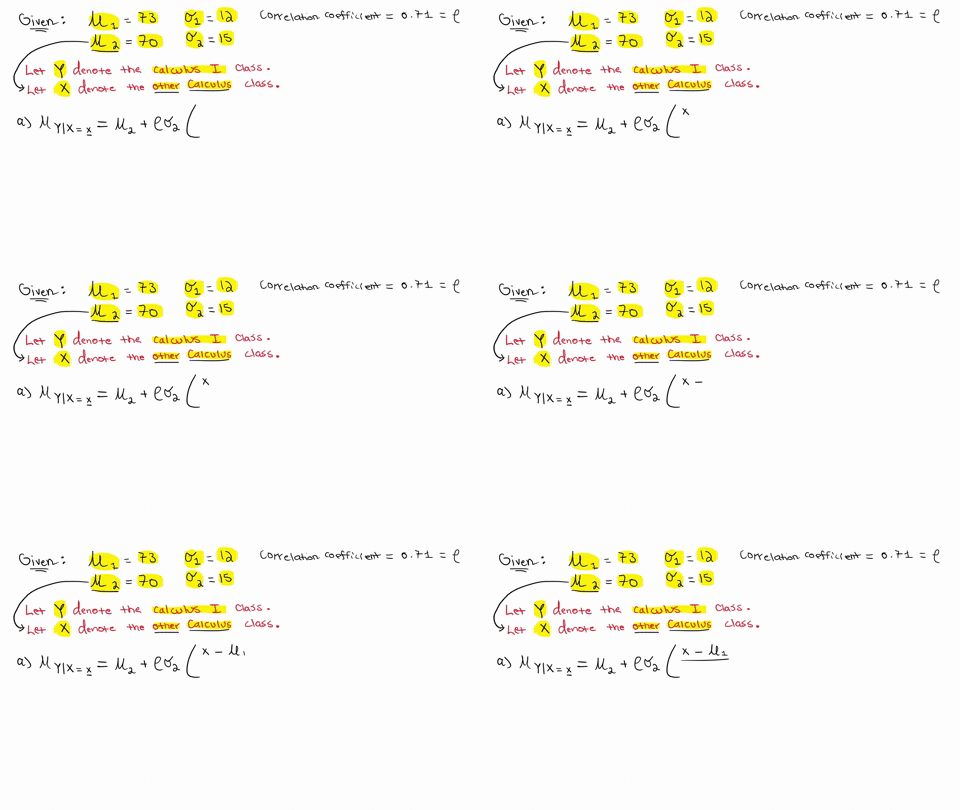
For a Calculus I class, the final exam score $Y$ and the average $X$ of the four earlier tests have a
bivariate normal distribution with mean $\mu_{1}=73,$ standard deviation $\sigma_{1}=12,$ mean $\mu_{2}=70$ , standard deviation $\sigma_{2}=15 .$ The correlation is $\rho=.71 .$ Determine

$\begin{array}{ll}{\text {
(a) }} & {\mu_{Y|X=x}} \\ {\text {
(b) }} & {\sigma_{Y|X=x}^{2}} \\ {\text {
(c) }} & {\sigma_{Y|X=x}}\end{array}$
(d) $P(Y>90 | X=80),$ i.e., the probability that the final exam score exceeds 90 given that the average of the four earlier tests is 80

Chapter 4: Joint Probability Distributions and Their Applications
Section 1: Jointly Distributed Random Variables
Farouq Hanonn
04:07
College Physics

Following vigorous exercise, the body temperature of an 80.0-kg person is$40.0^{\circ} \mathrm{C}$ . At what rate in watts must the person transfer thermal energy to reduce the the body temperature to $37.0^{\circ} \mathrm{C}$ in $30.0 \mathrm{min}$, assuming the body continues to produce energy at the rate of $150 \mathrm{W} ?$
$(1 \text { watt }=1 \text { joule/second or } 1 \mathrm{W}=1 \mathrm{J} / \mathrm{s})$

Chapter 14: Heat and Heat Transfer Methods
Farouq Hanonn
03:59
College Physics

Even when shut down after a period of normal use, a large commercial nuclear reactor transfers thermal energy at the rate of 150 MW by the radioactive decay of fission products. This heat transfer causes a rapid increase in temperature if the cooling system fails (1 watt $=1$ joule/second or $1 \mathrm{W}=1 \mathrm{J} / \mathrm{s}$ and $1 \mathrm{MW}=1$ megawatt) .
(a) Calculate the rate of temperature increase in degrees Celsius per second ( $^{\circ} \mathrm{C} / \mathrm{s}$ ) if the mass of the reactor core is $1.60 \times 10^{5} \mathrm{kg}$ and it has an average specific heat of $0.3349 \mathrm{kJ} / \mathrm{kg}^{\circ} \cdot \mathrm{C} .$ (b) How long would it take to obtain a temperature increase of $2000^{\circ} \mathrm{C},$ which could cause some metals holding the radioactive materials to melt? (The initial rate of temperature increase would be greater than that calculated here because the heat transfer is concentrated in a smaller mass. Later, however, the temperature increase would slow down because the $5 \times 10^{5}$ -kg steel containment vessel would also begin to heat up.)

Chapter 14: Heat and Heat Transfer Methods
Farouq Hanonn
06:26
College Physics

A bag containing $0^{\circ} \mathrm{C}$ ice is much more effective in absorbing energy than one containing the same amount of $0^{\circ} \mathrm{C}$ water.
a. How much heat transfer is necessary to raise the temperature of $0.800 \mathrm{kg}$ of water from $0^{\circ} \mathrm{C}$ to $30.0^{\circ} \mathrm{C} ?$
b. How much heat transfer is required to first melt $0.800 \mathrm{kg}$ of $0^{\circ} \mathrm{C}$ ice and then raise its temperature?
c. Explain how your answer supports the contention that the ice is more effective.

Chapter 14: Heat and Heat Transfer Methods
Farouq Hanonn
07:03
College Physics

(a) How much heat transfer is required to raise the temperature of a 0.750 -kg aluminum pot containing $2.50 \mathrm{kg}$ of water from $30.0^{\circ} \mathrm{C}$ to the boiling point and then boil away $0.750 \mathrm{kg}$ of water? (b) How long does this take if the rate of heat transfer is $500 \mathrm{W}$ 1 watt $=1$ joule/second $(1 \mathrm{W}=1 \mathrm{J} / \mathrm{s}) ?$

Chapter 14: Heat and Heat Transfer Methods
Farouq Hanonn
05:01
College Physics

On a certain dry sunny day, a swimming pool's temperature would rise by $1.50^{\circ} \mathrm{C}$ if not for evaporation. What fraction of the water must evaporate to carry away precisely enough energy to keep the temperature constant?

Chapter 14: Heat and Heat Transfer Methods
Farouq Hanonn
1 2