Hebe Lee

Numerade Educator
Teaching Assisstant

Biography

I have done so my physics problems throughout my education. I have been teaching physics and doing research for 5 fives. I'd like to work online and using the simplest language to help students solve problems.

My linked in is file is here: https://www.linkedin.com/in/hongxi-li-8749307b/

Education

Hebe has not yet added their education credentials.

Educator Statistics

Numerade tutor for 6 years
59 Students Helped

Topics Covered

Understanding Equilibrium and Elasticity: A Comprehensive Guide
Discover the Fascinating World of Nuclear Physics

Hebe's Textbook Answer Videos

02:01
College Physics for APĀ® Courses

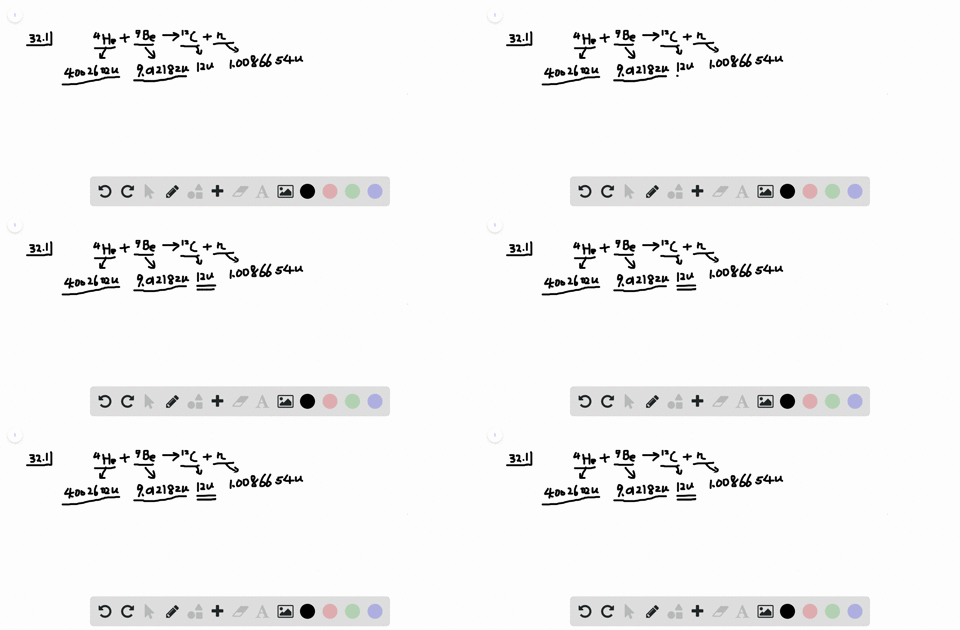
A neutron generator uses an $\alpha$ source, such as radium, to bombard beryllium, inducing the reaction
$^{4} \mathrm{He}+^{9} \mathrm{Be} \rightarrow^{12} \mathrm{C}+n .$ Such neutron sources are called
RaBe sources, or PuBe sources if they use plutonium to get the $\alpha$ s. Calculate the energy output of the reaction in MeV.

Chapter 32: Medical Applications of Nuclear Physics
Hebe Lee
01:41
College Physics for APĀ® Courses

The purpose of producing 99 Mo (usually by neutron activation of natural molybdenum, as in the preceding problem) is to produce $99 \mathrm{~m} \mathrm{Tc}$. Using the rules, verify that the $\beta^{-}$ decay of $99 \mathrm{Mo}$ produces $99 \mathrm{~m} \mathrm{Tc} .$ (Most $99 \mathrm{~m} \mathrm{Tc}$
nuclei produced in this decay are left in a metastable excited state denoted ${ }^{99 \mathrm{~m}} \mathrm{Tc} .$.)

Chapter 32: Medical Applications of Nuclear Physics
Hebe Lee
01:50
College Physics for APĀ® Courses

Table 32.1 indicates that 7.50 $\mathrm{mCi}$ of 99 $\mathrm{m}$ Tc is used in a
brain scan. What is the mass of technetium?

Chapter 32: Medical Applications of Nuclear Physics
Hebe Lee
02:41
College Physics for APĀ® Courses

The activities of ${ }^{131} \mathrm{I}$ and $123 \mathrm{I}$ used in thyroid scans are given in Table 32.1 to be 50 and $70 \mu \mathrm{Ci}$, respectively. Find
and compare the masses of ${ }^{131} \mathrm{I}$ and ${ }^{123} \mathrm{I}$ in such scans, given their respective half-lives are $8.04 \mathrm{~d}$ and $13.2 \mathrm{~h}$. The masses are so small that the radioiodine is usually mixed with stable iodine as a carrier to ensure normal chemistry and distribution in the body.

Chapter 32: Medical Applications of Nuclear Physics
Hebe Lee
02:28
College Physics for APĀ® Courses

(a) Neutron activation of sodium, which is 100$\%$ 23 $\mathrm{Na}$ produces $^{24} \mathrm{Na},$ which is used in some heart scans, as seen in Table 32.1 . The equation for the reaction is $^{23} \mathrm{Na}+n \rightarrow^{24} \mathrm{Na}+\gamma .$ Find its energy output, given the
mass of 24 $\mathrm{Na}$ is 23.990962 $\mathrm{u}$ . (b) What mass of $^{24} \mathrm{Na}$ produces the needed 5.0 -mci activity, given its half-life is 15.0 $\mathrm{h}$ ?

Chapter 32: Medical Applications of Nuclear Physics
Hebe Lee
01:35
College Physics for APĀ® Courses

What is the dose in mSv for: (a) a 0.1 Gy x-ray? (b) 2.5 mGy of neutron exposure to the eye? (c) 1.5 mGy of $\alpha$ exposure?

Chapter 32: Medical Applications of Nuclear Physics
Hebe Lee
1 2 3 4 5 ... 10