Himanshu Garg

Other Schools
Individual tutor

Biography

Hi, I have done my graduation in Engineering and worked in corporate for a few years. For last 3 years, I am giving tuition classes for Chemistry, the subject I always loved.

Education

BS Engineering
Other Schools

Educator Statistics

Numerade tutor for 6 years
570 Students Helped

Topics Covered

Atoms, Molecules, and Ions: Understanding the Building Blocks of Matter
Understanding Electronic Structure: A Comprehensive Guide
Discover the Wonders of Chemistry: Your Introductory Guide
Unlocking the Power of Composition: Tips and Techniques
Effective Solutions for Your Business Needs
Unlocking the Power of Chemical Reactions: A Comprehensive Guide
Mastering Chemical Reactions and Stoichiometry for Optimal Results
Discover the Power of Liquids: Boost Your Health and Wellness Today!
Acid-Base Equilibria: Understanding the Balance
Unlocking the Power of Thermodynamics: A Comprehensive Guide
Exploring the Fascinating World of Thermochemistry | Learn More Today

Himanshu's Textbook Answer Videos

01:36
Chemistry Matter and Change

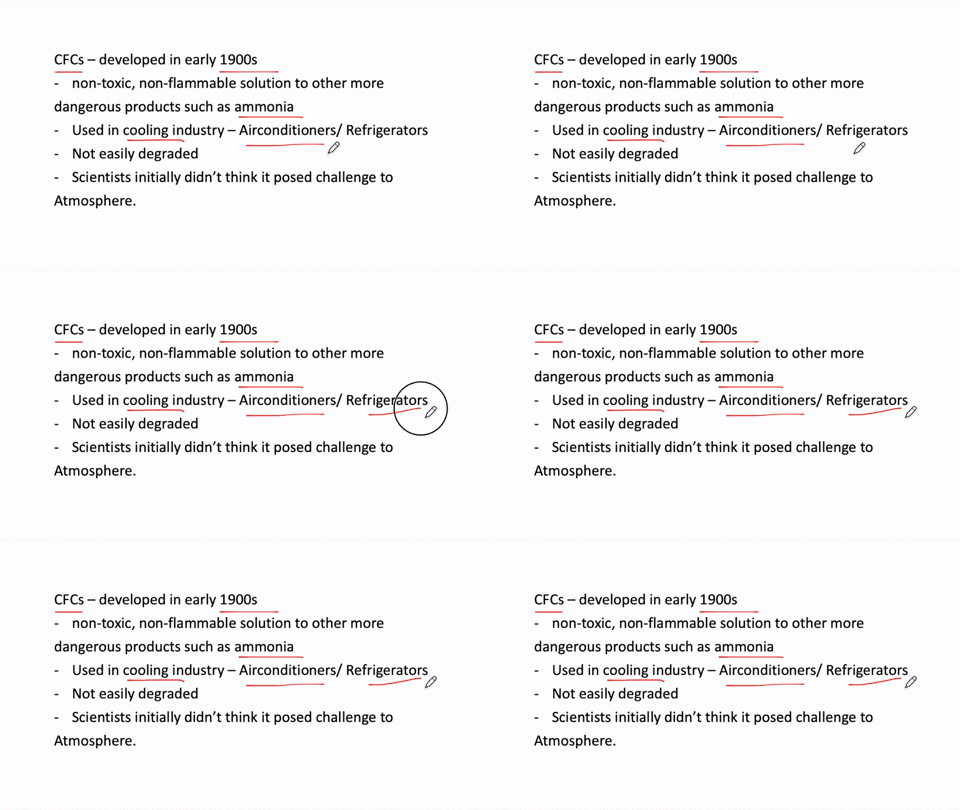
Explain why the concentration of CFCs increased in the atmosphere.

Chapter 1: Introduction to Chemistry
Himanshu Garg
00:58
Chemistry Matter and Change

Create a table that describes the three common states of matter in terms of their shape, volume, and compressibility.

Chapter 3: Matter—Properties and Changes
Himanshu Garg
01:55
Chemistry Matter and Change

Classify each of the following as a physical or a chemical property.

a. Iron and oxygen form rust.
b. Iron is more dense than aluminum.
c. Magnesium burns brightly when ignited.
d. Oil and water do not mix.
e. Mercury melts at $-39^{\circ} C$

Chapter 3: Matter—Properties and Changes
Himanshu Garg
01:03
Chemistry Matter and Change

Organize Create a chart that compares physical and chemical properties. Give two examples for each type of property.

Chapter 3: Matter—Properties and Changes
Himanshu Garg
01:35
Chemistry Matter and Change

A Classify each example as a physical change or a chemical change.

a. crushing an aluminum can
b. recycling used aluminum cans to make new aluminum cans
c. aluminum combining with oxygen to form aluminum oxide

Chapter 3: Matter—Properties and Changes
Himanshu Garg
00:56
Chemistry Matter and Change

Calculate Solve each of the following.

a. In the complete reaction of 22.99 g of sodium with 35.45 $\mathrm{g}$ of chlorine, what mass of sodium chloride is formed?
b. A 12.2 -g sample of $X$ reacts with a sample of $Y$ to form 78.9 $\mathrm{g}$ of $X$ . What is the mass of $Y$ that reacted?

Chapter 3: Matter—Properties and Changes
Himanshu Garg
1 2 3 4 5 ... 81

Himanshu's Quick Ask Videos

05:00
Physics 101 Mechanics

Himanshu Garg
02:14
Chemistry 102

CPVC is degraded by both strong acids and strong bases at elevated temperatures; acids corrode process units unless very expensive corrosion-resistant construction materials are used; and aqueous slurries with high solids content are difficult to pump. Use these facts to explain why the wetcake from the centrifuge is not sent directly to the dryer instead of going through the resin neutralizer, why sodium bicarbonate is used to achieve the neutralization, and why additional water is fed to the neutralizer.
Himanshu Garg
02:14
Chemistry 102

CPVC is degraded by both strong acids and strong bases at elevated temperatures; acids corrode process units unless very expensive corrosion-resistant construction materials are used; and aqueous slurries with high solids content are difficult to pump. Use these facts to explain why the wetcake from the centrifuge is not sent directly to the dryer instead of going through the resin neutralizer, why sodium bicarbonate is used to achieve the neutralization, and why additional water is fed to the neutralizer.

Himanshu Garg
1