Jacob Paiste

University of Alabama at Birmingham
Tutor

Biography

I love physics and mathematics! I also enjoy teaching which I have done for a few years now as a teaching assistant and supplemental instructor at my university. I also enjoy tutoring high school students in mathematics and science!

Education

MS Physics
University of Alabama at Birmingham
BS Physics
University of Alabama at Birmingham

Educator Statistics

Numerade tutor for 6 years
244 Students Helped

Topics Covered

Master the Fundamentals of Physics: Learn Physics Basics
Mastering Motion: Achieving Efficiency Along a Straight Line
Motion in 2d or 3d
Find Your Dream Job: Discover the Best Work Opportunities
Discovering the Fundamentals: Newton's Laws of Motion Explained
Unlocking the Power of Magnetic Fields and Forces
Discovering the Sources of Magnetic Fields: A Comprehensive Guide
Unlock the Power of Kinetic Energy: Boost Your Efficiency Today
Unlocking the Power of Potential Energy: Discover the Benefits
Save Energy and Money with Effective Conservation Techniques
Understanding Temperature and Heat: A Comprehensive Guide
Unlocking the Secrets of Thermal Properties: Understanding Matter
Understanding the First Law of Thermodynamics: Key Concepts
Understanding the Second Law of Thermodynamics: Key Principles
Electromagnetic Induction: Understanding the Science and Applications
Understanding Inductance: A Comprehensive Guide

Jacob's Textbook Answer Videos

02:43
Physics for Scientists and Engineers with Modern Physics

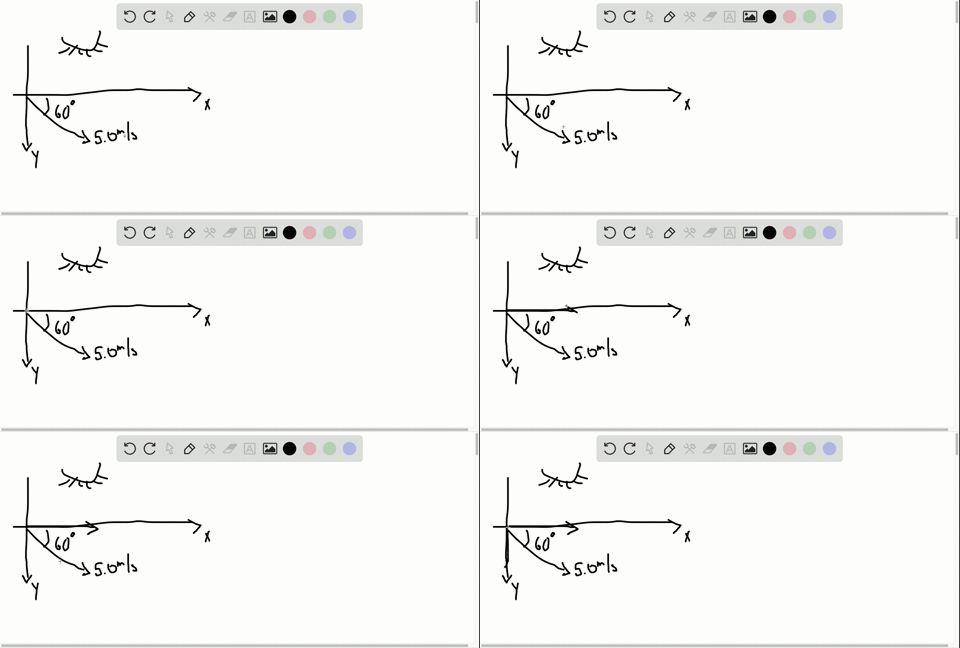
When the Sun is directly overhead, a hawk dives toward the ground with a constant velocity of 5.00 $\mathrm{m} / \mathrm{s}$ at $60.0^{\circ}$ below the horizontal. Calculate the speed of its shadow on the level ground.

Chapter 4: Motion in Two Dimensions
Jacob Paiste
09:35
Physics for Scientists and Engineers with Modern Physics

A particle initially located at the origin has an acceleration of $\overrightarrow{\mathbf{a}}=3.00 \hat{\mathrm{j}} \mathrm{m} / \mathrm{s}^{2}$ and an initial velocity of $\overrightarrow{\mathbf{v}}_{i}=5.00 \hat{\mathrm{i}} \mathrm{m} / \mathrm{s}$. Find (a) the vector position of the particle at any time $\iota$ (b) the velocity of the particle at any time $t,(c)$ the coordinates of the particle at $t=2.00 \mathrm{s},$ and $(\mathrm{d})$ the speed of the particle at $t=2.00 \mathrm{s}$

Chapter 4: Motion in Two Dimensions
Jacob Paiste
13:45
Physics for Scientists and Engineers with Modern Physics

Review. A snowmobile is originally at the point with position vector 29.0 $\mathrm{m}$ at $95.0^{\circ}$ counterclockwise from the $x$ axis, moving with velocity 4.50 $\mathrm{m} / \mathrm{s}$ at $40.0^{\circ} .$ It moves with constant acceleration 1.90 $\mathrm{m} / \mathrm{s}^{2}$ at $200^{\circ} .$ After 5.00 s have elapsed, find (a) its velocity and (b) its position vector.

Chapter 4: Motion in Two Dimensions
Jacob Paiste
14:19
Physics for Scientists and Engineers with Modern Physics

In a local bar, a customer slides an empty beer mug down the counter for a refill. The height of the counter is $h$. The mug slides off the counter and strikes the floor at distance d from the base of the counter. (a) With what velocity did the mug leave the counter? (b) What was the direction of the mug’s velocity just before it hit the floor?

Chapter 4: Motion in Two Dimensions
Jacob Paiste
05:25
Physics for Scientists and Engineers with Modern Physics

To start an avalanche on a mountain slope, an artillery shell is fired with an initial velocity of 300 $\mathrm{m} / \mathrm{s}$ at $55.0^{\circ}$ above the horizontal. It explodes on the mountainside 42.0 $\mathrm{s}$ after firing. What are the $x$ and $y$ coordinates of the shell where it explodes, relative to its firing point?

Chapter 4: Motion in Two Dimensions
Jacob Paiste
11:19
Physics for Scientists and Engineers with Modern Physics

A rock is thrown upward from level ground in such a way that the maximum height of its flight is equal to its horizontal range $R$ (a) At what angle $\theta$ is the rock thrown? (b) In terms of its original range $R,$ what is the range $R_{\max }$ the rock can attain if it is launched at the same speed but at the optimal angle for maximum range? (c) What If? Would your answer to part (a) be different if the rock is thrown with the same speed on a different planet? Explain.

Chapter 4: Motion in Two Dimensions
Jacob Paiste
1 2 3 4 5 ... 41