James York

University of Colorado at Colorado Springs
Programming - Java / C

Biography

Hello!
My name is James York and I am currently a Sophomore at the University of Colorado - Colorado Springs pursuing a degree in Computer Engineering. In my free time I love to create Robots and machines. I have taken Calculus 1-3, (Calc II in both HS and College), and Physics 1 & 2, along with numerous engineering courses. I love teaching and trying to solve interesting problems and would thoroughly enjoy an opportunity to be an educator for Numerade.

Education

BA Computer Engineering
University of Colorado at Colorado Springs

Educator Statistics

Numerade tutor for 6 years
17 Students Helped

Topics Covered

Exploring Probability Topics: From Basics to Advanced Strategies
Understanding the Normal Distribution: A Comprehensive Guide
Linear Regression & Correlation: Analyzing Data Relationships

James's Textbook Answer Videos

04:54
Probability with Applications in Engineering, Science, and Technology

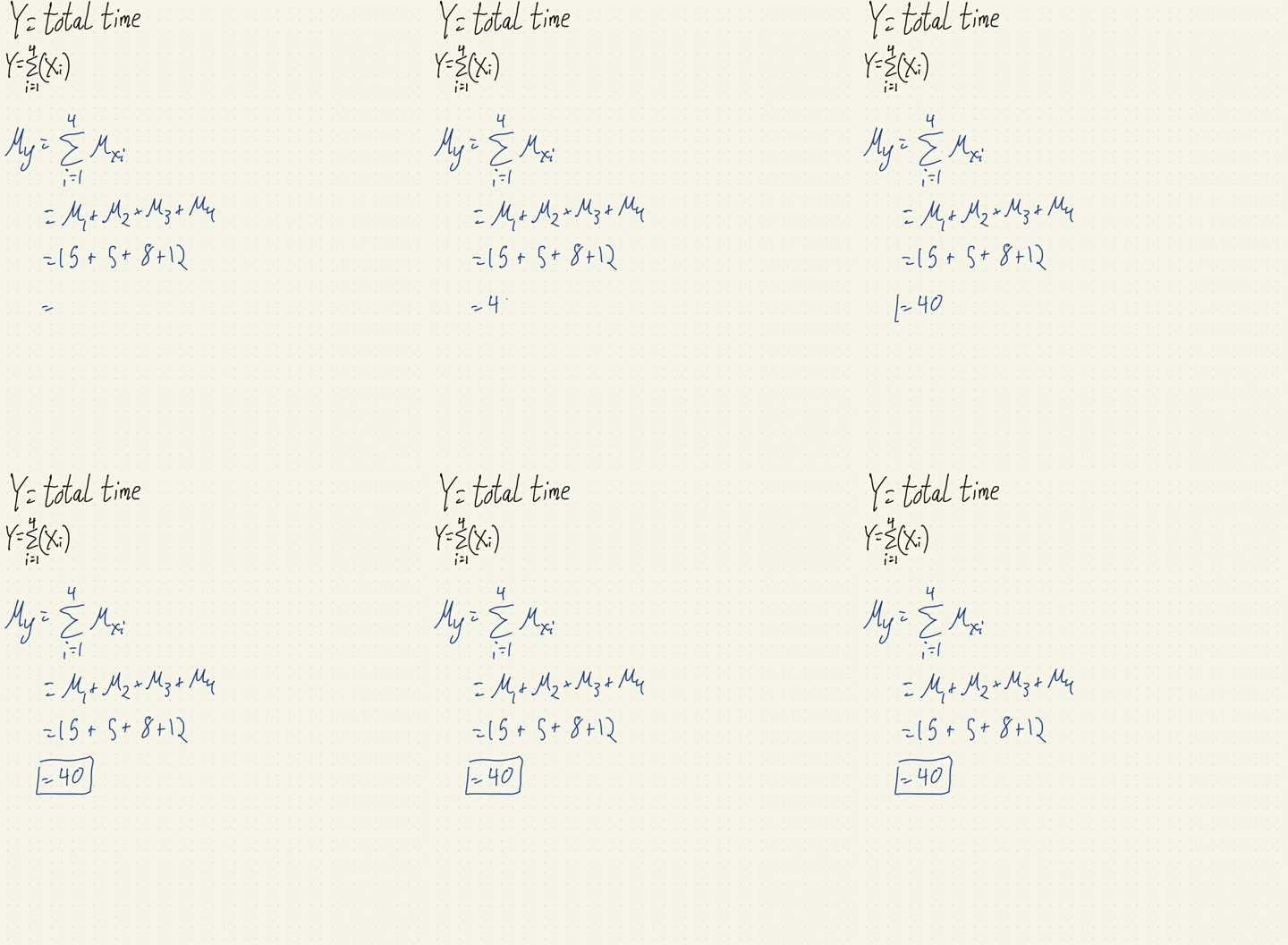
A professor has three errands to take care of in the Administration Building. Let $X_{i}=$ the time
that it takes for the $i$ th errand $(i=1,2,3),$ and let $X_{4}=$ the in minutes that spends walking to and from the building and between each errand. Suppose the $X_{i}$ s are independent, normally distributed, with the following means and standard deviations: $\mu_{1}=15, \sigma_{1}=4$ $\mu_{2}=5, \sigma_{2}=1, \mu_{3}=8, \sigma_{3}=2, \mu_{4}=12, \sigma_{4}=3 .$ She plans to leave her office at precisely $10 : 00$ a.m. and wishes to post a note on her door that reads, "I will return by $t$ a.m." What time $t$ should she write down if she wants the probability of her arriving after $t$ to be .01$?$

Chapter 4: Joint Probability Distributions and Their Applications
Section 1: Jointly Distributed Random Variables
James York
01:34
Elementary Statistics

a. Is there a relationship (pattern) between the two variables length of a rainbow trout and weight of a rainbow trout? Explain why or why not.
b. Do you think it is reasonable (or possible) to predict the weight of a rainbow trout based on the length of the rainbow trout? Explain why or why not.

Chapter 3: Descriptive Analysis and Presentation of Bivariate Data
Section 1: Bivariate Data
James York
01:40
Elementary Statistics

a. Is there a relationship between a person's height and shoe size as he or she grows from an infant to age $16 ?$ As one variable gets larger, does the other also get larger? Explain your answers.
b. Is there a relationship between height and shoe size for people who are older than 16 years of age? Do taller people wear larger shoes? Explain your answers.

Chapter 3: Descriptive Analysis and Presentation of Bivariate Data
Section 1: Bivariate Data
James York
04:26
Elementary Statistics

In a national survey of 500 business and 500 leisure travelers, each was asked where he or she would most like "more space."a. Express the table as percentages of the total.
b. Express the table as percentages of the row totals. Why might one prefer the table to be expressed this way?
c. Express the table as percentages of the column totals. Why might one prefer the table to be expressed this way?

Chapter 3: Descriptive Analysis and Presentation of Bivariate Data
Section 1: Bivariate Data
James York
02:47
Elementary Statistics

The "In the eye of the beholder" graphic shows two circle graphs, each with four sections. This same information could be represented in the form of a $2 \times 4$ contingency table of two qualitative variables.
a. Identify the population and name the two variables.
b. Construct the contingency table using entries of percentages based on row totals.

Chapter 3: Descriptive Analysis and Presentation of Bivariate Data
Section 1: Bivariate Data
James York
01:59
Elementary Statistics

The perfect age" graphic shows the results from a $9 \times 2$ contingency table for one qualitative and one quantitative variable.a. Identify the population and name the qualitative and quantitative variables.
b. Construct a bar graph showing the two distributions side by side.
c. Does there seem to be a big difference between the genders on this subject?

Chapter 3: Descriptive Analysis and Presentation of Bivariate Data
Section 1: Bivariate Data
James York
1 2 3