Kim Trang Nguyen

California State University - Los Angeles
chemistry adjunct

Biography

Chemistry adjunct teaching lecture and lab of introductory and general chemistry. Currently I am an adjunct teaching chemistry for nursing major, the course include general chemistry and organic chemistry.
I can teach both org chem and gen chem.

Education

MS Chemistry
California State University - Los Angeles
BS Chemistry
California State University - Los Angeles

Educator Statistics

Numerade tutor for 6 years
947 Students Helped

Topics Covered

Unlocking the Power of Chemical Reactions: A Comprehensive Guide
Unlocking the Wonders of Organic Chemistry: An Introduction
Explore the Fascinating World of Nuclear Chemistry
Exploring the Fascinating World of Electrochemistry | Learn More Now
Mastering the Structure & Synthesis of Alcohols: A Comprehensive Guide
Understanding Electronic Structure: A Comprehensive Guide
Effective Solutions for Your Business Needs
Aqueous Equilibria: Understanding the Balance of Solutions
Mastering Chemical Reactions and Stoichiometry for Optimal Results
Discover the Power of Liquids: Boost Your Health and Wellness Today!
Acid-Base Equilibria: Understanding the Balance
Discover the Wonders of Chemistry: Your Introductory Guide
Unlocking the Power of Composition: Tips and Techniques
Unlocking the Power of Periodic Table Properties | Boost Your Knowledge
Atoms, Molecules, and Ions: Understanding the Building Blocks of Matter
Unlocking the Power of Thermodynamics: A Comprehensive Guide
Exploring the Fascinating World of Thermochemistry | Learn More Today

Kim Trang's Textbook Answer Videos

06:12
Organic Chemistry

Consider the following energy diagram.
a. How many steps are involved in this reaction?
b. Label $\Delta{H}^\circ$ and $E_a$ for each step, and label $\Delta{H}^\circ_{overall}.$
c. Label each transition state.
d. Which point on the graph corresponds to a reactive intermediate?
e. Which step is rate-determining?
f. Is the overall reaction endothermic or exothermic?

Chapter 6: Understanding Organic Reactions
Section 8: Energy Diagram for a Two-Step Reaction Mechanism
Kim Trang Nguyen
03:38
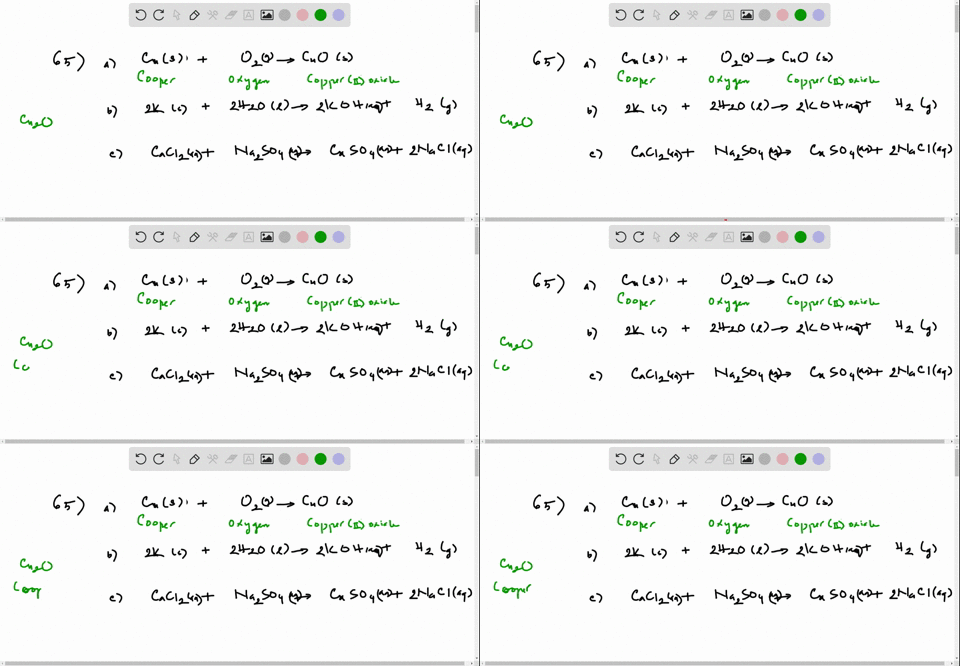
Chemistry Matter and Change

Write word equations for the following skeleton
equations.
$$\begin{array}{l}{\text { a. } \mathrm{Cu}(\mathrm{s})+\mathrm{O}_{2}(\mathrm{g}) \rightarrow \mathrm{CuO}(\mathrm{s})} \\ {\text { b. } \mathrm{K}(\mathrm{s})+\mathrm{H}_{2} \mathrm{O}(\mathrm{l}) \rightarrow \mathrm{KOH}(\mathrm{aq})+\mathrm{H}_{2}(\mathrm{g})} \\ {\text { c. } \mathrm{CaCl}_{2}(\mathrm{aq})+\mathrm{Na}_{2} \mathrm{SO}_{4}(\mathrm{aq}) \rightarrow \mathrm{CaSO}_{4}(\mathrm{s})+\mathrm{NaCl}(\mathrm{aq})}\end{array}$$

Chapter 9: Chemical Reactions
Kim Trang Nguyen
05:21
Chemistry Matter and Change

Write chemical equations for each of the following
decomposition reactions. One or more products might
be identified.
$$\begin{array}{l}{\text { a. magnesium bromide } \rightarrow} \\ {\text { b. cobalt(II) oxide } \rightarrow} \\ {\text { c. titanium(IV) hydroxide } titanium (IV) oxide + water \rightarrow} \\ {\text { d. barium carbonate } \rightarrow \text { barium oxide }+\text { carbon dioxide }}\end{array}$$

Chapter 9: Chemical Reactions
Kim Trang Nguyen
06:29
Chemistry Matter and Change

Write complete ionic and net ionic equations for each of
the following reactions.
$$\begin{array}{l}{\text { a. } \mathrm{K}_{2} \mathrm{S}(\mathrm{aq})+\mathrm{CoCl}_{2}(\mathrm{aq}) \rightarrow 2 \mathrm{KCl}(\mathrm{aq})+\mathrm{CoS}(\mathrm{s})} \\ {\text { b. } \mathrm{H}_{2} \mathrm{SO}_{4}(\mathrm{aq})+\mathrm{CaCO}_{3}(\mathrm{s}) \rightarrow} \mathrm{H}_{2} \mathrm{O}(1)+\mathrm{CO}_{2}(\mathrm{g})+\mathrm{CaSO}_{4}(\mathrm{s})\\ {\text { c. } 2 \mathrm{HClO}(\mathrm{aq})+\mathrm{Ca}(\mathrm{OH})_{2}(\mathrm{aq}) \rightarrow} \\ {2 \mathrm{H}_{2} \mathrm{O}(1)+\mathrm{Ca}(\mathrm{ClO})_{2}(\mathrm{aq})}\end{array}$$

Chapter 9: Chemical Reactions
Kim Trang Nguyen
08:29
Chemistry Matter and Change

Write complete ionic and net ionic equations for each of
the following reactions.
$$\begin{array}{l}{\text { a. } \mathrm{H}_{3} \mathrm{PO}_{4}(\mathrm{aq})+3 \mathrm{RbOH}(\mathrm{aq}) \rightarrow 3 \mathrm{H}_{2} \mathrm{O}(1)+\mathrm{Rb}_{3} \mathrm{PO}_{4}(\mathrm{aq})} \\ {\text { b. } \mathrm{HCl}(\mathrm{aq})+\mathrm{NH}_{4} \mathrm{OH}(\mathrm{aq}) \rightarrow \mathrm{H}_{2} \mathrm{O}(\mathrm{l})+\mathrm{NH}_{4} \mathrm{Cl}(\mathrm{aq})} \\ {\text { c. } 2 \mathrm{HI}+\left(\mathrm{NH}_{4}\right)_{2} \mathrm{S}(\mathrm{aq}) \rightarrow \mathrm{H}_{2} \mathrm{S}(\mathrm{g})+2 \mathrm{NH}_{4} \mathrm{I}(\mathrm{aq})} \\ {\text { d. } \mathrm{HNO}_{3}(\mathrm{aq})+\mathrm{KCN}(\mathrm{aq})+\mathrm{HCN}(\mathrm{g})+\mathrm{KNO}_{3}(\mathrm{aq})}\end{array}$$

Chapter 9: Chemical Reactions
Kim Trang Nguyen
03:09
Chemistry Matter and Change

Write the word equation for each of these skeleton equations. $C_{6} \mathrm{H}_{6}$ is the formula for benzene.
$$\begin{array}{l}{\text { a. } C_{6} \mathrm{H}_{6}(1)+\mathrm{O}_{2}(\mathrm{g}) \rightarrow \mathrm{CO}_{2}(\mathrm{g})+\mathrm{H}_{2} \mathrm{O}(1)} \\ {\text { b. } \mathrm{CO}(\mathrm{g})+\mathrm{O}_{2}(\mathrm{g}) \rightarrow \mathrm{CO}_{2}(\mathrm{g})} \\ {\text { c. } \mathrm{Cl}_{2}(\mathrm{g})+\mathrm{NaBr}(\mathrm{s}) \rightarrow \mathrm{NaCl}(\mathrm{s})+\mathrm{Br}_{2}(\mathrm{g})} \\ {\text { d. } \mathrm{CaCO}_{3}(\mathrm{s}) \rightarrow \mathrm{CaO}(\mathrm{s})+\mathrm{CO}_{2}(\mathrm{g})}\end{array}$$

Chapter 9: Chemical Reactions
Kim Trang Nguyen
1 2 3 4 5 ... 158