Krish Desai

Numerade Educator
Workshop Teacher

Biography

I have a passion for math and science, and have been taking advanced courses in those subjects throughout middle- and high-school. In high-school, I joined Junior Achievement and began teaching students about STEM. While I don't intend to become a teacher, I did discover a small passion for passing on the information I've learned as a student to others.

***I have not started my freshman year yet, so I do not have a GPA currently. My high school GPA was 4.56/4.0

Education

Krish has not yet added their education credentials.

Educator Statistics

Numerade tutor for 6 years
54 Students Helped

Topics Covered

Discover the Power of Liquids: Boost Your Health and Wellness Today!
Discover the Power of Solids for Your Everyday Needs
Understanding Chemical Equilibrium: A Comprehensive Guide
Unlocking the Power of Chemical Reactions: A Comprehensive Guide
Understanding Electronic Structure: A Comprehensive Guide

Krish's Textbook Answer Videos

10:42
Introductory Econometrics

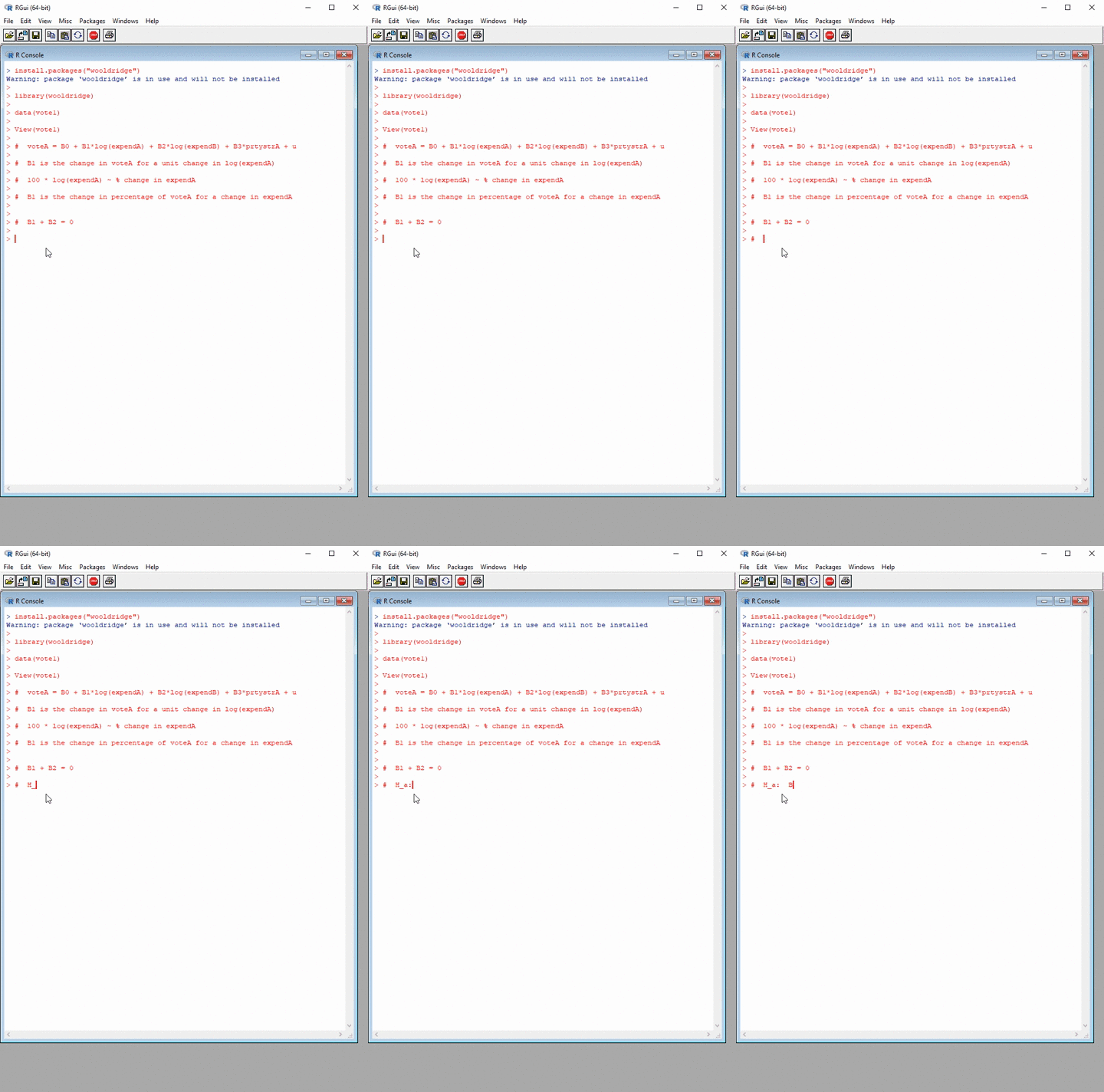
The following model can be used to study whether campaign expenditures affect election outcomes:
voteA$=\beta_{0}+\beta_{1} \log (e x p e n d A)+\beta_{2} \log (e x p e n d B)+\beta_{3} p r t y s t r A+u$
where voteA is the percentage of the vote received by Candidate A, expendA and expendB are campaign expenditures by Candidates $A$ and $B$ , and prystrA is a measure of party strength for Candidate A (the percentage of the most recent presidential vote that went to A' party).
(i) What is the interpretation of $\beta_{1} ?$
(ii) In terms of the parameters, state the null hypothesis that a 1$\%$ increase in A's expenditures is offset by a 1$\%$ increase in B's expenditures.
(iii) Estimate the given model using the data in VOTE1 and report the results in usual form. Do A's expenditures affect the outcome? What about B's expenditures? Can you use these results to test the hypothesis in part (ii)?
(iv) Estimate a model that directly gives the $t$ statistic for testing the hypothesis in part (ii). What do you conclude? (Use a two-sided alternative.)

Chapter 4: Multiple Regression Analysis: Inference
Krish Desai
10:21
Introductory Econometrics

(i) Apply RESET from equation $(9.3)$ to the model estimated in Computer Exercise $\mathrm{C} 5$ in Chapter $7 .$ Is there evidence of functional form misspecification in the equation?
(ii) Compute a heteroskedasticity-robust form of RESET. Does your conclusion from part (i) change?

Chapter 9: More on Specification and Data Issues
Krish Desai
05:54
Introductory Econometrics

Use the data set WAGE2 for this exercise.
(i) Use the variable KWW (the "knowledge of the world of work" test score) as a proxy for ability
in place of IQ in Example 9.3. What is the estimated return to education in this case?
(ii) Now, use IQ and KWW together as proxy variables. What happens to the estimated return to
education?
(iii) In part (ii), are IQ and KWW individually significant? Are they jointly significant?

Chapter 9: More on Specification and Data Issues
Krish Desai
06:22
Introductory Econometrics

Use the data for the year 1990 in INFMRT for this exercise.
(i) Reestimate equation (9.43), but now include a dummy variable for the observation on the
District of Columbia (called DC). Interpret the coefficient on DC and comment on its size and
significance.
(ii) Compare the estimates and standard errors from part (i) with those from equation (9.44). What
do you conclude about including a dummy variable for a single observation?

Chapter 9: More on Specification and Data Issues
Krish Desai
08:24
Introductory Econometrics

Use the data in RDCHEM to further examine the effects of outliers on OLS estimates and to see how
LAD is less sensitive to outliers. The model is
$$=\beta_{0}+\beta_{1} \text { sales }+\beta_{2} \text { sales }^{2}+\beta_{3} \text { profmarg }+u$$
where you should first change sales to be in billions of dollars to make the estimates easier to
interpret.
(i) Estimate the above equation by OLS, both with and without the firm having annual sales of
almost $40 billion. Discuss any notable differences in the estimated coefficients.
(ii) Estimate the same equation by LAD, again with and without the largest firm. Discuss any
important differences in estimated coefficients.
(iii) Based on your findings in (i) and (ii), would you say OLS or LAD is more resilient to outliers?

Chapter 9: More on Specification and Data Issues
Krish Desai
04:24
Introductory Econometrics

Redo Example 4.10 by dropping schools where teacher benefits are less than 1$\%$ of salary.
(i) How many observations are lost?
(ii) Does dropping these observations have any important effects on the estimated trade off?

Chapter 9: More on Specification and Data Issues
Krish Desai
1 2 3 4 5 ... 9