Laurent Bergeron

Other Schools
Tutor

Biography

Tutor for physics classes in Simon Fraser University

Education

MS Physics
Other Schools
BS Physics
Other Schools

Educator Statistics

Numerade tutor for 7 years
171 Students Helped

Topics Covered

Introduction to Combinatorics & Probability: Understanding the Basics
Understanding Temperature and Heat: A Comprehensive Guide
Unlocking the Secrets of Thermal Properties: Understanding Matter
Taylor Series
Unlocking the Power of Functions: Boost Your Programming Skills
Master the Fundamentals of Physics: Learn Physics Basics
Mastering Motion: Achieving Efficiency Along a Straight Line
Motion in 2d or 3d
Discovering the Fundamentals: Newton's Laws of Motion Explained
Mastering Newton's Laws: Tips for Applying Them Effectively
Discover the Fascinating World of Nuclear Physics

Laurent's Textbook Answer Videos

06:20
Physics: Principles with Applications

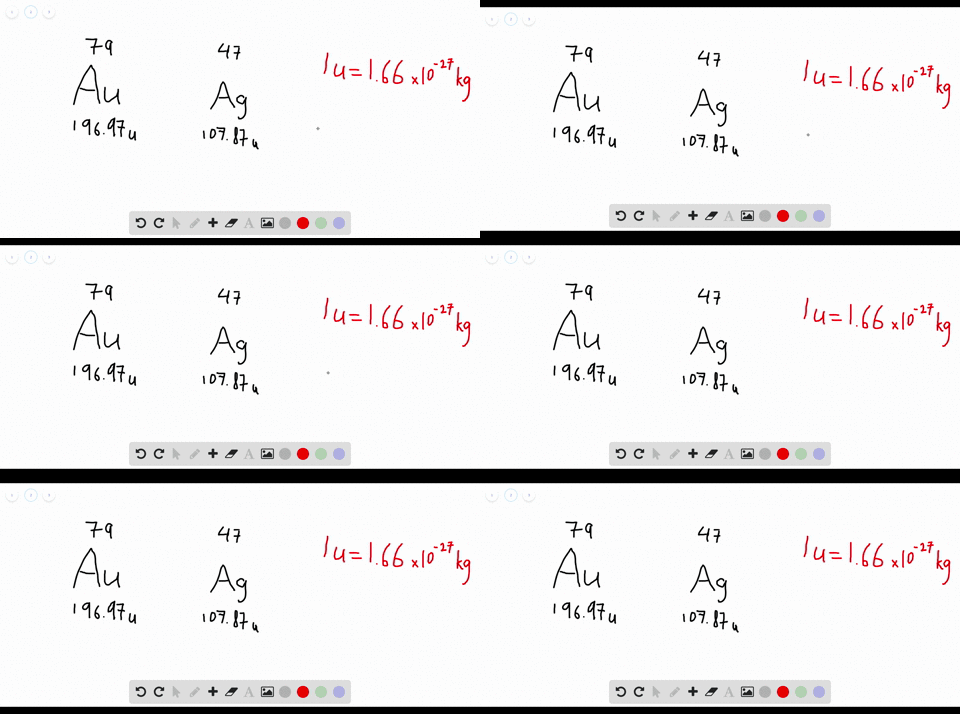
(I) How does the number of atoms in a 27.5-gram gold ring compare to the number in a silver ring of the same mass?

Chapter 13: TEMPERATURE AND KINETIC THEORY
Section 1: Atomic Theory of Matter
Laurent Bergeron
02:49
Physics: Principles with Applications

(I) ($a$) "Room temperature" is often taken to be 68$^\circ$F. What is this on the Celsius scale? ($b$) The temperature of the filament in a lightbulb is about 1900$^\circ$C. What is this on the Fahrenheit scale?

Chapter 13: TEMPERATURE AND KINETIC THEORY
Section 2: Temperature and Thermometers
Laurent Bergeron
01:13
Physics: Principles with Applications

(I) A thermometer tells you that you have a fever of 38.9$^\circ$C. What is this in Fahrenheit?

Chapter 13: TEMPERATURE AND KINETIC THEORY
Section 2: Temperature and Thermometers
Laurent Bergeron
02:52
Physics: Principles with Applications

(II) Determine the temperature at which the Celsius and Fahrenheit scales give the same numerical reading ($T_C=T_F$).

Chapter 13: TEMPERATURE AND KINETIC THEORY
Section 2: Temperature and Thermometers
Laurent Bergeron
04:40
Physics: Principles with Applications

(I) The Eiffel Tower (Fig. 13$-$31) is built of wrought iron approximately 300 m tall. Estimate how much its height changes between January (average temperature of 2$^\circ$C) and July (average temperature of 25$^\circ$C). Ignore the angles of the iron beams and treat the tower as a vertical beam.
FIGURE 13–31 Problem 9. The Eiffel Tower in Paris. (CANT COPY FIGURE)

Chapter 13: TEMPERATURE AND KINETIC THEORY
Section 4: Thermal Expansion
Laurent Bergeron
05:56
Physics: Principles with Applications

(I) Super Invar$^\mathrm{TM}$, an alloy of iron and nickel, is a strong material with a very low coefficient of thermal expansion (0.20 $\times$ 10$^{-6}$/C$^\circ$). A 1.8-m-long tabletop made of this alloy is used for sensitive laser measurements where extremely high tolerances are required. How much will this alloy table expand along its length if the temperature increases 6.0 C$^\circ$?
Compare to tabletops made of steel.

Chapter 13: TEMPERATURE AND KINETIC THEORY
Section 4: Thermal Expansion
Laurent Bergeron
1 2 3 4 5 ... 27