Marcus Esteban

MacEwan University
Tutor

Biography

I have little teaching experience but I am able to share my process of problem-solving. Answering textbook questions in my field of study, Economics, was what kept my grades afloat. If it would help, I will share my transcript to show that my grades for Economics average to a more respectable GPA.

I have won two awards: one for presenting my paper, and another for the paper of the year in my field for 2016. I have just finished my courses in December and seeking employment opportunities.

Education

BA Economics
MacEwan University

Educator Statistics

Numerade tutor for 6 years
16 Students Helped

Topics Covered

Discover the Power of Introduction: Your Guide to Making a Lasting Impression
How Markets Work: Understanding the Dynamics of Supply and Demand
Understanding Firm Behavior and Industry Organization
Markets and Welfare

Marcus's Textbook Answer Videos

03:07
Economics

Suppose you are running the food concession at the athletic events for your college. You sell hot dogs, colas, and potato chips. What are your inputs of capital, labor, and materials? If the demand for hot dogs declines, what steps could you take to reduce output in the short run? In the long run?

Chapter 6: Production and Business Organization
Marcus Esteban
02:21
Economics Principles, Problems, and Policies

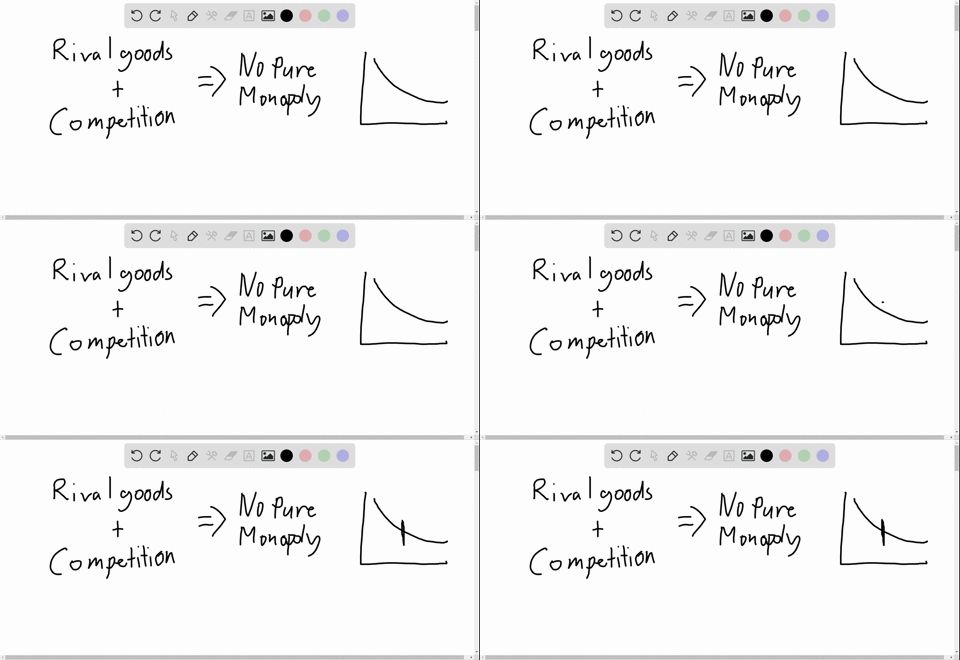
"No firm is completely sheltered from rivals; all firms compete for consumer dollars. If that is so, then pure monopoly does not exist." Do you agree? Explain. How might you use Chapter 6 's concept of cross elasticity of demand to judge whether monopoly exists?

Chapter 10: Pure Monopoly
Marcus Esteban
01:39
Economics Principles, Problems, and Policies

Discuss the major barriers to entry into an industry. Explain how each barrier can foster either monopoly or oligopoly. Which barriers, if any, do you feel give rise to monopoly that is socially justifiable?

Chapter 10: Pure Monopoly
Marcus Esteban
01:30
Economics Principles, Problems, and Policies

How does the demand curve faced by a purely monopolistic seller differ from that confronting a purely competitive firm? Why does it differ? Of what significance is the difference? Why is the pure monopolist's demand curve not perfectly inelastic?

Chapter 10: Pure Monopoly
Marcus Esteban
03:25
Economics Principles, Problems, and Policies

Use the demand schedule to the upper right to calculate total revenue and marginal revenue at each quantity. Plot the demand, total-revenue, and marginal revenue curves and explain the relationships between them. Explain why the marginal revenue of the fourth unit of output is $\$ 3.50$, even though its price is $\$ 5 .$ Use Chapter 6 's total-revenue test for price elasticity to designate the elastic and inelastic segments of your graphed demand curve. What generalization can you make as to the relationship between marginal revenue and elasticity of demand? Suppose the marginal cost of successive units of output was zero. What output would the profit-seeking firm produce? Finally, use your analysis to explain why a monopolist would never produce in the inelastic region of demand.

Chapter 10: Pure Monopoly
Marcus Esteban
01:40
Economics Principles, Problems, and Policies

Suppose a pure monopolist is faced with the demand schedule shown below and the same cost data as the competitive producer discussed in question 4 at the end of Chapter $9 .$ Calculate the missing total-revenue and margina lrevenue amounts, and determine the profit-maximizing price and profit-earning output for this monopolist. What is the monopolist's profit? Verify your answer graphically and by comparing total revenue and total cost.

Chapter 10: Pure Monopoly
Marcus Esteban
1 2 3