Noor Aldeen Almusleh

Al Al-bayt University

Biography

I'm a physics teacher with 3 years of experience. I'm familiar with many topics in physics and I can teach high school and undergraduate level.
I have some experience with creating videos as I was doing that during my teaching time.

Education

BS Physics
Al Al-bayt University

Educator Statistics

Numerade tutor for 6 years
77 Students Helped

Topics Covered

Understanding Electromagnetic Waves: A Comprehensive Guide
Exploring the Fascinating World of Mechanical Waves
Unlocking the Power of Magnetic Fields and Forces
Discovering the Sources of Magnetic Fields: A Comprehensive Guide
Exploring the Fascinating World of Quantum Physics
Unlock the Power of Vectors: Discover Their Limitless Possibilities

Noor Aldeen's Textbook Answer Videos

02:38
University Physics with Modern Physics

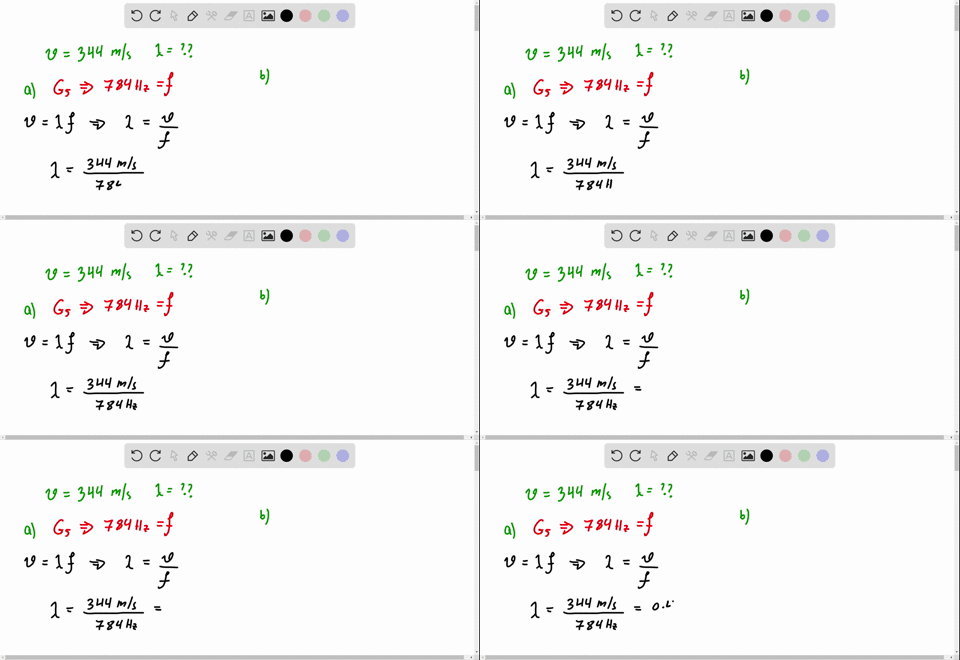
The speed of sound in air at $20^{\circ} \mathrm{C}$ is 344 $\mathrm{m} / \mathrm{s} .$ (a) What is
the wavelength of a sound wave with a frequency of 784 $\mathrm{Hz}$ , corresponding to the note $\mathrm{G}_{5}$ on a piano, and how many milliseconds does each vibration take? (b) What is the wavelength of a sound wave one octave higher than the note in part (a)?

Chapter 15: Mechanical Waves
Noor Aldeen Almusleh
03:12
University Physics with Modern Physics

Audible Sound. Provided the amplitude is sufficiently great, the human ear can respond to longitudinal waves over a range of frequencies from about 20.0 $\mathrm{Hz}$ to about 20.0 $\mathrm{kHz}$ . (a) If you were to mark the beginning of each complete wave pattern with a red dot for the long-wavelength sound and a blue dot for the short-wavelength sound, how far apart would the red dots be, and how far apart would the blue dots be? (b) In reality would adjacent dots in each set be far enough apart for you to easily measure their separation with a meter stick? (c) Suppose you repeated part (a) in water, where sound travels at 1480 $\mathrm{m} / \mathrm{s}$ . How far apart would the dots be in each set? Could you readily measure their separation with a meter stick?

Chapter 15: Mechanical Waves
Noor Aldeen Almusleh
01:57
University Physics with Modern Physics

Tsunami! On December $26,2004,$ a great earthquake occurred off the coast of Sumatra and triggered immense waves (tsunami) that killed some $200,000$ people. Satellites observing these waves from space measured 800 $\mathrm{km}$ from one wave crest to the next and a period between waves of 1.0 hour. What was the speed of these waves in $\mathrm{m} / \mathrm{s}$ and in $\mathrm{km} / \mathrm{h}$ ? Does your answer help you understand why the waves caused such devastation?

Chapter 15: Mechanical Waves
Noor Aldeen Almusleh
01:48
University Physics with Modern Physics

Ultrasound Imaging. Sound having frequencies above the range of human hearing (about $20,000 \mathrm{Hz}$ ) is called ultrasound. Waves above this frequency can be used to penetrate the body and to produce images by reflecting from surfaces. In a typical ultrasound scan, the waves travel through body tissue with a speed of 1500 $\mathrm{m} / \mathrm{s} .$ For a good, detailed image, the wavelength should be no more than 1.0 $\mathrm{mm} .$ What frequency sound is required for a good scan?

Chapter 15: Mechanical Waves
Noor Aldeen Almusleh
05:42
University Physics with Modern Physics

(a) Audible wavelengths. The range of audible frequencies is from about 20 $\mathrm{Hz}$ to $20,000 \mathrm{Hz}$ . What is the range of the wavelengths of audible sound in air? (b) Visible light. The range of visible light extends from 400 $\mathrm{nm}$ to 700 $\mathrm{nm} .$ What is the range of visible frequencies of light? (c) Brain surgery. Surgeons can remove brain tumors by using a cavitron ultrasonic surgical aspirator, which produces sound waves of frequency 23 $\mathrm{kHz}$ . What is the wavelength of these waves in air? (d) Sound in the body. What would be the wavelength of the sound in part (c) in bodily fluids in which the speed of sound is 1480 $\mathrm{m} / \mathrm{s}$ but the frequency is unchanged?

Chapter 15: Mechanical Waves
Noor Aldeen Almusleh
08:08
University Physics with Modern Physics

Transverse waves on a string have wave speed 8.00 $\mathrm{m} / \mathrm{s}$ , amplitude $0.0700 \mathrm{m},$ and wavelength 0.320 $\mathrm{m} .$ The waves travel in the $-x$ -direction, and at $t=0$ the $x=0$ end of the string has its maximum upward displacement. (a) Find the frequency, period,
and wave number of these waves. (b) Write a wave function describing the wave. (c) Find the transverse displacement of a par-ticle at $x=0.360 \mathrm{m}$ at time $t=0.150 \mathrm{s}$ . (d) How much time must elapse from the instant in part (c) until the particle at $x=0.360 \mathrm{m}$ next has maximum upward displacement?

Chapter 15: Mechanical Waves
Noor Aldeen Almusleh
1 2 3 4 5 ... 13