Pahk Thepchatri

Emory University
Special Education Teacher

Biography

Before becoming an educator, my training was in the field of computational drug design. I would work with scientists across other disciplines in the development and testing of potential therapeutic agents for the treatment of cancer and viral-related diseases.

After 7 years in the drug discovery field, I became a sixth grade science teacher. My focus was to encourage my students to own their education. I primarily did this through project-based design where I would introduce a question and ask the students to design a means to answer that question through research, peer discussions, video lectures, and presentation of their work as a final.

I eventually became a special education teacher, first at the high school level, and then at the elementary level. The goal is still the same, to empower students to own the learning through accommodation of their lessons and reinforcement of concepts through the use of digital-based activities.

Education

Phd chemistry
Emory University

Educator Statistics

Numerade tutor for 6 years
89 Students Helped

Topics Covered

Effective Solutions for Your Business Needs
Discover the Wonders of Chemistry: Your Introductory Guide
Atoms, Molecules, and Ions: Understanding the Building Blocks of Matter
Unlocking the Power of Composition: Tips and Techniques
Discover the Wonders of Aromatic Compounds - Unleash Their Power Today!
Unlocking the Power of Chemical Reactions: A Comprehensive Guide
Condensations and Alpha Substitutions of Carbonyl Compounds Explained
Mastering Chemical Reactions and Stoichiometry for Optimal Results

Pahk's Textbook Answer Videos

11:13
Chemistry A Molecular Approach

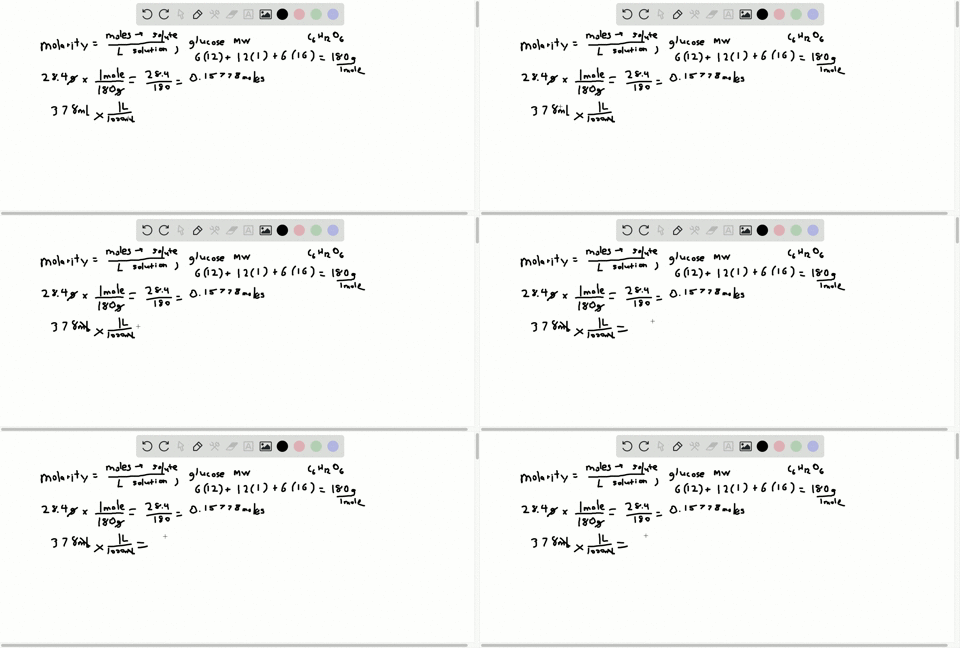
A solution is prepared by dissolving 28.4 $\mathrm{g}$ of glucose $\left(\mathrm{C}_{6} \mathrm{H}_{12} \mathrm{O}_{6}\right)$ in 355 $\mathrm{g}$ of water. The final volume of the solution is 378 $\mathrm{mL} .$ For this solution, calculate the concentration in each unit. $$\begin{array}{ll}{\text { a. molarity }} & {\text { b. molality }} \\ {\text { c. percent by mass }} & {\text { d. mole fraction }} \\ {\text { e. mole percent }}\end{array}$$

Chapter 13: Solutions
Pahk Thepchatri
09:55
Chemistry A Molecular Approach

A solution contains 50.0 $\mathrm{g}$ of heptane $\left(\mathrm{C}_{7} \mathrm{H}_{16}\right)$ and 50.0 $\mathrm{g}$ of octane $\left(\mathrm{C}_{8} \mathrm{H}_{18}\right)$ at $25^{\circ} \mathrm{C}$ The vapor pressures of pure heptane and pure octane at $25^{\circ} \mathrm{C}$ are 45.8 torr and 10.9 torr, respectively. Assuming ideal behavior, answer the following:
$$\begin{array}{l}{\text { a. What is the vapor pressure of each of the solution compo- }} \\ {\text { nents in the mixture? }} \\ {\text { b. What is the total pressure above the solution? }} \\ {\text { c. What is the composition of the vapor in mass percent? }} \\ {\text { d. Why is the composition of the vapor different from the com- }} \\ {\text { position of the solution? }}\end{array}$$

Chapter 13: Solutions
Pahk Thepchatri
08:38
Chemistry A Molecular Approach

A solution contains 4.08 $\mathrm{g}$ of chloroform $\left(\mathrm{CHCl}_{3}\right)$ and 9.29 $\mathrm{g}$ of acetone $\left(\mathrm{CH}_{3} \mathrm{COCH}_{3}\right) .$ The vapor pressures at $35^{\circ} \mathrm{C}$ of pure chloroform and pure acetone are 295 torr and 332 torr, respectively. Assuming ideal behavior, calculate the vapor pressures of each of the components and the total vapor pressure above the solution. The experimentally measured total vapor pressure of the solution at $35^{\circ} \mathrm{C}$ is 312 torr. Is the solution ideal? If not, what can you say about the relative strength of chloroform acetone interactions compared to the acetone-acetone and chloroform-chloroform interactions?

Chapter 13: Solutions
Pahk Thepchatri
06:25
Chemistry A Molecular Approach

A glucose solution contains 55.8 $\mathrm{g}$ of glucose $\left(\mathrm{C}_{6} \mathrm{H}_{12} \mathrm{O}_{6}\right)$ in 455 $\mathrm{g}$ of water. Determine the freezing point and boiling point of the solution.

Chapter 13: Solutions
Pahk Thepchatri
05:57
Chemistry A Molecular Approach

What mass of salt (NaCl) should you add to 1.00 L of water in an ice cream maker to make a solution that freezes at $-10.0^{\circ} \mathrm{C}$ ? Assume complete dissociation of the NaCl and density of
1.00 $\mathrm{g} / \mathrm{mL}$ for water.

Chapter 13: Solutions
Pahk Thepchatri
01:54
Chemistry A Molecular Approach

A 1.2 $\mathrm{m}$ aqueous solution of an ionic compound with the formula $\mathrm{MX}_{2}$ has a boiling point of $101.4^{\circ} \mathrm{C}$ . Calculate the van't Hoff factor $(i)$ for $\mathrm{MX}_{2}$ at this concentration.

Chapter 13: Solutions
Pahk Thepchatri
1 2 3 4 5 ... 15