RK

Rajesh Kumar

Numerade Educator
Subject Matter Expert

Biography

I have a strong academic background in physics and have been authoring Physics questions in chegg-india since last 3 years. For last 6 months I am working at SixRedMarbles, whose client is the CourseHero, as Physics and Mathematics subject matter expert.

Education

Rajesh has not yet added their education credentials.

Educator Statistics

Numerade tutor for 6 years
6 Students Helped

Topics Covered

Find Your Dream Job: Discover the Best Work Opportunities
Unlock the Power of Kinetic Energy: Boost Your Efficiency Today
Unlocking the Power of Potential Energy: Discover the Benefits
Unlock the Secrets of Fluid Mechanics with Our Expert Guide

RAJESH's Textbook Answer Videos

03:58
Physics: Principles with Applications

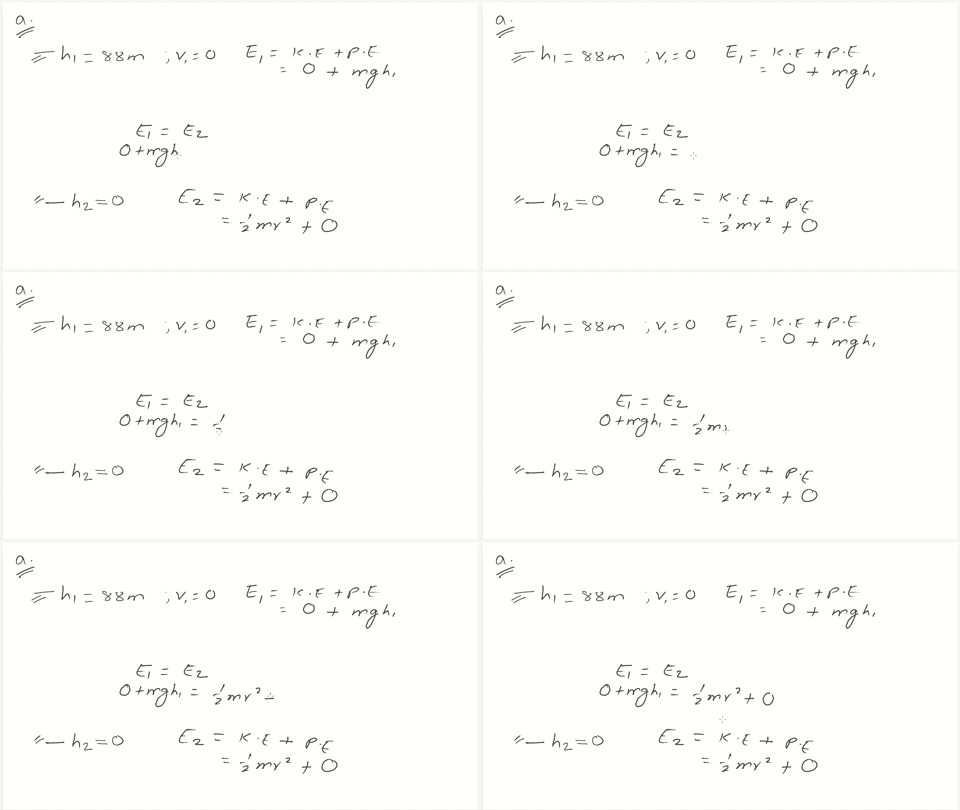
Water flows over a dam at the rate of 680 kg/s and falls vertically 88 m before striking the turbine blades. Calculate ($a$) the speed of the water just before striking the turbine blades (neglect air resistance), and ($b$) the rate at which mechanical energy is transferred to the turbine blades, assuming 55% efficiency.

Chapter 6: WORK AND ENERGY
Rajesh Kumar
02:01
Physics for Scientists and Engineers

Find the order of magnitude of the density of the nucleus of an atom. What does this result suggest concerning the structure of matter? Model a nucleus as protons and neutrons closely packed together. Each has mass $1.67 \times 10^{-27} \mathrm{kg}$ and radius on the order of $10^{-15} \mathrm{m}$

Chapter 14: Fluid Mechanics
Rajesh Kumar
01:24
Physics for Scientists and Engineers

A $50.0-\mathrm{kg}$ woman balances on one hecl of a pair of highheeled shoes. If the heel is circular and has a radius of $0.500 \mathrm{cm},$ what pressure does she exert on the floor?

Chapter 14: Fluid Mechanics
Rajesh Kumar
02:34
Physics for Scientists and Engineers

What is the total mass of the Earth's atmosphere? (The $\mathrm{ra}$ dius of the Earth is $6.37 \times 10^{6} \mathrm{m},$ and atmospheric pressure at the surface is $1.013 \times 10^{5} \mathrm{N} / \mathrm{m}^{2} .$ )

Chapter 14: Fluid Mechanics
Rajesh Kumar
02:30
Physics for Scientists and Engineers

The small piston of a hydraulic lift has a cross-scrional area of $3.00 \mathrm{cm}^{2},$ and its large piston has a cross-sectional area of $\left.200 \mathrm{cm}^{2} \text { (Figure } 14.4\right) .$ What force must be applied to the small piston for the lift to raise a load of $15.0 \mathrm{kN} ?$ (In service stations, this force is usually exerted by compressed air.)

Chapter 14: Fluid Mechanics
Rajesh Kumar
03:28
Physics for Scientists and Engineers

(a) A very powerful vacuum cleaner has a hose $2.86 \mathrm{cm}$ in diameter. With no nozzle on the hose, what is the weight of the heaviest brick that the cleaner can lift? (Fig. P11.10a) (b) What If? A very powerful octopus uses one sucker of diameter $2.86 \mathrm{cm}$ on each of the two shells of a clam in an attempt to pull the shells apart (Fig. P14.10b). Find the greatest force the octopus can exert in salt water $32.3 \mathrm{m}$ deep. Cauliom: Experimental verification can be interesting, but do not drop a brick on your foot. Do not overheat the motor of a vacuum cleaner. Do not get an octopus mad at you.

Chapter 14: Fluid Mechanics
Rajesh Kumar
1