Riley Mankin

University of California, Berkeley
Tutor

Biography

I am currently entering my junior year at UC Berkeley and pursuing a B.S. in Chemical Engineering with a concentration in Business and Management from the College of Chemistry. I worked for two years at a local tutoring company, tutoring high school students in chemistry, math (calculus, statistics, algebra), physics and biology. I really enjoy teaching and helping students in any way I can.

Education

BS Chemical Engineering
University of California, Berkeley

Educator Statistics

Numerade tutor for 6 years
45 Students Helped

Topics Covered

Unlocking the Power of Thermodynamics: A Comprehensive Guide
Exploring the Fascinating World of Thermochemistry | Learn More Today
Discover the Power of Gases: Benefits and Applications
Unlocking the Power of Chemical Reactions: A Comprehensive Guide
Aqueous Equilibria: Understanding the Balance of Solutions

Riley's Textbook Answer Videos

03:41
General Chemistry: Principles and Modern Applications

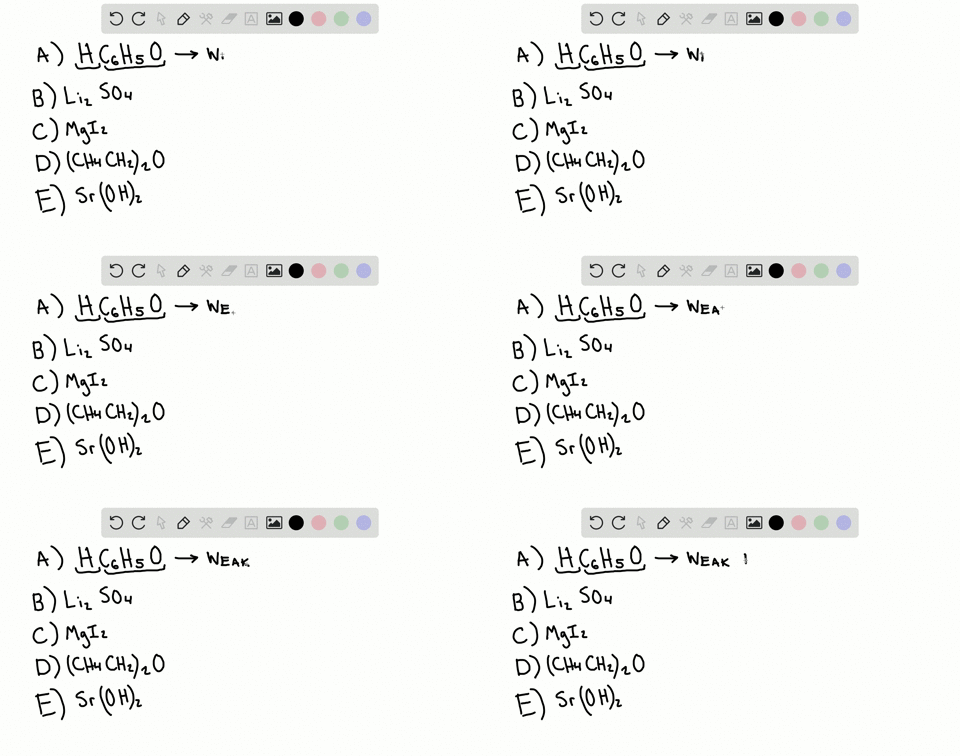
Using information from this chapter, indicate whether each of the following substances in aqueous solution is a nonelectrolyte, weak electrolyte, or strong electrolyte.
(a) $\mathrm{HC}_{6} \mathrm{H}_{5} \mathrm{O} ;$ (b) $\mathrm{Li}_{2} \mathrm{SO}_{4} ;$ (c) $\mathrm{MgI}_{2} ;$ (d) $\left(\mathrm{CH}_{3} \mathrm{CH}_{2}\right)_{2} \mathrm{O}$
(e) $\operatorname{Sr}(\mathrm{OH})_{2}.$

Chapter 5: Introduction to Reactions in Aqueous Solutions
Riley Mankin
02:00
General Chemistry: Principles and Modern Applications

What response would you expect in the apparatus of Figure $5-4$ if the solution tested were $1.0 \mathrm{M} \mathrm{HCl} ?$ What response would you expect if the solution were both $1.0 \mathrm{M} \mathrm{HCl}$ and $1.0 \mathrm{M} \mathrm{CH}_{3} \mathrm{COOH} ?$

Chapter 5: Introduction to Reactions in Aqueous Solutions
Riley Mankin
04:32
General Chemistry: Principles and Modern Applications

Sketches (a-c) are molecular views of the solute in an aqucous solution. For cach of the sketches, indicate whether the solute is a strong, weak, or nonelectrolyte; and which of these substances it is: sodium chloride, propionic acid, hypochlorous acid, ammonia, barium bromide, ammonium chloride, methanol.

Chapter 5: Introduction to Reactions in Aqueous Solutions
Riley Mankin
04:12
General Chemistry: Principles and Modern Applications

Determine the concentration of the ion indicated in each solution. (a) $\left[\mathrm{K}^{+}\right]$ in $0.238 \mathrm{M} \mathrm{KNO}_{3} ;$ (b) $\left[\mathrm{NO}_{3}^{-}\right]$ in $0.167 \mathrm{M} \mathrm{Ca}\left(\mathrm{NO}_{3}\right)_{2} ;(\mathrm{c})\left[\mathrm{Al}^{3+}\right]$ in $0.083 \mathrm{M} \mathrm{Al}_{2}\left(\mathrm{SO}_{4}\right)_{3}.$
(d) $\left[\mathrm{Na}^{+}\right]$ in $0.209 \mathrm{M} \mathrm{Na}_{3} \mathrm{PO}_{4}.$

Chapter 5: Introduction to Reactions in Aqueous Solutions
Riley Mankin
03:07
General Chemistry: Principles and Modern Applications

A solution is prepared by dissolving $0.132 \mathrm{g}$
$\mathrm{Ba}(\mathrm{OH})_{2} \cdot 8 \mathrm{H}_{2} \mathrm{O}$ in $275 \mathrm{mL}$ of water solution. What is $\left[\mathrm{OH}^{-}\right]$ in this solution?

Chapter 5: Introduction to Reactions in Aqueous Solutions
Riley Mankin
1 2 3 4 5 ... 8