Ryan Williams

University of New Hampshire
Student Tutor

Biography

I have been tutoring college level mathematics every semester for the Center For Academic Resources at the University of New Hampshire, to which I am regarded as one of the strongest tutors, since September of 2018. I, specifically, have helped 4 students through college-level Calculus and 3 through college-level Physics and have gained a lot of experience working with trouble students and tough concepts. This opportunity would be a great way for me to be able to work while pursuing my Ph.D. in Medical Physics at the University of Massachusetts Lowell. I will be fully available on the weekend and select weekdays to construct videos.

Education

BS Physics
University of New Hampshire
Phd Medical Physics
University of Massachusetts - Lowell

Educator Statistics

Numerade tutor for 6 years
321 Students Helped

Topics Covered

Stand Out with Differentiation Strategies | Boost Your Business
Unlocking the Power of Functions: Boost Your Programming Skills
Power Series
Differential Equations Made Simple: Expert Tips & Resources
Mastering Second Order Differential Equations: Tips and Techniques
Unlock the Power of Vectors: Discover Their Limitless Possibilities
Master Vector Calculus with Our Comprehensive Guide
Exploring the Wonders of Atomic Physics: A Comprehensive Guide
Discover the Fascinating World of Nuclear Physics
Discover the Fascinating World of Particle Physics Today
Understanding Moment Impulse and Collisions for Better Physics
Introduction and Vectors
Motion in 2d or 3d
Understanding Electric Charge and Field: A Comprehensive Guide

Ryan's Textbook Answer Videos

09:22
University Physics with Modern Physics

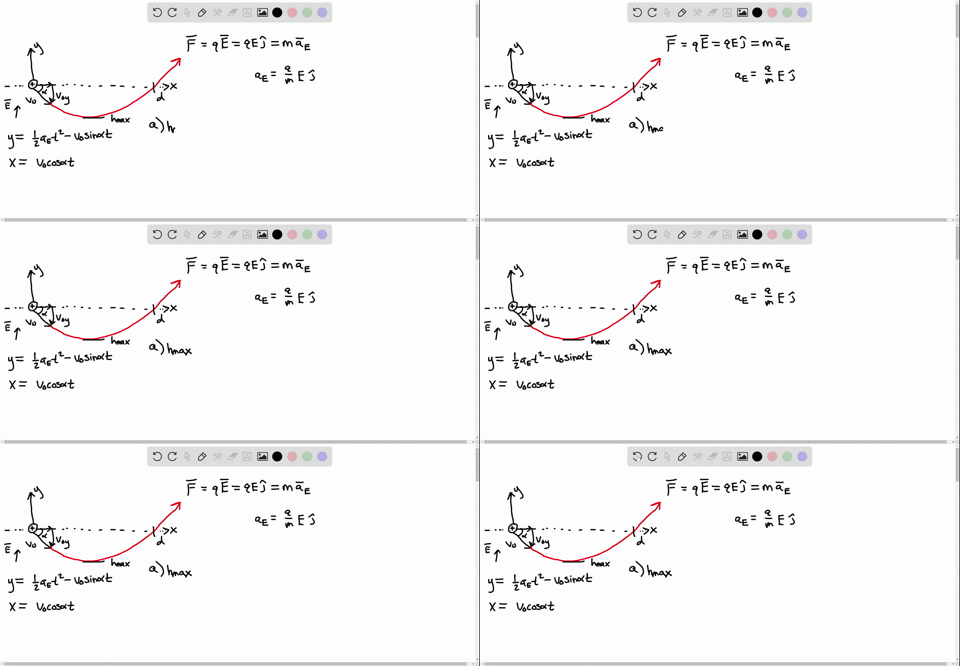
A proton is projected into a uniform electric field that points vertically upward and has magnitude $E$. The initial velocity of the proton has a magnitude $v_0$ and is directed at an angle $\alpha$ below the horizontal. (a) Find the maximum distance $h_{max}$ that the proton descends vertically below its initial elevation. Ignore gravitational forces. (b) After what horizontal distance d does the proton return to its original elevation? (c) Sketch the trajectory of the proton. (d) Find the numerical values of $h_{max}$ and $d$ if $E =$ 500 N$/$C, $v_0 =$ 4.00 $\times 10^5$ m$/$s, and $\alpha =$ 30.0$^\circ$.

Chapter 21: Electric Charge and Electric Field
Ryan Williams
03:09
Calculus Early Transcendentals

$3-32$ Differentiate the function.
$y=\frac{x^{2}-2 \sqrt{x}}{4}$

Chapter 3: Differentiation Rules
Section 1: Derivatives of Polynomials and Exponential Functions
Ryan Williams
02:06
Physics Principles with Applications

(I) A constant friction force of 25 $\mathrm{N}$ acts on a $65-\mathrm{kg}$ skier for 20 $\mathrm{s}$ . What is the skier's change in velocity?

Chapter 7: Linear Momentum
Ryan Williams
01:50
Physics Principles with Applications

(II) A 0.145 -kg baseball pitched at 39.0 $\mathrm{m} / \mathrm{s}$ is hit on a horizontal line drive straight back toward the pitcher at 52.0 $\mathrm{m} / \mathrm{s}$ . If the contact time between bat and ball is $3.00 \times 10^{-3} \mathrm{s}$ , calculate the average force between the ball and bat during contact.

Chapter 7: Linear Momentum
Ryan Williams
02:43
Physics Principles with Applications

(II) A child in a boat throws a 6.40 -kg package out horizontally with a speed of 10.0 $\mathrm{m} / \mathrm{s}$ , Fig. $7-31 .$ Calculate the velocity of the boat immediately after, assuming it was initially at rest. The mass of the child is 26.0 $\mathrm{kg}$ , and that of the boat is 45.0 $\mathrm{kg}$ . Ignore water resistance.

Chapter 7: Linear Momentum
Ryan Williams
02:12
Physics Principles with Applications

(II) Calculate the force exerted on a rocket, given that the propelling gases are expelled at a rate of 1500 $\mathrm{kg} / \mathrm{s}$ with a speed of $4.0 \times 10^{4} \mathrm{m} / \mathrm{s}$ (at the moment of takeoff).

Chapter 7: Linear Momentum
Ryan Williams
1 2 3 4 5 ... 54

Ryan's Quick Ask Videos

09:22
Physics 102 Electricity and Magnetism

A proton is projected into a uniform electric field that points vertically upward and has magnitude $E$. The initial velocity of the proton has a magnitude $v_0$ and is directed at an angle $\alpha$ below the horizontal. (a) Find the maximum distance $h_{max}$ that the proton descends vertically below its initial elevation. Ignore gravitational forces. (b) After what horizontal distance d does the proton return to its original elevation? (c) Sketch the trajectory of the proton. (d) Find the numerical values of $h_{max}$ and $d$ if $E =$ 500 N$/$C, $v_0 =$ 4.00 $\times 10^5$ m$/$s, and $\alpha =$ 30.0$^\circ$.

Ryan Williams
1