TO

Tomi Obadiya

Numerade Educator
Teaching Assistant

Biography

• teach two physics lab sections of 24 students each weekly all through the academic year
• guide students in labs to discover solutions to problems themselves by directing their thought process
• hand out and grade assignments on relevant topics taught to evaluate conceptual understanding and logical reasoning
• attend a weekly two-hour teaching seminar to develop teaching skills
• correspond with students on Blackboard or related inter-campus communication system

Education

Tomi has not yet added their education credentials.

Educator Statistics

Numerade tutor for 6 years
21 Students Helped

Topics Covered

Motion in 2d or 3d
Discovering the Fundamentals: Newton's Laws of Motion Explained
Electromagnetic Induction: Understanding the Science and Applications
Understanding Inductance: A Comprehensive Guide

Tomi's Textbook Answer Videos

39:01
University Physics with Modern Physics

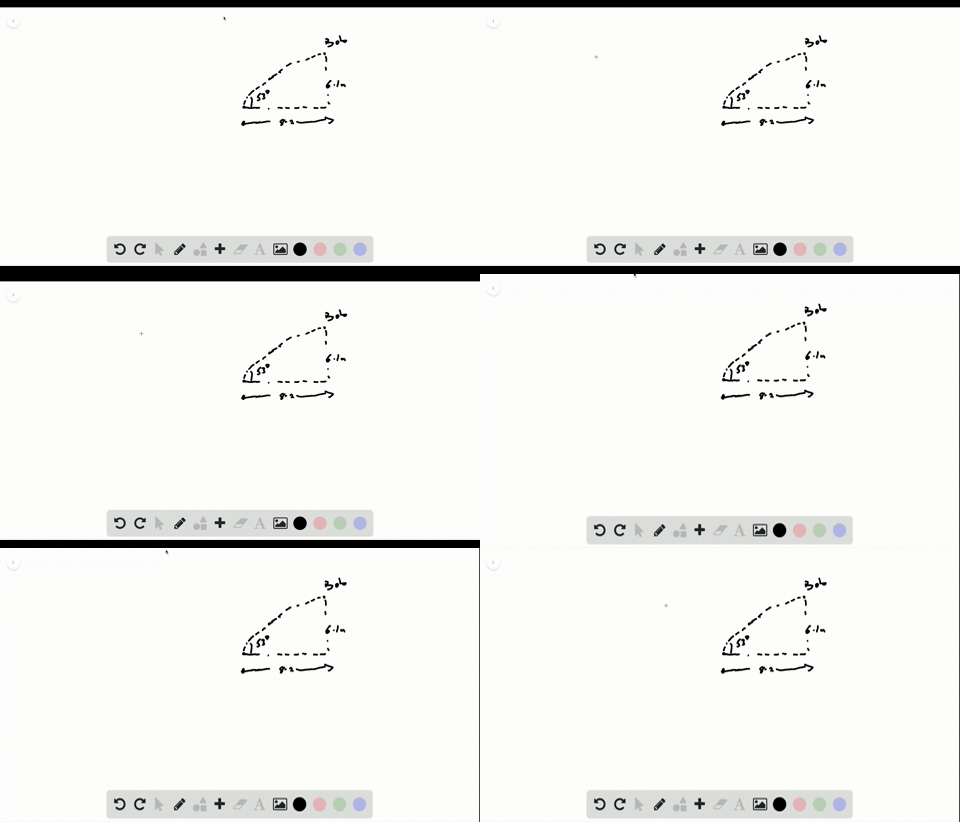
A new circus act is called the Texas Tumblers. Lovely Mary Belle swings from a trapeze, projects herself at an angle of $53^{\circ},$ and is supposed to be caught by Joe Bob, whose hands are 6.1 $\mathrm{m}$ above and 8.2 m horizontally from her launch point (Fig. P3.66). You can ignore air resistance. (a) What initial speed $v_{0}$ must Mary Belle have just to reach Joe Bob? (b) For the initial speed calculated in part (a), what are the magnitude and direction of her velocity when Mary Belle reaches Joe Bob? (c) Assuming that Mary Belle has the initial speed calculated in part (a), draw $x$ -t, $y-t, v_{x}-t,$ and $v_{y}-t$ graphs showing the motion of both tumblers. Your graphs should show the motion up until the point where Mary Belle reaches Joe Bob.(d) The night of their debut performance, Joe Bob misses her completely as she flies past. How far horizontally does Mary Belle travel, from her initial launch point, before landing in the safety net 8.6 m below her starting point?

Chapter 3: Motion in Two or Three Dimensions
Tomi Obadiya
03:28
Physics

A 0.085-T magnetic field passes through a circular ring of radius 4.1 $\mathrm{cm}$ at an angle of $22^{\circ}$ with the normal. Find the magnitude of the magnetic flux through the ring.

Chapter 23: Magnetic Flux and Faraday's Law of Inductic
Tomi Obadiya
04:47
Physics

A uniform magnetic field of 0.0250 T points vertically upward. Find the magnitude of the magnetic flux through each of the five sides of the open-topped rectangular box shown in FIGURE 23-31, given that the dimensions of the box are $L=32.5 \mathrm{cm}, W=12.0 \mathrm{cm},$ and $H=10.0 \mathrm{cm}.$

Chapter 23: Magnetic Flux and Faraday's Law of Inductic
Tomi Obadiya
03:12
Physics

A magnetic field is oriented at an angle of $67^{\circ}$ to the normal of a rectangular area 5.9 $\mathrm{cm}$ by 7.8 $\mathrm{cm} .$ If the magnetic flux through this surface has a magnitude of $4.8 \times 10^{-5} \mathrm{T} \cdot \mathrm{m}^{2},$ what is the strength of the magnetic field?

Chapter 23: Magnetic Flux and Faraday's Law of Inductic
Tomi Obadiya
02:27
Physics

MRI Solenoid The magnetic field produced by an MRI solenoid 2.5 $\mathrm{m}$ long and 1.2 $\mathrm{m}$ in diameter is 1.7 $\mathrm{T}$ . Find the magnitude of the magnetic flux through the core of this solenoid.

Chapter 23: Magnetic Flux and Faraday's Law of Inductic
Tomi Obadiya
03:39
Physics

Find the magnitude of the magnetic flux through the floor of a house that measures 22 $\mathrm{m}$ by 18 $\mathrm{m} .$ Assume that the Earth's magnetic field at the location of the house has a horizontal component of $2.6 \times 10^{-5} \mathrm{T}$ pointing north, and a downward vertical component of $4.2 \times 10^{-5} \mathrm{T}.$

Chapter 23: Magnetic Flux and Faraday's Law of Inductic
Tomi Obadiya
1 2 3 4