Yanlian Xin

Michigan State University
Springboard International Bilingual School

Biography

I am a physics teacher with excellent analytical and quantitative skills to tackle physics problems. I have experience in teaching Undergraduate Physics Labs, Middle School Physics, and SAT Physics. My personal mission is to use my resourcefulness and intelligence to help students find the best path to achieve their goals.

Education

MS Physics
Michigan State University

Educator Statistics

Numerade tutor for 6 years
67 Students Helped

Topics Covered

Find Your Dream Job: Discover the Best Work Opportunities
Unlock the Power of Kinetic Energy: Boost Your Efficiency Today
Save Energy and Money with Effective Conservation Techniques
Calculating Electrical Power: Resistance and EMF
Electromagnetic Induction: Understanding the Science and Applications
Understanding Inductance: A Comprehensive Guide
Understanding Electric Charge and Field: A Comprehensive Guide
Understanding Gauss's Law: A Comprehensive Guide
Unlocking the Power of Electric Potential: Exploring its Benefits
Capacitance and Dielectrics: Understanding the Basics
Motion in 2d or 3d
Discovering the Fundamentals: Newton's Laws of Motion Explained

Yanlian's Textbook Answer Videos

01:22
University Physics with Modern Physics

Two crickets, Chirpy and Milada, jump from the top of a vertical cliff. Chirpy just drops and reaches the ground in 3.50 s, while Milada jumps horizontally with an initial speed of 95.0 $\mathrm{cm} / \mathrm{s} .$ How far from the base of the cliff will Milada hit the ground?

Chapter 3: Motion in Two or Three Dimensions
Yanlian Xin
05:26
Cracking The AP Physics 1 Exam

As a rock of mass 4 kg drops from the edge of a 40-meter-high cliff, it experiences air resistance, whose average strength during the descent is 20 N. At what speed will the rock hit the ground?
(A) 10 $\mathrm{m} / \mathrm{s}$
(B) 12 $\mathrm{m} / \mathrm{s}$
(C) 16 $\mathrm{m} / \mathrm{s}$
(D) 20 $\mathrm{m} / \mathrm{s}$

Chapter 5: Work, Energy, and Power
Yanlian Xin
02:09
Physics for Scientists and Engineers with Modern Physics

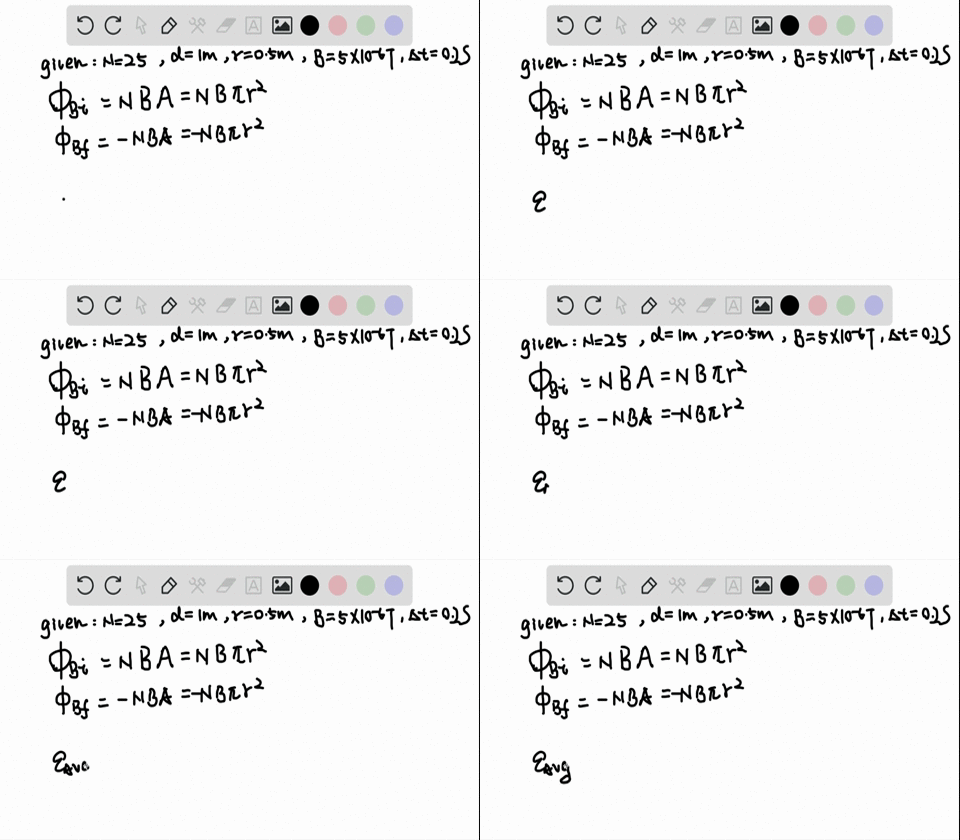
A 25 -turn circular coil of wire has diameter 1.00 $\mathrm{m}$ . It is placed with its axis along the direction of the Earth's magnetic field of 50.0$\mu \mathrm{T}$ and then in 0.200 $\mathrm{s}$ is flipped $180^{\circ} . \mathrm{An}$ average emf of what magnitude is generated in the coil?

Chapter 31: Faraday’s Law
Yanlian Xin
01:32
Physics for Scientists and Engineers with Modern Physics

A circular loop of wire of radius 12.0 $\mathrm{cm}$ is placed in a magnetic field directed perpendicular to the plane of the loop as in Figure $\mathrm{P} 31.3 .$ If the field decreases at the rate of 0.0500 $\mathrm{T} / \mathrm{s}$ in some time interval, find the magnitude of the emf induced in the loop during this interval.

Chapter 31: Faraday’s Law
Yanlian Xin
02:23
Physics for Scientists and Engineers with Modern Physics

A strong electromagnet produces a uniform magnetic field of 1.60 T over a cross-sectional area of $0.200 \mathrm{m}^{2} .$ A coil having 200 turns and a total resistance of 20.0$\Omega$ is placed around the electromagnet. The current in the electromagnet is then smoothly reduced until it reaches zero in 20.0 ms. What is the current induced in the coil?

Chapter 31: Faraday’s Law
Yanlian Xin
03:49
Physics for Scientists and Engineers with Modern Physics

Scientific work is currently underway to determine whether weak oscillating magnetic fields can affect human health. For example, one study found that drivers of trains had a higher incidence of blood cancer than other railway workers, possibly due to long exposure to mechanical devices in the train engine cab. Consider a magnetic field of magnitude $1.00 \times 10^{-3} \mathrm{T}$ , oscillating sinusoidally at 60.0 $\mathrm{Hz}$ . If the diameter of a red blood cell is $8.00 \mu \mathrm{m},$ determine the maximum emf that can be generated around the perimeter of a cell in this field.

Chapter 31: Faraday’s Law
Yanlian Xin
1 2 3 4 5 ... 11