CG

Cameron Geisler

Numerade Educator
Private tutor

Biography

I am a private tutor and I have interests in teaching mathematics. I am just about to finish my undergraduate math degree in the honours program at my school. As a student, I have previously created math instructional videos on my YouTube channel:
https://www.youtube.com/channel/UCjSNDoNg6g93eePUACTOuew
I'm interested in getting back into this style of video instruction.

Education

Cameron has not yet added their education credentials.

Educator Statistics

Numerade tutor for 5 years
8 Students Helped

Topics Covered

Maximizing Accuracy with Effective Sampling and Data Analysis
Unlocking Insights with Descriptive Statistics: A Comprehensive Guide
Unlocking Insights with Data Description: The Key to Effective Analysis
Mastering Exponential and Logarithmic Functions: Your Ultimate Guide
Mastering Equations and Inequalities: Your Guide to Mathematical Success
Solving Systems of Equations and Inequalities: A Comprehensive Guide
Functions

Cameron's Textbook Answer Videos

02:27
Precalculus

Work each problem.
Show that $\frac{\sqrt{2}}{2}+\frac{\sqrt{2}}{2} i$ is a square root of $i$

Chapter 1: Equations and Inequalities
Section 3: Complex Numbers
Cameron Geisler
03:00
Precalculus

Work each problem.
Show that $\frac{\sqrt{3}}{2}+\frac{1}{2} i$ is a cube root of $i$

Chapter 1: Equations and Inequalities
Section 3: Complex Numbers
Cameron Geisler
01:05
Precalculus

Apply the properties of logarithms to simplify each expression. Do not use a calculator.
$$8^{\log _{8} 5}$$

Chapter 3: Exponential and Logarithmic Functions
Section 3: Properties of Logarithms
Cameron Geisler
12:11
Applied Calculus For Business, Economics, and Finance

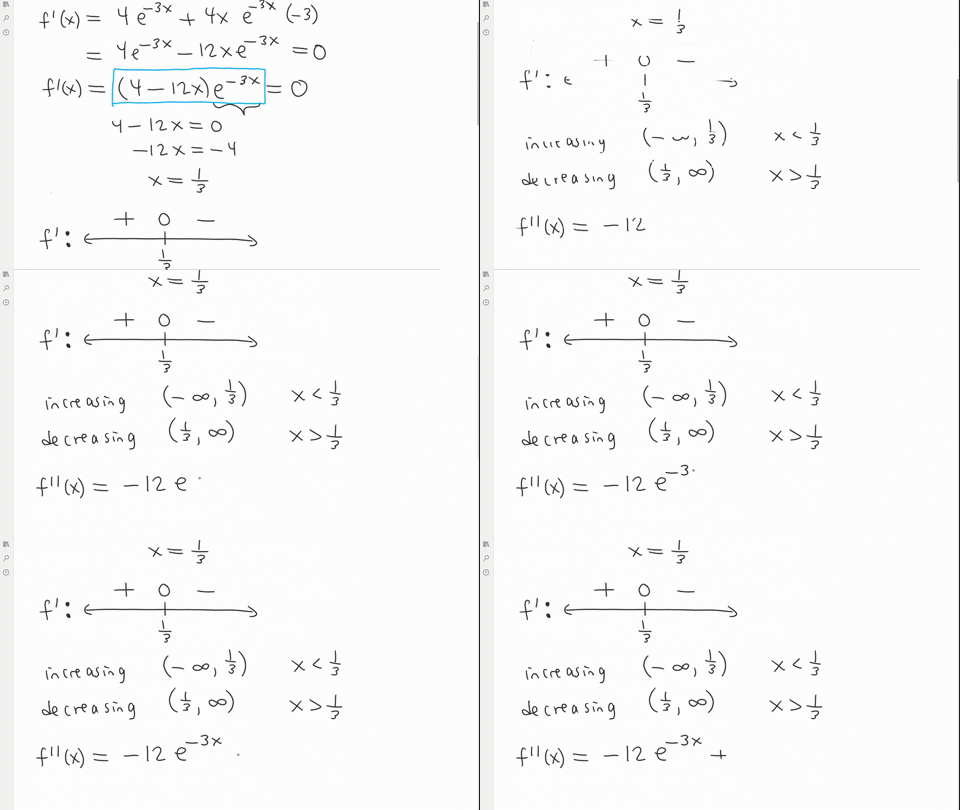
Given the function defined by the equation $f(x)=4 x e^{-3 x},$ (a) Determine on which intervals the function is (a) increasing and decreasing, (b) concave upward and downward, (c) determine any relative extrema (d) Sketch the graph.
(e) What, if any, are the extrema of the function?

Chapter 4: Exponential and Logarithmic Functions
Section 4: The Derivative of the Exponential Function
Cameron Geisler
05:06
Applied Calculus For Business, Economics, and Finance

Find the area of the triangle formed by the $x$ -axis and the tangent lines to the curves $y=e^{a x}$ and $y=e^{-a x}$ at the point where $x=0$, where $a$ is a constant.

Chapter 4: Exponential and Logarithmic Functions
Section 4: The Derivative of the Exponential Function
Cameron Geisler
1 2