Carolyn Shasha

Brown University

Biography

Carolyn has not yet added a biography.

Education

BA Physics
Brown University
MS Physics
University of Washington
Phd Physics
University of Washington

Educator Statistics

Numerade tutor for 7 years
91 Students Helped

Topics Covered

Mastering the Rotation of Rigid Bodies: Tips & Techniques
Explore the Fascinating Dynamics of Rotational Motion
Understanding Equilibrium and Elasticity: A Comprehensive Guide
Unlocking the Power of Magnetic Fields and Forces
Discovering the Sources of Magnetic Fields: A Comprehensive Guide
Electromagnetic Induction: Understanding the Science and Applications
Understanding Inductance: A Comprehensive Guide
Discovering the Fundamentals: Newton's Laws of Motion Explained
Mastering Newton's Laws: Tips for Applying Them Effectively

Carolyn's Textbook Answer Videos

09:47
University Physics with Modern Physics

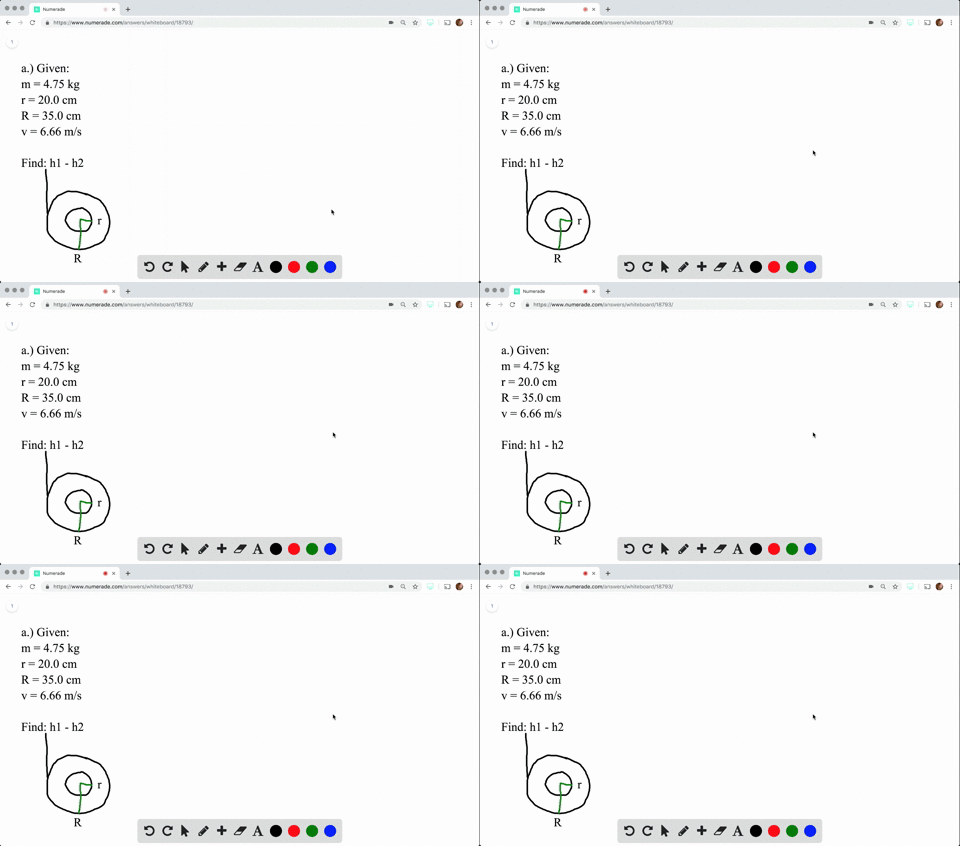
A thin, light string is wrapped around the outer rim of a uniform hollow cylinder of mass 4.75 kg having inner and outer radii as shown in $\textbf{Fig. E10.25.}$ The cylinder is then released from
rest. (a) How far must the cylinder fall before its center is moving at 6.66 m/s? (b) If you just dropped this cylinder without any string, how fast would its center be moving when it had fallen the distance in part (a)? (c) Why do you get two different answers when the cylinder falls the same distance in both cases?
Figure E10.25
(CAN'T COPY THE FIGURE)

Chapter 10: Dynamics of Rotational Motion
Section 3: Rigid-Body Rotation About a Moving Axis
Carolyn Shasha
05:53
University Physics with Modern Physics

A short current element $\overrightarrow{dl}$ S = (0.500 mm)$\hat{\imath}$ carries a current of 5.40 A in the same direction as $\overrightarrow{dl}$. Point P is located at $\overrightarrow{r} =$ (-0.730 m)$\hat{\imath}$ + (0.390 m)$\hat{k}$ . Use unit vectors to express the magnetic field at $P$ produced by this current element.

Chapter 28: Sources of Magnetic Field
Section 2: Magnetic Field of a Current Element
Carolyn Shasha
05:06
University Physics with Modern Physics

Two parallel wires are 5.00 cm apart and carry currents in opposite directions, as shown in $\textbf{Fig. E28.12}$. Find the magnitude and direction of the magnetic field at point $P$ due to two 1.50-mm segments of wire that are opposite each other and each 8.00 cm from $P$.

Chapter 28: Sources of Magnetic Field
Section 2: Magnetic Field of a Current Element
Carolyn Shasha
04:02
University Physics with Modern Physics

A square wire loop 10.0 cm on each side carries a clockwise current of 8.00 A. Find the magnitude and direction of the magnetic field at its center due to the four 1.20-mm wire segments at the midpoint of each side.

Chapter 28: Sources of Magnetic Field
Section 2: Magnetic Field of a Current Element
Carolyn Shasha
02:21
University Physics with Modern Physics

A very long, straight horizontal wire carries a current such that 8.20 $\times$ 10$^{18}$ electrons per second pass any given point going from west to east. What are the magnitude and direction of the magnetic field this wire produces at a point 4.00 cm directly above it?

Chapter 28: Sources of Magnetic Field
Section 3: Magnetic Field of a Straight Current-Carrying Conductor
Carolyn Shasha
02:49
University Physics with Modern Physics

Certain bacteria (such as $Aquaspirillum$ $magnetotacticum$) tend to swim toward the earth's geographic north pole because they contain tiny particles, called magnetosomes, that are sensitive to a magnetic field. If a transmission line carrying 100 A is laid underwater, at what range of distances would the magnetic field from this line be great enough to interfere with the migration of these bacteria? (Assume that a field less than 5$\%$ of the earth's field would have little effect on the bacteria. Take the earth's field to be 5.0 $\times$ 10$^{-5}$ T, and ignore the effects of the seawater.)

Chapter 28: Sources of Magnetic Field
Section 3: Magnetic Field of a Straight Current-Carrying Conductor
Carolyn Shasha
1 2 3 4 5 ... 15