Chris Dimenichi

Lehigh University

Biography

Chris has not yet added a biography.

Education

Chris has not yet added their education credentials.

Educator Statistics

Numerade tutor for 7 years
21 Students Helped

Topics Covered

Find Your Dream Job: Discover the Best Work Opportunities
Unlock the Power of Kinetic Energy: Boost Your Efficiency Today
Master the Fundamentals of Physics: Learn Physics Basics
Motion in 2d or 3d

Chris's Textbook Answer Videos

14:36
University Physics with Modern Physics

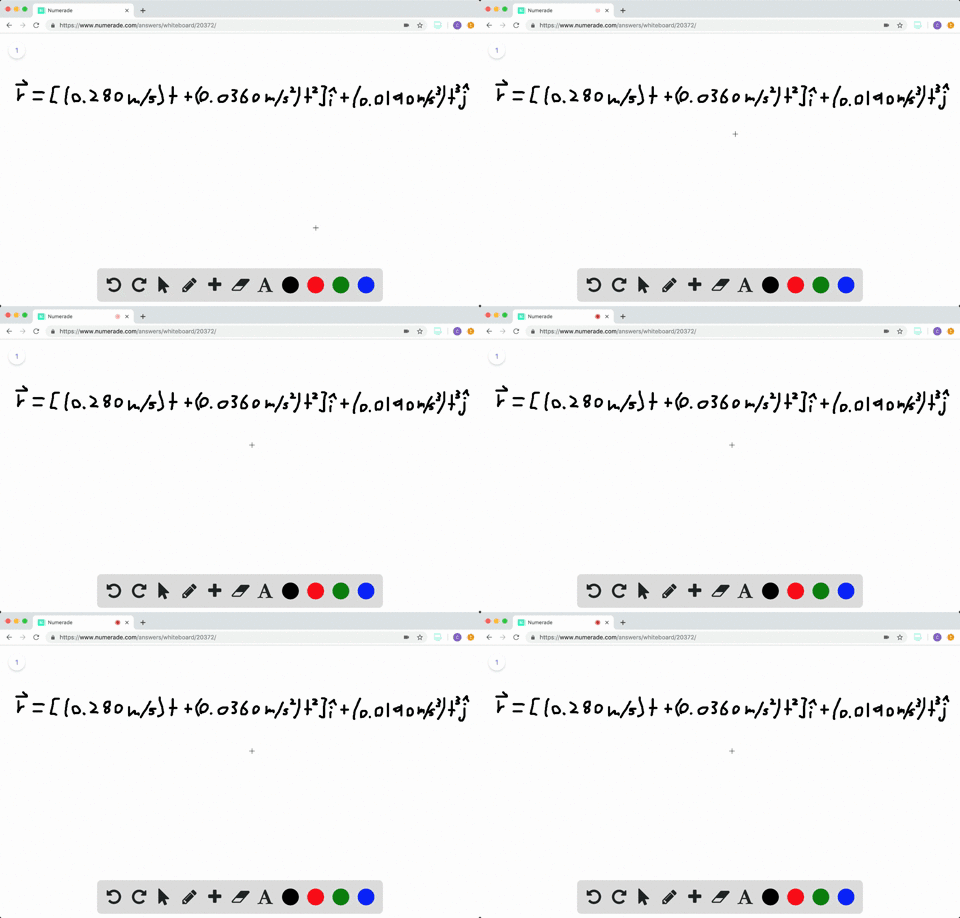
CALC The position of a squirrel running in a park is given by $\vec{r}= [(0.280 m/s)t + (0.0360 m/s^2)t^2] \hat{\imath}+(0.0190 m/s^3)t^3\hat{\jmath}$. (a) What are $v_x(t)$ and $v_y(t)$, the $x$- and $y$-components of the velocity of the squirrel, as functions of time? (b) At $t$ = 5.00 s, how far is the squirrel from its initial position? (c) At $t$ = 5.00 s, what are the magnitude and direction of the squirrel's velocity?

Chapter 3: Motion in Two or Three Dimensions
Section 1: Position and Velocity Vectors
Chris Dimenichi
16:12
University Physics with Modern Physics

A dog running in an open field has components of velocity $v_x$ = 2.6 m/s and $v_y$ = -1.8 m/s at $t_1$ = 10.0 s. For the time interval from $t_1$ = 10.0 s to $t_2$ = 20.0 s, the average acceleration of the dog has magnitude 0.45 m/s$^2$ and direction 31.0$^\circ$ measured from the +$x$-axis toward the +$y$-axis. At $t_2$ = 20.0 s, (a) what are the $x$- and $y$-components of the dog's velocity? (b) What are the magnitude and direction of the dog's velocity? (c) Sketch the velocity vectors at $t_1$ and $t_2$. How do these two vectors differ?

Chapter 3: Motion in Two or Three Dimensions
Section 2: The Acceleration Vector
Chris Dimenichi
14:28
University Physics with Modern Physics

CALC A remote-controlled car is moving in a vacant parking lot. The velocity of the car as a function of time is given by $\hat{v} =[5.00 m/s - (0.0180 m/s^3)t^2] \hat{\imath} = [2.00 m/s + (0.550 m/s^2)t]\hat{j}$. (a) What are $a_x(t)$ and $a_y(t)$, the $x$- and $y$-components of the car's velocity as functions of time? (b) What are the magnitude and direction of the car's velocity at $t$ = 8.00 s? (b) What are the magnitude and direction of the car's acceleration at $t$ = 8.00 s?

Chapter 3: Motion in Two or Three Dimensions
Section 2: The Acceleration Vector
Chris Dimenichi
06:20
University Physics with Modern Physics

A daring 510-N swimmer dives off a cliff with a running horizontal leap, as shown in $Fig. E3.10$. What must her minimum speed be just as she leaves the top of the cliff so that she will miss the ledge at the bottom, which is 1.75 m wide and 9.00 m below the top of the cliff?
(Figure can't copy)Fig. E3.10

Chapter 3: Motion in Two or Three Dimensions
Section 3: Projectile Motion
Chris Dimenichi
33:52
University Physics with Modern Physics

A rookie quarterback throws a football with an initial upward velocity component of 12.0 m/s and a horizontal velocity component of 20.0 m/s. Ignore air resistance. (a) How much time is required for the football to reach the highest point of the trajectory? (b) How high is this point? (c) How much time (after it is thrown) is required for the football to return to its original level? How does this compare with the time calculated in part (a)? (d) How far has the football traveled horizontally during this time? (e) Draw $x-t, y-t, v_x-t$, and $v_y-t$ graphs for the motion.

Chapter 3: Motion in Two or Three Dimensions
Section 3: Projectile Motion
Chris Dimenichi
19:16
University Physics with Modern Physics

The froghopper, $Philaenus$ $spumarius$, holds the world record for insect jumps. When leaping at an angle of 58.0$^\circ$ above the horizontal, some of the tiny critters have reached a maximum height of 58.7 cm above the level ground. (See $Nature$, Vol. 424, July 31, 2003, p. 509.) (a) What was the takeoff speed for such a leap? (b) What horizontal distance did the froghopper cover for this world-record leap?

Chapter 3: Motion in Two or Three Dimensions
Section 3: Projectile Motion
Chris Dimenichi
1 2 3 4