04:05
Chemistry Principles and Reactions
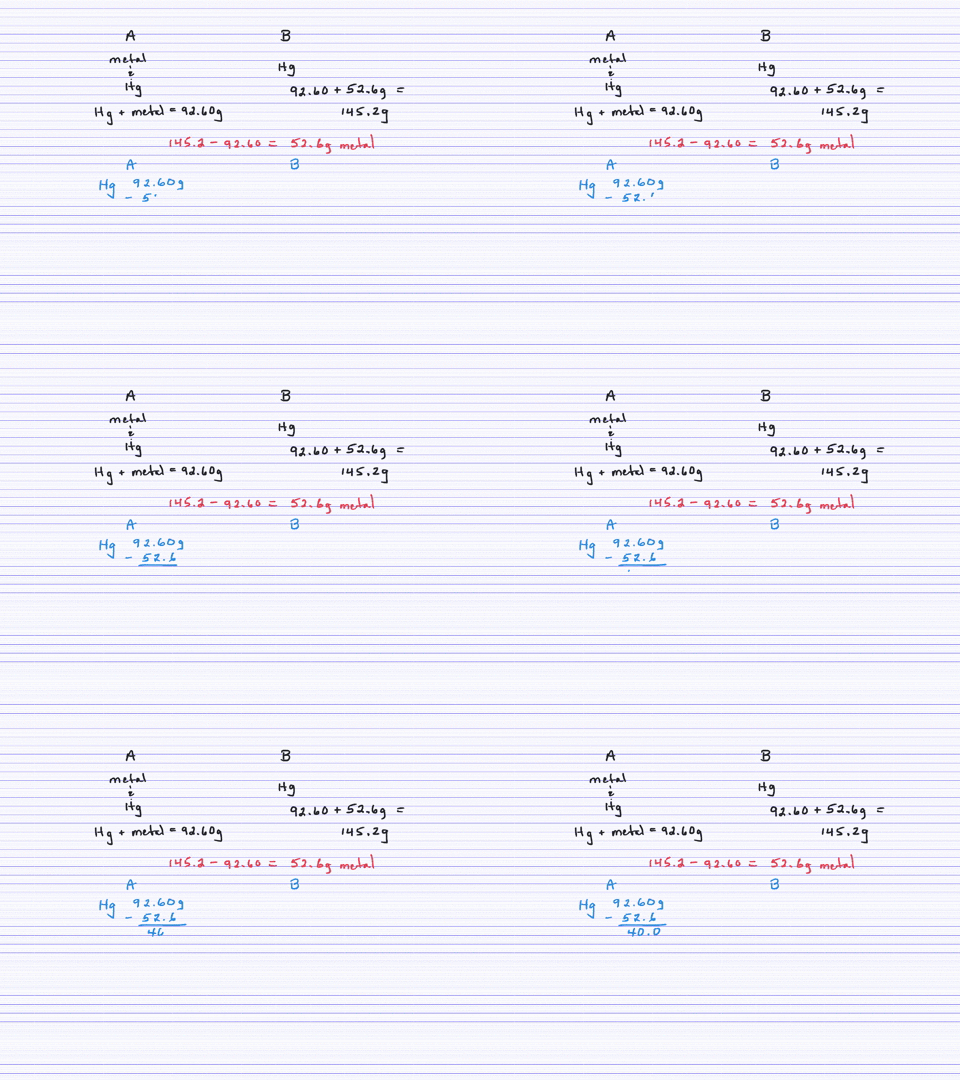
A student determines the density of a metal by taking two cylinders of equal mass and volume. Cylinder $\mathrm{A}$ is filled with mercury and the metal. The mercury and metal together have a mass of 92.60 g. Cylinder $B$ is filled only with mercury. The mass of the mercury in cylinder $\mathrm{B}$ is $52.6 \mathrm{~g}$ more than the mass of mercury and metal in cylinder A. What is the density of the metal? The density of mercury is $13.6 \mathrm{~g} / \mathrm{cm}^{3}$