ER

Ethan Renner

Boston College
ACE tutoring

Biography

My name is Ethan Renner and I'm currently a sophomore at Boston College pursuing a degree in economics. In addition to economics, I'm aiming to complete minors in finance and film studies, and I have a passion for photography and video editing. I enjoy playing basketball, and fishing is one of my favorite hobbies. In regards to economics, I took AP Macro in high school and have completed intermediate level college courses in both macro and microeconomics, as well as statistics.

Education

BA Economics
Boston College

Educator Statistics

Numerade tutor for 5 years
9 Students Helped

Topics Covered

The Economics of Public Sector: Understanding Government Spending
Understanding Firm Behavior and Industry Organization

Ethan's Textbook Answer Videos

03:30
Principles of Microeconomics

Before selling anyone a health insurance policy, the
Kramer Insurance Company requires that applicants
undergo a medical examination. Those with signifi-
cant preexisting medical problems are charged more.
This is an example of
a. moral hazard.
b. adverse selection.
c. signaling.
d. screening.

Chapter 22: Frontiers of Microeconomics
Ethan Renner
03:36
Economics Principles, Problems, and Policies

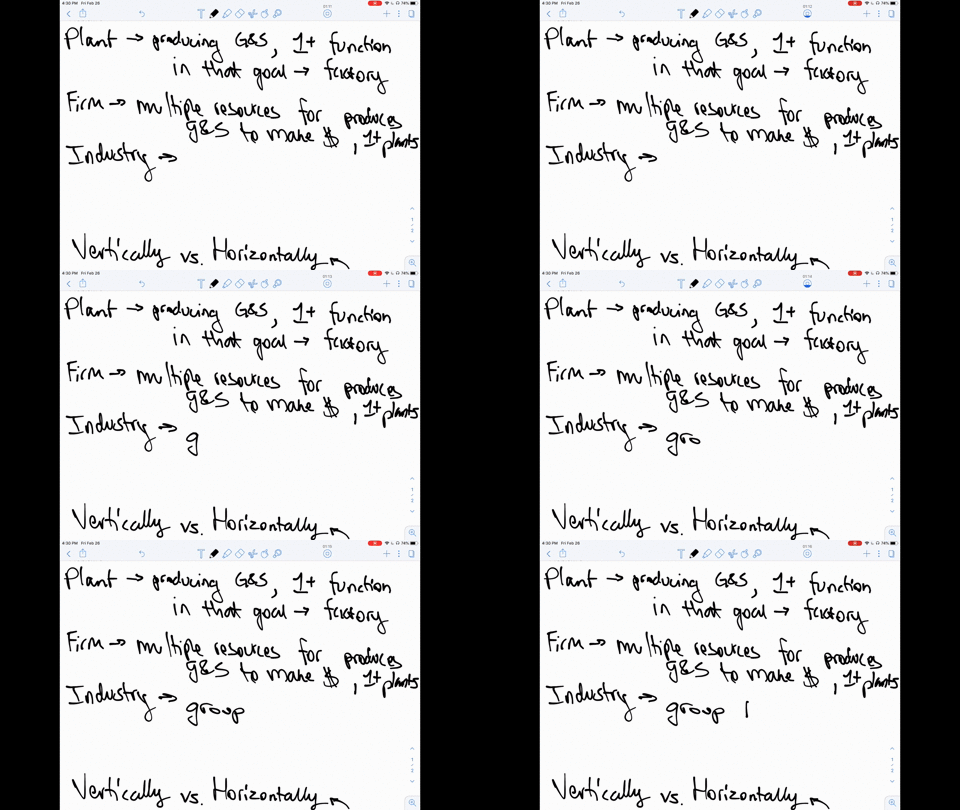
Distinguish between a plant, a firm, and an industry. Contrast a vertically integrated firm, a horizontally integrated firm, and a conglomerate. Cite an example of a horizontally integrated firm from which you have recently made a purchase.

Chapter 4: The U.S. Economy: Private and Public Sectors
Ethan Renner
02:57
Economics Principles, Problems, and Policies

What are the three major legal forms of business organization? Which form is the most prevalent in terms of numbers? Why do you think that is so? Which form is dominant in terms of total sales? What major advantages of this form of business organization gave rise to its dominance?

Chapter 4: The U.S. Economy: Private and Public Sectors
Ethan Renner
02:21
Economics Principles, Problems, and Policies

What is the principal-agent problem as it relates to managers and stockholders? How did firms try to solve it in the $1990 \mathrm{s}$ ? In what way did the "solution" backfire on some firms?

Chapter 4: The U.S. Economy: Private and Public Sectors
Ethan Renner
03:10
Economics Principles, Problems, and Policies

Use the circular flow diagram to show how each of the following government actions simultaneously affects the allocation of resources and the distribution of income:
a. The construction of a new high school.
b. A 2 -percentage-point reduction of the corporate income
tax.
c. An expansion of preschool programs for disadvantaged children.
d. The levying of an excise tax on polluters.

Chapter 4: The U.S. Economy: Private and Public Sectors
Ethan Renner
02:11
Economics Principles, Problems, and Policies

What do economists mean when they say government purchases are "exhaustive" expenditures whereas government transfer payments are "non-exhaustive" expenditures? Cite an example of a government purchase and a government transfer payment.

Chapter 4: The U.S. Economy: Private and Public Sectors
Ethan Renner
1 2