I have a passion to share and transfer knowledge to others. I hope to inspire and produce an even passion in people, who would go on to come up with even better solutions, to our world's problems.
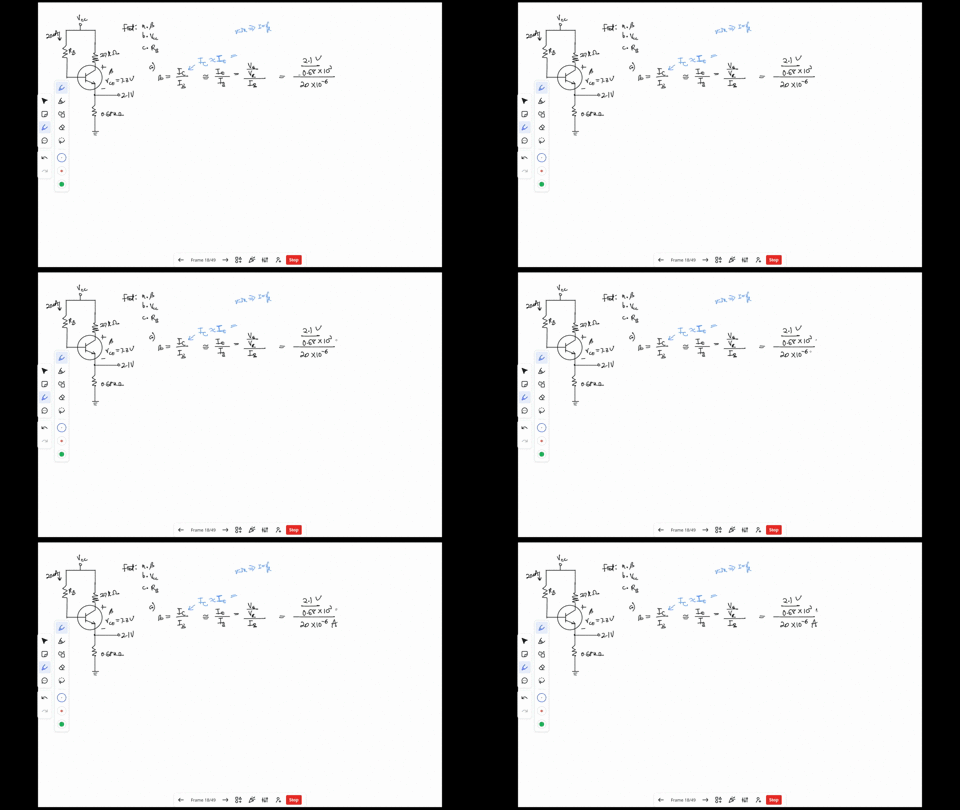
Given the information provided in Fig. 124 , determine:a. $\beta$b. $V_{C C}$$\mathbf{c} . R_{B}$
Each of the following problems describes an algorithm implemented on a computer satisfying the axioms (13.5) and $(13.7) .$ For each one, state whether the algorithm is backward stable, stable but not backward stable, or unstable, and prove it or at least give a reasonably convincing argument. Besure to follow the definitions as given in the text.(a) Data: $x \in \mathbb{C} .$ Solution: $2 x,$ computed as $x \oplus x$(b) Data: $x \in \mathbb{C}$. Solution: $x^{2},$ computed as $x \otimes x$(c) Data: $x \in \mathbb{C} \backslash\{0\} .$ Solution: $1,$ computed as $x \oplus x .$ (A machine satisfying (13.6) will give exactly the right answer, but our definitions are based on the weaker condition $(13.7) .)$(d) Data: $x \in \mathbb{C}$. Solution: $0,$ computed as $x \ominus x .$ (Again, a real machine may do better than our definitions based on $(13.7) .)$(e) Data: none. Solution: $e,$ computed by summing $\sum_{k=0}^{\infty} 1 / k !$ from left to right using $\otimes$ and $\oplus,$ stopping when a summand is reached of magnitude$<\epsilon_{\text {machine }}$(f) Data: none. Solution: $e,$ computed by the same algorithm as above except with the series summed from right to left. (g) Data: none. Solution: $\pi,$ computed by doing an exhaustive search to find the smallest floating point number $x$ in the interval [3,4] such that $s(x) \otimes$ $s\left(x^{\prime}\right) \leq 0 .$ Here $s(x)$ is an algorithm that calculates $\sin (x)$ stably in the given interval, and $x^{\prime}$ denotes the next floating point number after $x$ in the floating point system.
In each of the following situations, indicate whether $f=O(g),$ or $f=\Omega(g),$ or both (in which case $f=\Theta(g))$
Show that, if $c$ is a positive real number, then $g(n)=1+c+c^{2}+\dots+c^{n}$ is:(a) $\Theta(1)$ if $c<1$(b) $\Theta(n)$ if $c=1$(c) $\Theta\left(c^{n}\right)$ if $c>1$The moral: in big- - $\Theta$ terms, the sum of a geometric series is simply the first term if the series is strictly decreasing, the last term if the series is strictly increasing, or the number of terms if the series is unchanging.
The Fibonacci numbers $F_{0}, F_{1}, F_{2}, \ldots,$ are defined by the rule\[F_{0}=0, F_{1}=1, F_{n}=F_{n-1}+F_{n-2}\]In this problem we will confirm that this sequence grows exponentially fast and obtain some bounds on its growth.(a) Use induction to prove that $F_{n} \geq 2^{0.5 n}$ for $n \geq 6$(b) Find a constant $c<1$ such that $F_{n} \leq 2^{c n}$ for all $n \geq 0 .$ Show that your answer is correct.(c) What is the largest $c$ you can find for which $F_{n}=\Omega\left(2^{\circ n}\right) ?$
You are the manager of BARNIS, a toy manufacturing company. The cost function for your remote control cars is C(x) = 0.25x^2 + 96x + 800 dollars per day, where x is the number of remote control cars you manufacture per day, up to a maximum of 3,000 cars per day.
How many remote control cars should you build to minimize the average cost?
a) Determine the objective function (in terms of x): Average cost = ________
b) The derivative of the objective function is equal to _________
c) Stationary point at: x = _________ (Exact to 2 decimal places)
d) Therefore, you must make ________ remote control cars per day for a minimum average cost of $_________ per car.
4. Find the mean, median, and mode for the set of data.65, 78, 90, 104, 90, 126
You're flying from Joint Base Lewis-McChord (JBLM) to anundisclosed location 93 km south and 192 km east. Mt. Rainier islocated approximately 56 km east and 40 km south of JBLM. If youare flying at a constant speed of 800 km/hr, how long after youdepart JBLM will you be the closest to Mt. Rainier? Convert to minutes
f(x) = {2x + 3 if x < 4x^2 + 4 if x ≥ 4
(a) Find f(-2)(b) Find f(7)(c) What point is the y-intercept?
Your recorded score for this problem is 0.0%. The topic is past due but partial credit is available. Your submissions willLet r(x) = (8x - 6) / (7x + 8). Find and simplifyr^-1(x) =Submit Answers.
Let f(x) = x + 1 and g(x) = 2x - 1. In the Figure above, match the colors of the graphs in this Figure with the functions given. Enter y for yellow, b for blue, r for red, and g for green, as appropriate. y = f(x) y = g(x) y = (f ∘ g)(x) y = (g ∘ f)(x)