Geoff Glaspie

University of Michigan - Ann Arbor
Teacher

Biography

I became a high school math teacher 3 years ago after working in industry for 32 years to follow my passion for teaching and math. I also have a deep appreciation for the problem solving skills that come with learning about math and for being able to share how math is used in the world outside academia.

Education

BS Mechanical Engineering
University of Michigan - Ann Arbor
BS Mechanical Engineering
University of Michigan - Ann Arbor

Educator Statistics

Numerade tutor for 5 years
121 Students Helped

Topics Covered

Breaking Limits: Unlock Your Potential with Our Expert Solutions
Exploring the World of Derivatives: A Comprehensive Guide
Master Trigonometry with Our Comprehensive Guide
Discover the Basics of Trigonometry: Your Introduction to Triangles
Mastering Equations and Inequalities: Your Guide to Mathematical Success
Solving Systems of Equations and Inequalities: A Comprehensive Guide
Functions
Applications of Integration: Exploring Real-World Solutions

Geoff's Textbook Answer Videos

09:09
Precalculus with Limits

Investment Portfolio An investor has up to
$\$ 450,000$ to invest in two types of investments. Type $A$
pays 6$\%$ annually and type $B$ pays 10$\%$ annually. To
have a well-balanced portfolio, the investor imposes the
following conditions. At least one-half of the total
portfolio is to be allocated to type A investments and at
least one-fourth of the portfolio is to be allocated to
type $\mathrm{R}$ investments. What is the optimal amount that
should be invested in each type of investment? What is
the optimal return?

Chapter 7: Systems of Equations and Inequalities
Section 6: Linear Programming
Geoff Glaspie
09:30
Precalculus: Functions and Graphs

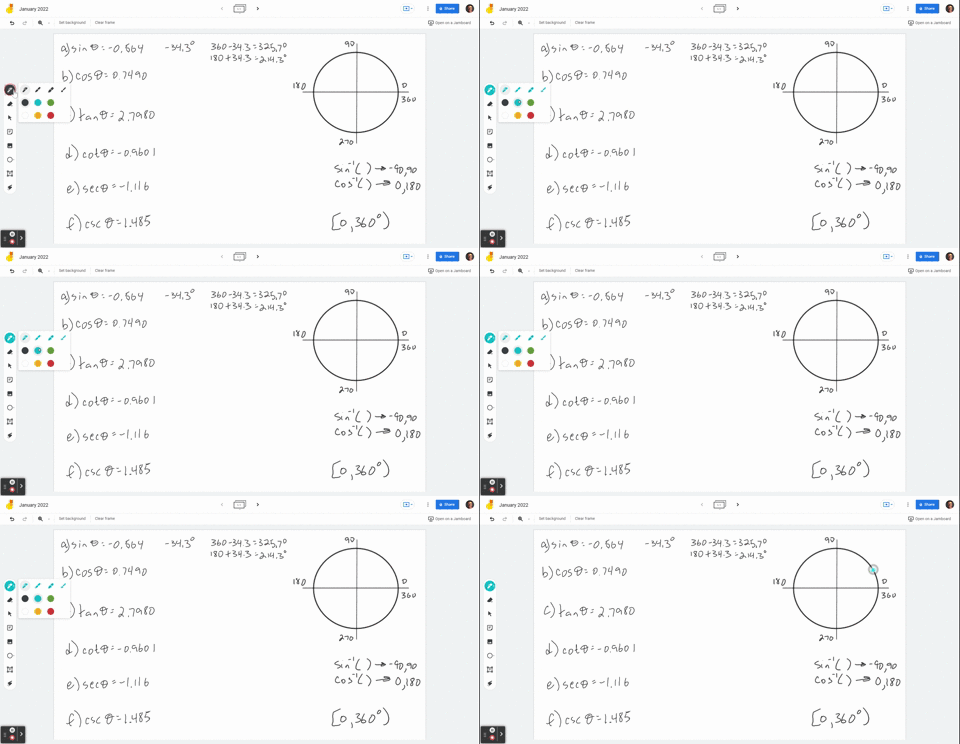
Approximate, to the nearest $0.1^{\circ},$ all angles $\theta$ in the interval $\left[0^{\circ}, 360^{\circ}\right)$ that satisfy the equation.
(a) $\sin \theta=-0.5640$
(b) $\cos \theta=0.7490$
(c) $\tan \theta=2.798$
(d) cot $\theta=-0.9601$
(e) $\sec \theta=-1.116$
(f) cse $\theta=1.485$

Chapter 5: The Trigonometric Functions
Section 4: Values of the Trigonometric Functions
Geoff Glaspie
07:53
Precalculus: Functions and Graphs

Approximate, to the nearest $0.1^{\circ},$ all angles $\theta$ in the interval $\left[0^{\circ}, 360^{\circ}\right)$ that satisfy the equation.
(a) $\sin \theta=0.8225$
(b) $\cos \theta=-0.6604$
(c) $\tan \theta=-1.5214$
(d) cot $\theta=1.3752$
(e) $\sec \theta=1.4291$
(f) csc $\theta=-2.3179$

Chapter 5: The Trigonometric Functions
Section 4: Values of the Trigonometric Functions
Geoff Glaspie
09:50
Precalculus: Functions and Graphs

Approximate, to the nearest 0.01 radian, all angles $\theta$ in the interval $[0,2 \pi)$ that satisfy the equation.
(a) $\sin \theta=0.4195$
(b) $\cos \theta=-0.1207$
(c) $\tan \theta=-3.2504$
(d) cot $\theta=2.6815$
(e) $\sec \theta=1.7452$
(f) $\csc \theta=-4.8521$

Chapter 5: The Trigonometric Functions
Section 4: Values of the Trigonometric Functions
Geoff Glaspie
02:30
Precalculus: Functions and Graphs

Robot's arm Points on the terminal sides of angles play an important part in the design of arms for robots. Suppose a robot has a straight arm 18 inches long that can rotate about the origin in a coordinate plane. If the robot's hand is located at $(18,0)$ and then rotates through an angle of $60^{\circ}$ what is the new location of the hand?

Chapter 5: The Trigonometric Functions
Section 4: Values of the Trigonometric Functions
Geoff Glaspie
1 2 3 4 5 ... 11

Geoff's Quick Ask Videos

09:44
Algebra


1. Two marbles are drawn randomly one after the other
without replacement from a jar that contains 8 red marbles, 8 white
marbles, and 9 yellow marbles. Find the probability of the
following events.
(a) A red marble is drawn first followed by a white marble.
The probability is :
(b) A white marble is drawn first followed by a white marble.
The probability is :
(c) A yellow marble is not drawn at all.
The probability is :
2. In a certain community, 20% of the families own a dog,
and 20% of the families that own a dog also own a cat. It is also
known that 30% of all the families own a cat.
What is the probability that a randomly selected family owns a
cat?
What is the conditional probability that a randomly selected family
doesn't own a dog given that it owns a cat?

Geoff Glaspie
03:37
Algebra

A bicycle factory runs two assembly lines, A and B. 94% of line A's products pass inspection and 92% of line B's products pass inspection. 50% of the factory's bikes come off assembly line B and the rest come off line A. Find the probability that one of the factory's bikes passed inspection and came off assembly line B.

Geoff Glaspie
10:57
Calculus 1 / AB

Rotate the region bounded by y=2x+1, x=4, and y=3, about the line x=-4, and find its volume.
a.) Graph
b.) Complete step by step solution
c.) Final Answer

Geoff Glaspie
03:58
Precalculus

Recall the equation for a circle with center ( h , k ) and
radius r . At what point in the first quadrant does the line with
equation y = 1.5 x + 1 intersect the circle with radius 3 and
center (0, 1)? x=? y=? round to third decimal place.

Geoff Glaspie
05:10
Precalculus

A buoy oscillates in simple harmonic motion as waves go past.
The buoy moves a total of 3.5 feet from its high point to its low
point and returns to it high point every 10 seconds.
a) Write an equation that describes the motion of the buoy,
where the high point corresponds to the time t at t = 0.
b) Find the frequency .
c) Write an equation for the same situation but the buoy starts
at its low point and returns to its low point in 8 seconds.

Geoff Glaspie
02:00
Precalculus

Find a formula for the inverse function of each of the following functions:
1. The function that takes any input and subtracts 4 from it.2. The function that takes any input and multiplies it by - 1/2.

Geoff Glaspie
1 2 3 4 5 ... 10