Jean Gephart

Numerade Educator
Teacher

Biography

I am a 23-year veteran teacher of chemistry, teaching all levels (remedial through college General Chemistry). I love traveling and hiking!

Education

Jean has not yet added their education credentials.

Educator Statistics

Numerade tutor for 3 years
620 Students Helped

Topics Covered

Unlocking the Power of Thermodynamics: A Comprehensive Guide
Effective Solutions for Your Business Needs
Atoms, Molecules, and Ions: Understanding the Building Blocks of Matter
Unlocking the Power of Composition: Tips and Techniques
Discover the Power of Gases: Benefits and Applications
Discover the Wonders of Chemistry: Your Introductory Guide
Mastering Chemical Reactions and Stoichiometry for Optimal Results
Temperature and the Kinetic Theory of Gases
Unlock the Secrets of Organic Chemistry: Essential Guide
Discover the Power of Organic Compounds: Benefits and Uses
Exploring the Fascinating World of Thermochemistry | Learn More Today
Unlocking the Power of Chemical Reactions: A Comprehensive Guide
Aqueous Equilibria: Understanding the Balance of Solutions
Discover the Power of Liquids: Boost Your Health and Wellness Today!
Discover the Power of Solids for Your Everyday Needs
Discover the Power of Kinetics: Unleash Your Potential
Understanding Chemical Bonding: The Key to Molecular Structure
Electromagnetic Waves
Unlocking the Power of Periodic Table Properties | Boost Your Knowledge
Understanding Acids and Bases: A Comprehensive Guide
Aqueous Solutions
Understanding Electronic Structure: A Comprehensive Guide
Periodic Table
Understanding Chemical Equilibrium: A Comprehensive Guide
Acids and bases
Exploring the Fascinating World of Electrochemistry | Learn More Now
Spectroscopy
Explore the Fascinating World of Molecular Geometry - Discover More!
Understanding Structure and Bonding: A Comprehensive Guide

Jean's Textbook Answer Videos

0:00
Chemistry Structure and Properties

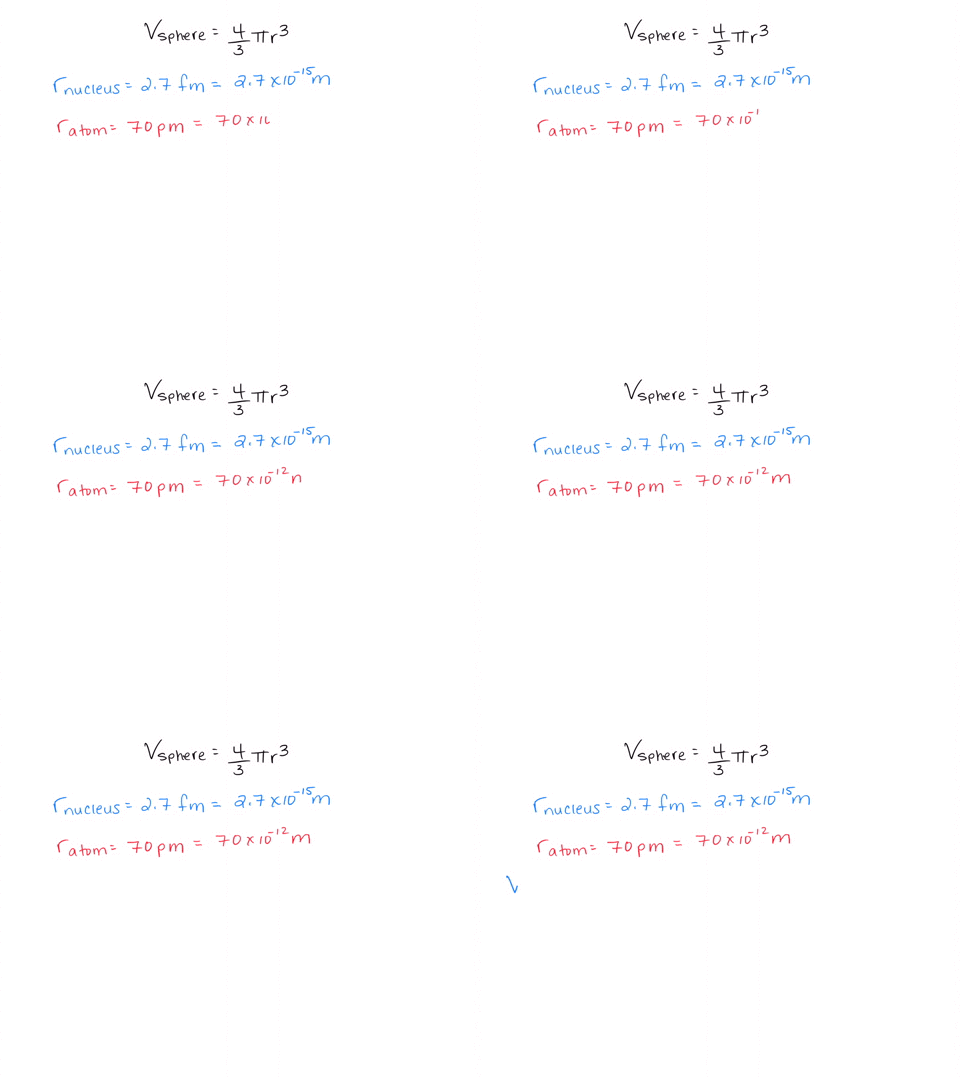
Carbon-12 contains 6 protons and 6 neutrons. The radius of the nucleus is approximately 2.7 fm (femtometers), and the radius of the atom is
approximately 70 pm (picometers). Calculate the volume of the nucleus and the volume of the atom. What percentage of the carbon atom's volume is occupied by the nucleus? (Assume two significant figures.)

Chapter 2: Measurement, Problem Solving, and the Mole Concept
Jean Gephart
0:00
Chemistry Structure and Properties

Titanium occurs in the magnetic mineral ilmenite ( $\mathrm{FeT} \mathrm{O}_{3} ),$ which is
often found mixed with sand. The ilmenite can be separated from the sand with magnets. The titanium can then be extracted from the ilmenite
by the following set of reactions:
$$\begin{array}{r}{\mathrm{FeTiO}_{3}(s)+3 \mathrm{Cl}_{2}(g)+3 \mathrm{C}(s) \longrightarrow} \\ {3 \mathrm{CO}(g)+\mathrm{FeCl}_{2}(s)+\mathrm{TiCl}_{4}(g)}\end{array}$$
$$\mathrm{TiCl}_{4}(g)+2 \mathrm{Mg}(s) \longrightarrow 2 \mathrm{MgCl}_{2}(l)+\mathrm{Ti}(s)$$
Suppose that an ilmenite-sand mixture contains 22.8$\%$ ilmenite by mass
and that the first reaction is carried out with a 90.8$\%$ yield. If the second
reaction is carried out with an 85.9$\%$ yield, what mass of titanium can we
obtain from 1.00 $\mathrm{kg}$ of the ilmenite-sand mixture?

Chapter 8: Chemical Reactions and Chemical Quantities
Jean Gephart
0:00
Chemistry Matter and Change

Determine the oxidation number of the boldface element in the following formulas for
ions.
$$
\text { a. } \mathrm{NH}_{4}^+ \quad \text { b. } \mathrm{AsO}_{4}^{3-} \quad \text { c. } \mathrm{CrO}_{4}^{2-}
$$

Chapter 19: Redox Reactions
Jean Gephart
0:00
Chemistry A Molecular Approach

Consider this overall reaction, which is experimentally observed to be second order in $\mathrm{X}$ and first order in $\mathrm{Y}$:
\begin{equation}\mathrm{X}+\mathrm{Y} \longrightarrow \mathrm{XY}\end{equation}
\begin{equation}\begin{array}{l}{\text { a. Does the reaction occur in a single step in which } \mathrm{X} \text { and } \mathrm{Y}} \\ \quad {\text { collide? }} \\ {\text { b. Is this two-step mechanism valid? }}\end{array}
\end{equation}
\begin{equation}
\begin{array}{ll}{2 \mathrm{X} \underset{k_{2}}{\rightleftharpoons^{k_{2}}} \mathrm{X}_{2}} & {\text { Fast }} \\ {\mathrm{X}_{2}+\mathrm{Y} \underset{\mathrm{k}_{3}}{\longrightarrow} \mathrm{XY}+\mathrm{X}} & {\text { Slow }}\end{array}
\end{equation}

Chapter 14: Chemical Kinetics
Jean Gephart
0:00
Chemistry

Iron(II) sulfate, $\mathrm{FeSO}_{4},$ is prescribed for the treatment of anemia. How many moles of FeSO_ are present in a standard 300 $\mathrm{mg}$ tablet? How many iron(II) ions?

Chapter 3: Mass Relationships in Chemical Reactions
Jean Gephart
0:00
Chemistry

Hexamethylenediamine $\left(\mathrm{C}_{6} \mathrm{H}_{6} \mathrm{N}_{2}\right)$ is one of the starting materials for the production of nylon. It can be prepared from adipic acid $\left(\mathrm{C}_{6} \mathrm{H}_{10} \mathrm{O}_{4}\right)$ by the following overall equation:
$$
\mathrm{C}_{6} \mathrm{H}_{10} \mathrm{O}_{4}(l)+2 \mathrm{NH}_{3}(g)+4 \mathrm{H}_{2}(g) \rightarrow \mathrm{C}_{6} \mathrm{H}_{16} \mathrm{N}_{2}(l)+4 \mathrm{H}_{2} \mathrm{O}(l)
$$
What is the percent yield for the reaction if 765 g of hexamethylenediamine is made from $1.00 \times 10^{3} \mathrm{g}$ of adipic acid?

Chapter 3: Stoichiometry
Jean Gephart
1 2 3 4 5 ... 11

Jean's Quick Ask Videos

09:55
Chemistry 101

You are given a sample that contains a mixture of the following two arsenic-containing minerals: duranosite (As4S) and getchellite (AsSbS3). You start with a sample of this mixture that has a mass of 65.96 grams. You perform a reaction that converts the arsenic (As) in these minerals into the form iron(III) arsenate (FeAsO4), and 77.75 grams of this product are obtained. What is the percent by mass of duranosite in the original sample?

Jean Gephart
01:04
Chemistry 101

Predict the compound formula from the combination of the following ions Ca2+ and ClO–1.
a. CaClO2
b. CaClO
c. Ca(ClO)2
d. Ca(ClO)2

Jean Gephart
01:29
Chemistry 101

Consider the following reactions:
Which of the elementary reactions shown above has a molecularity
of two?
A)
elementary reaction (a)
B)
elementary reaction (b)
C)
elementary reaction (c)
D)
elementary reactions (a), (b), and (c)

Jean Gephart
02:45
Chemistry 101

What is the pH at 25°C of a solution that results from mixing
equal volumes of a 0.05 M solution of acetic acid and a 0.025 M
solution of sodium hydroxide?

Jean Gephart
02:19
Chemistry 101

If 26.8 mL of AgNO3 is needed to precipitate all the Cl- ions in a 0.770-mg sample of KCl (forming AgCl), what is the molarity of the AgNO3 solution?

Jean Gephart
04:13
Chemistry 101

When 0.85 g of calcium is placed in a 100 ml of water, hydrogen gas is evolved along with the formation of calcium hydroxide. What would the concentration of [OH-] after the reaction was finished be? Assume the reaction went to completion, all calcium hydroxide is soluble and density of water is 1.0 g ml-.

Jean Gephart
1 2 3 4 5 ... 70