JH

Jodi Hansen

Numerade Educator
Teacher

Biography

I have been teaching for 29 years. I have been teaching AP Chemistry since 2010 and have been an AP Chemistry Exam Reader for the College Board for the past 7 summers.

Education

Jodi has not yet added their education credentials.

Educator Statistics

Numerade tutor for 5 years
8 Students Helped

Topics Covered

Atoms, Molecules, and Ions: Understanding the Building Blocks of Matter
Unlocking the Power of Composition: Tips and Techniques
Understanding Electronic Structure: A Comprehensive Guide
Periodic Table
Understanding Chemical Bonding: The Key to Molecular Structure

Jodi's Textbook Answer Videos

03:43
Chemistry A Molecular Approach

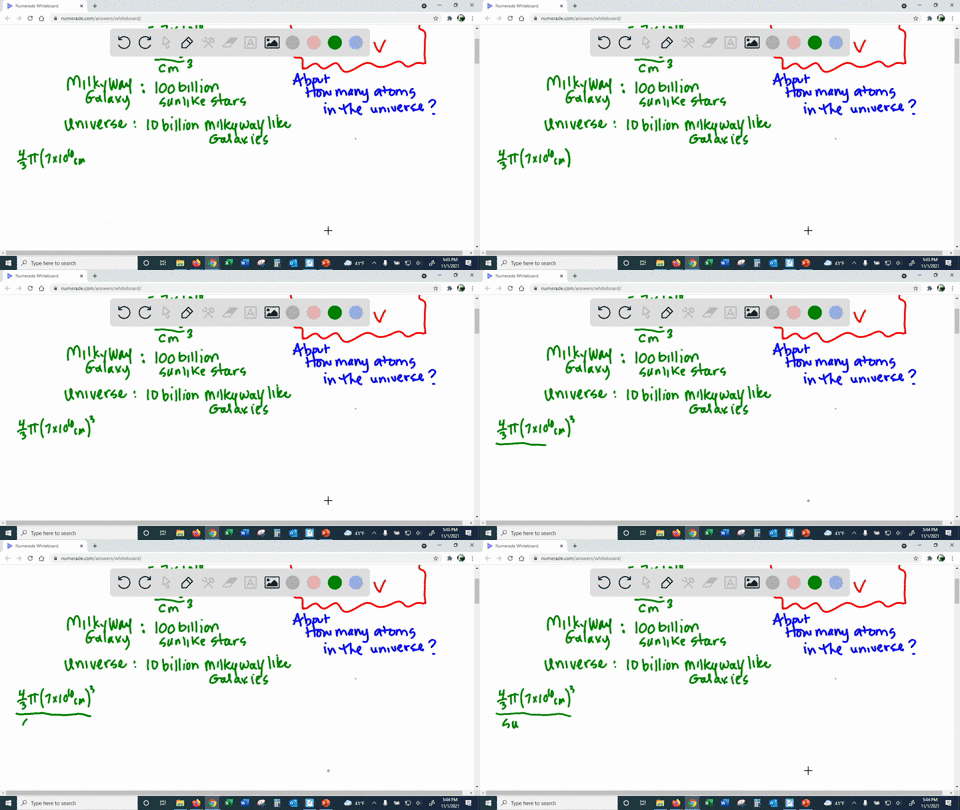
Use the concepts in this chapter to obtain an estimate for the number of atoms in the universe. Make the following assumptions: (a) All of the atoms in the universe are hydrogen atoms in stars. (This is not a ridiculous assumption because over threefourths of the atoms in the universe are in fact hydrogen. Gas and dust between the stars represent only about $15 \%$ of the visible matter of our galaxy, and planets compose a far tinier fraction.) (b) The sun is a typical star composed of pure hydrogen with a density of $1.4 \mathrm{~g} / \mathrm{cm}^{3}$ and a radius of $7 \times 10^{8} \mathrm{~m}$.
(c) Each of the roughly 100 billion stars in the Milky Way galaxy contains the same number of atoms as our sun. (d) Each of the 10 billion galaxies in the visible universe contains the same number of atoms as our Milky Way galaxy.

Chapter 2: Atoms and Elements
Jodi Hansen
03:00
Chemistry A Molecular Approach

Below is a representation of 50 atoms of a fictitious element called pearsonium (Ps). The red spheres represent Ps-296, the blue spheres Ps-297, and the green spheres Ps-298.
a. Assuming that the sample is statistically representative of a naturally occurring sample, calculate the percent natural abundance of each Ps isotope.
b. Draw the mass spectrum for a naturally occurring sample of Ps.
c. The mass of each Ps isotope is measured relative to $\mathrm{C}-12$ and tabulated. Use the mass of $\mathrm{C}-12$ to convert each of the masses
to amu and calculate the atomic mass of Ps.
$$
\begin{array}{cc}
\text { Isotope } & \text { Mass } \\
\hline \text { Ps-296 } & 24.6630 \times \text { Mass }\left({ }^{12} C\right) \\
\hline \text { Ps-297 } & 24.7490 \times \text { Mass }\left({ }^{12} C\right) \\
\hline \text { Ps-298 } & 24.8312 \times \text { Mass }\left({ }^{12} C\right) \\
\hline
\end{array}
$$

Chapter 2: Atoms and Elements
Jodi Hansen
01:57
Chemistry A Molecular Approach

Which answer is an example of the law of multiple proportions? Explain.
a. Two different samples of water are found to have the same ratio of hydrogen to oxygen.
b. When hydrogen and oxygen react, the mass of water formed is exactly equal to the mass of hydrogen and oxygen that reacted.
c. The mass ratio of oxygen to hydrogen in water is $8: 1 .$ The mass ratio of oxygen to hydrogen in hydrogen peroxide (a compound that only contains hydrogen and oxygen) is 16:1.

Chapter 2: Atoms and Elements
Jodi Hansen
04:12
Chemistry A Molecular Approach

In a naturally occurring sample, $19.8 \%$ of boron atoms have five neutrons and $80.2 \%$ have six neutrons. What is the mass num-
ber of each boron isotope? Sketch a sample of 10 atoms that is nearly representative of a natural sample. What is the average mass of the atoms in your drawing? What is the atomic mass of boron? (Boron-10 has a mass of 10.01294 amu, and boron-11 has a mass of 11.00931 amu. $)$

Chapter 2: Atoms and Elements
Jodi Hansen
04:46
Chemistry A Molecular Approach

Calculate the mass in grams of one mole of each of the following (the mass of a single item is given in parentheses): electrons $\left(9.10938 \times 10^{-28} \mathrm{~g}\right),$ protons $\left(1.67262 \times 10^{-24} \mathrm{~g}\right),$ neutrons
$\left(1.67493 \times 10^{-24} \mathrm{~g}\right),$ atoms of carbon- $12\left(1.992646 \times 10^{-23} \mathrm{~g}\right)$
and doughnuts $(74 \mathrm{~g})$. Compare the mass of one mole of carbon-12 atoms to the sum of the masses of the particles that it contains. If the doughnut mentioned in this question were made entirely of carbon, how many atoms would it contain?

Chapter 2: Atoms and Elements
Jodi Hansen
1 2