John Nicolle

Rice University
Teacher

Biography

Hey my name is john nicholle i am a chemistry and biology expert.. i have a teaching experience of 7 years and now i am teaching in an Indian institute

Education

BS Physics
Rice University

Educator Statistics

Numerade tutor for 5 years
2409 Students Helped

Topics Covered

Discover the Wonders of Chemistry: Your Introductory Guide
Acid-Base Equilibria: Understanding the Balance
Exploring the Fascinating World of Electrochemistry | Learn More Now
Discover the Power of Liquids: Boost Your Health and Wellness Today!
Discover the Power of Solids for Your Everyday Needs
Understanding Chemical Equilibrium: A Comprehensive Guide
Unlocking the Power of Functions: Boost Your Programming Skills
Functions
Mastering Linear Functions: A Comprehensive Guide
Stand Out with Differentiation Strategies | Boost Your Business
Mastering Integrals: Tips and Tricks for Calculus Success
Integration
Mastering Multiple Integrals: Techniques and Tips
Mastering Integration Techniques for Optimal Results
Applications of Integration: Exploring Real-World Solutions
Multiple Integration
Unlock the Power of Sequences: Boost Your Productivity
Discover the Best Series to Binge-Watch | Your Ultimate Guide
Mastering Sequences and Series: A Comprehensive Guide
Understanding Complex Numbers: A Comprehensive Guide
Rational Functions: Understanding Their Properties and Applications
Graph Linear Functions
Exploring the Functions of Multiple Variables
Vector Functions: Understanding the Basics
Vectors and Vector Valued Functions
Transition Metals
Atoms, Molecules, and Ions: Understanding the Building Blocks of Matter
Exploring the Chemistry of Nonmetals: Properties and Reactions
Discover the Power of Kinetics: Unleash Your Potential
Exploring the Fascinating World of Thermochemistry | Learn More Today
Discover the Power of Gases: Benefits and Applications
Effective Solutions for Your Business Needs
Aqueous Solutions
Explore the Fascinating World of Nuclear Chemistry
Mastering Chemical Reactions and Stoichiometry for Optimal Results
Unlock the Secrets of Organic Chemistry: Essential Guide
Exploring the Structure and Stereochemistry of Alkanes
Cellular Respiration and Fermentation: Understanding the Basics
The Fascinating Chemistry of Life: Discovering the Building Blocks
Carbohydrates, proteins, and lipids
Carbohydrates and Nucleic Acids: The Building Blocks of Life
Unlocking the Power of Periodic Table Properties | Boost Your Knowledge
Periodic Table
Carboxylic Acids: Properties, Reactions, and Applications
Exploring Carboxylic Acid Derivatives: Properties and Applications
Carboxylic acids and their derivatives
Unlocking the Wonders of Organic Chemistry: An Introduction
Unlocking the Secrets of Stereochemistry: Exploring Molecular Structures
Stereoisomerism

John's Textbook Answer Videos

06:15
World of Chemistry

Give a simple definition of an acid.

Chapter 4: Nomenclature
Section 2: Naming and Writing Formulas for More
John Nicolle
02:41
Inorganic Chemistry

The ions $\mathrm{H}_{2}^{+}$ and $\mathrm{H}_{3}^{+}$ have been observed in gas discharges.
a. $\mathrm{H}_{2}^{+}$ has been reported to have a bond distance of $106 \mathrm{pm}$ and a bond dissociation enthalpy of $255 \mathrm{kJ} \mathrm{mol}^{-1}$. Comparable values for the neutral molecule are $74.2 \mathrm{pm}$ and $436 \mathrm{kJ} \mathrm{mol}^{-1}$. Are these values for $\mathrm{H}_{2}^{+}$ in agreement with the molecular orbital picture of this ion? Explain.
b. Assuming $\mathrm{H}_{3}^{+}$ to be triangular (the probable geometry), describe the molecular orbitals of this ion and determine
the expected $\mathrm{H}-\mathrm{H}$ bond order.

Chapter 8: Chemistry of the Main Group Elements
John Nicolle
01:44
Inorganic Chemistry

The species $\mathrm{He}_{2}^{+}$ and $\mathrm{HeH}^{+}$ have been observed spectroscopically. Preparc molecular orbital diagrams for these two ions. What would you predict for the bond order of each?

Chapter 8: Chemistry of the Main Group Elements
John Nicolle
01:27
Inorganic Chemistry

The chemical species IF $_{4}$ and $\mathrm{XeF}_{4}$ are known. Is the isoclectronic ion $\mathrm{CsF}_{4}^{+}$ plausible'? If it could be made, predict and sketch its most likely shape. Comment on whether such an ion might or might not be possible.

Chapter 8: Chemistry of the Main Group Elements
John Nicolle
01:17
Inorganic Chemistry

The equilibrium constant for the formation of the cryptand $[\mathrm{Sr}\{\text { cryptand }(2.2 .1)\}]^{2+}$ is larger than the equilibrium constants for the analogous calcium and barium cryptands. Suggest an explanation. (See F. Kauffmann, J-M. Lehn, J-P. Sauvage, Helv. Chim. Acta, $1976,59,1099 .)$

Chapter 8: Chemistry of the Main Group Elements
John Nicolle
01:40
Inorganic Chemistry

Gas phase $\mathrm{BeF}_{2}$ is monomeric and linear. Prepare a molecular orbital description of the bonding in BeF $_{2}$

Chapter 8: Chemistry of the Main Group Elements
John Nicolle
1 2 3 4 5 ... 219

John's Quick Ask Videos

02:06
Intro Stats / AP Statistics

Total plasma volume is important in determining the required
plasma component in blood replacement therapy for a person
undergoing surgery. Plasma volume is influenced by the overall
health and physical activity of an individual. Suppose that a
random sample of 40 male firefighters are tested and that
they have a plasma volume sample mean of x =
37.5 ml/kg (milliliters plasma per kilogram body weight).
Assume that 𝜎 = 7.60 ml/kg for the
distribution of blood plasma.
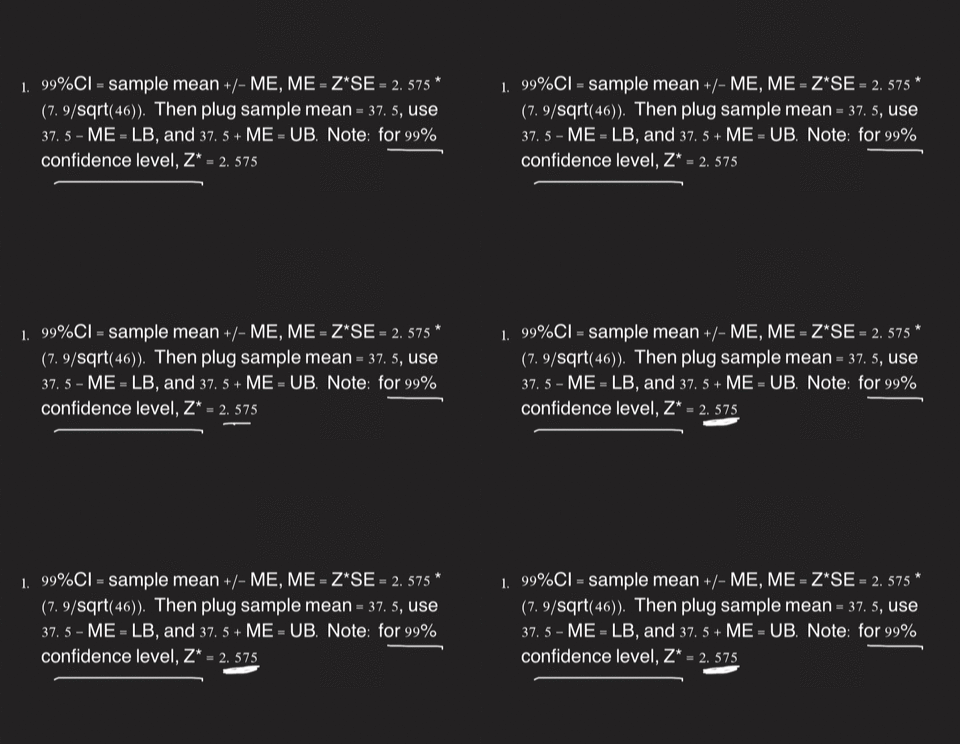
1) Find a 99% confidence interval for the population
mean blood plasma volume in male firefighters. What is the margin
of error? (Round your answers to two decimal places.)
lower limit ?
upper limit ?
margin error ?
2) What conditions are necessary for your calculations?
Select all that apply.
the distribution of weights is normal
𝜎 is known
𝜎 is unknown
the distribution of weights is uniform
n is large
3)Interpret your results in the context of this
problem.
The probability that this interval contains the true average
blood plasma volume in male firefighters is 0.99.
The probability that this interval contains the true average
blood plasma volume in male firefighters is 0.01.
We are 99% confident that the true average blood plasma volume
in male firefighters falls within this interval.
We are 1% confident that the true average blood plasma volume in
male firefighters falls within this interval.
4)Find the sample size necessary for a 99% confidence level with
maximal margin of error E = 2.60 for
the mean plasma volume in male firefighters. Round up to the
nearest whole number.
Male firefighters ?

John Nicolle
03:35
Chemistry 101

Chlorofluorocarbons (CFCs) are nontoxic,
nonflammable chemicals containing atoms of carbon, chlorine, and
fluorine. They are used in the manufacture of aerosol sprays,
blowing agents for foams and packing materials, as solvents, and as
refrigerants.
1. When released into the atmosphere, chlorofluorocarbons (CFCs)
react with UV light, producing atomic chlorine. Atomic chlorine
goes on to act as a catalyst in the destruction of ozone. Using any
resources available to you, determine how much CFCs
(chlorofluorocarbons) would need to be released into the atmosphere
to completely destroy the ozone layer.
2. CFCs were subsequently banned and alternative chemicals were
found as substitutes. What were the social and economic impacts of
switching away from CFCs?

John Nicolle
02:55
Chemistry 101

A solution of KOH has a pH of 10.50. How many grams of SrO
should be dissolved in sufficient water to make 2.40 L of a
solution having the same pH? Express your answer with the
appropriate units.

John Nicolle
01:19
Chemistry 101

- Elements neptunium and plutonium were created in the lab by the process of...
a. neutron absorption
b. beta decay
c. alpha particle absorption
d. positron emission

- Moseley's experiments showed that the periodic table is, in fact, arranged by:
a. atomic mass
b. density
c. atomic number
d. atomic radius (size)

- What was the name of the new element that Ed McMillan discovered?
a. uranium
b. plutonium
c. neptunium
d. xenon

- Foil made from which element was used in the experiment to discover the positive charge of the atom?
a. titanium
b. aluminum
c. gold
d. silver

- What subject did Moseley study under Ernest Rutherford in graduate school?
a. nuclear chemistry
b. engineering
c. organic chemistry
d. microbiology

John Nicolle
01:00
Biology

Which statement is NOT typically true regarding core nucleosomes?
a) Contains two copies each of four different histone proteins
b) Binds DNA with almost no sequence specificity
c) Covers most chromosomal DNA in both prokaryotes and eukaryotes
d) Can fold up into more condensed, higher order structures

John Nicolle
04:52
Chemistry 101

A quantity of 0.225 g of a metal M (molar mass = 27.0 g/mol) liberated 0.303 L of molecular hydrogen (measured at 17°C and 741 mmHg) from an excess of hydrochloric acid. Deduce from these data the corresponding equation and write the formulas for the oxide and sulfate of M.
Using the smallest whole-number coefficients, write the balanced equation for the reaction of the metal, M, with hydrochloric acid. Include the phase abbreviations.
What is the formula of the oxide M? What is the formula of the sulfate of M?

John Nicolle
1 2 3 4 5 ... 180