KA

Kakra Atakora

Numerade Educator
STEM Student

Biography

Currently a medical student at the University of Ghana, but completed a Bachelor's degree in biochemistry, Cell and Molecular biology in 2018

Education

Kakra has not yet added their education credentials.

Educator Statistics

Numerade tutor for 5 years
4 Students Helped

Topics Covered

Understanding Electronic Structure: A Comprehensive Guide
Unlock the Secrets of Organic Chemistry: Essential Guide
Amino Acids, Peptides & Proteins - Essential Building Blocks
Unlocking the Secrets of Stereochemistry: Exploring Molecular Structures
Mastering the Structure and Synthesis of Alkenes: A Comprehensive Guide

Kakra's Textbook Answer Videos

05:19
Principles of Biochemistry

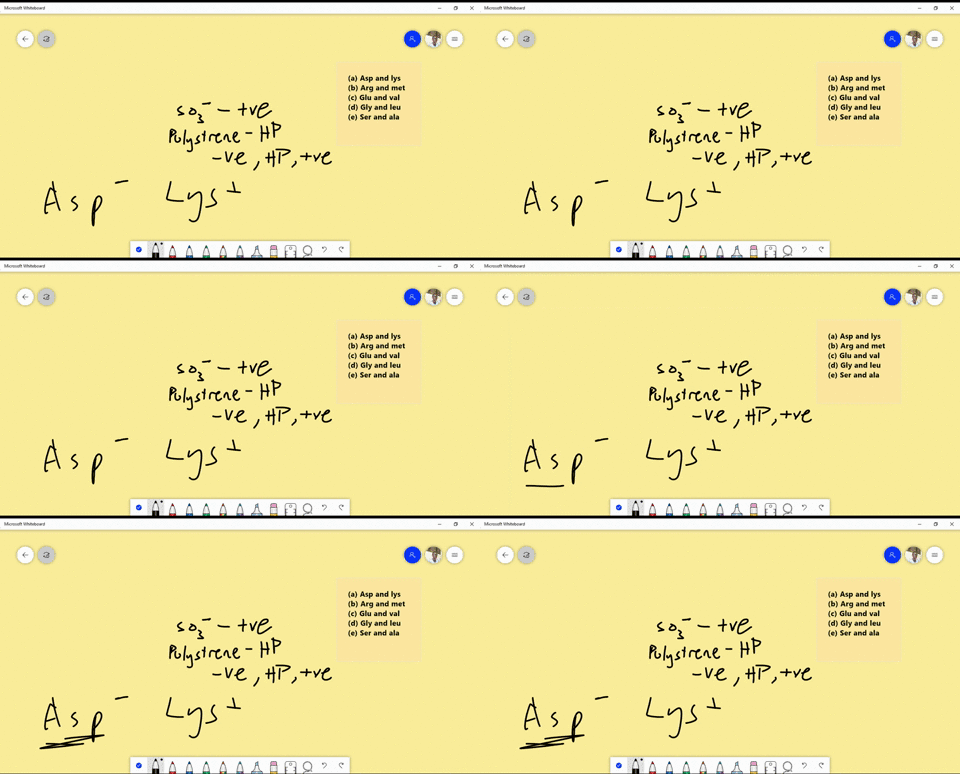
Mixtures of amino acids can be analyzed by first separating the mixture into its components through ionexchange chromatography. Amino acids placed on a cation-exchange resin (see Fig. $3-17$ a) containing sulfonate $\left(-\mathbf{S O}_{3}^{-}\right)$ groups flow down the column at different rates because of two factors that influence their movement: (1) ionic attraction between the sulfonate residues on the column and positively charged functional groups on the amino acids, and
(2) aggregation of nonpolar amino acid side chains with the hydrophobic backbone of the polystyrene resin. For each pair of amino acids listed, determine which will be eluted first from the cation-exchange column by a pH 7.0 buffer.
(a) Aspartate and lysine
(b) Arginine and methionine
(c) Glutamate and valine
(d) Glycine and leucine
(e) Serine and alanine

Chapter 3: Amino Acids, Peptides, and Proteins
Kakra Atakora
08:56
Principles of Biochemistry

One method for separating polypeptides makes use of their different solubilities. The solubility of large polypeptides in water depends on the relative polarity of their R groups, particularly on the number of ionized groups: the more ionized groups there are, the more soluble the polypeptide. Which of each pair of polypeptides that follow is more soluble at the indicated $\mathrm{pH} ?$
(a) (Gly) $_{20}$ or (Glu) $_{20}$ at $\mathrm{pH} 7.0$
(b) (Lys-Ala)$_{3}$ or (Phe-Met) $_{3}$ at $\mathrm{pH} 7.0$
(c) (Ala-Ser-Gly) $_{5}$ or (Asn-Ser-His) $_{5}$ at $\mathrm{pH} 6.0$
(d) (Ala-Asp-Gly) $_{5}$ or (Asn-Ser-His) $_{5}$ at $\mathrm{pH} 3.0$

Chapter 3: Amino Acids, Peptides, and Proteins
Kakra Atakora
09:00
Organic Chemistry

Tell whether the $\mathrm{H}_{\mathrm{a}}$ and $\mathrm{H}_{\mathrm{b}}$ hydrogens in each of the following compounds are enantiotopic, diastereotopic, or neither.

Chapter 5: Stereochemistry
Kakra Atakora
05:53
Organic Chemistry

Neglecting stereoisomers, give the structures of all compounds with molecular formula $\mathrm{C}_{5} \mathrm{H}_{10}$. Which ones can exist as stereoisomers?

Chapter 5: Stereochemistry
Kakra Atakora
1