Kartik Indoliya

Texas A&M University
Subject matter expert

Biography

I completed my master degree from central university of Rajasthan with good acedemic record. I am working as subject matter expert from last 3 years. I solved chemistry related questions.

Education

BS Mathematics
Texas A&M University

Educator Statistics

Numerade tutor for 5 years
759 Students Helped

Topics Covered

Effective Solutions for Your Business Needs
Atoms, Molecules, and Ions: Understanding the Building Blocks of Matter
Unlocking the Power of Composition: Tips and Techniques
Mastering Chemical Reactions and Stoichiometry for Optimal Results
Acids and bases
Understanding Acids and Bases: A Comprehensive Guide
Discover the Power of Kinetics: Unleash Your Potential
Electromagnetic Waves
Discover the Power of Solids for Your Everyday Needs
Discover the Power of Organic Compounds: Benefits and Uses
Transition Metals
Exploring the Fascinating World of Transition Metals and Coordination Chemistry

Kartik's Textbook Answer Videos

03:13
Chemistry and Chemical Reactivity

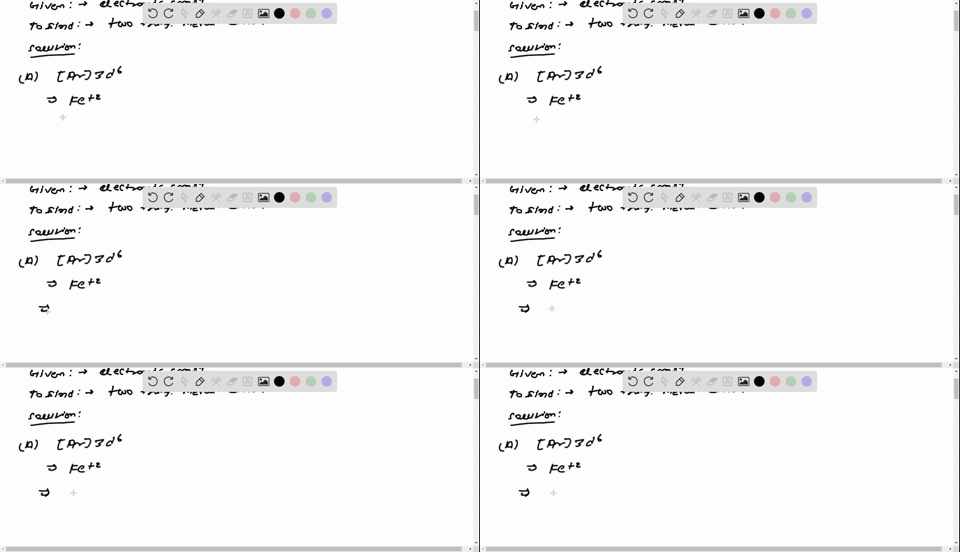
Identify two transition metal cations with each of the following electron configurations.
(a) $[\mathrm{Ar}] 3 d^{6}$
(c) $[\mathrm{Ar}] 3 d^{5}$
(b) $[\mathrm{Ar}] 3 d^{10}$
(d) $[\mathrm{Ar}] 3 d^{\mathrm{s}}$

Chapter 22: The Chemistry of the Transition Elements
Kartik Indoliya
04:04
Chemistry and Chemical Reactivity

Identify a cation of a first series transition metal that is isoelectronic with each of the following.
(a) $\mathrm{Fe}^{3+}$
(c) $\mathrm{Fe}^{2+}$
(b) $\mathrm{Zn}^{2+}$
(d) $\mathrm{Cr}^{3+}$

Chapter 22: The Chemistry of the Transition Elements
Kartik Indoliya
03:25
Chemistry and Chemical Reactivity

The following cquations represcnt various ways of obtaining transition metals from their compounds. Balance each equation.
(a) $\mathrm{Cr}_{2} \mathrm{O}_{3}(\mathrm{s})+\mathrm{Al}(\mathrm{s}) \longrightarrow \mathrm{Al}_{2} \mathrm{O}_{3}(\mathrm{s})+\mathrm{Cr}(\mathrm{s})$
(b) $\mathrm{TiCl}_{4}(\ell)+\mathrm{Mg}(\mathrm{s}) \longrightarrow \mathrm{Ti}(\mathrm{s})+\mathrm{MgCl}_{2}(\mathrm{s})$
(c) $\left[\mathrm{Ag}(\mathrm{CN})_{2}\right]^{-}(\mathrm{aq})+\mathrm{Zn}(\mathrm{s}) \longrightarrow$
$\mathrm{Ag}(\mathrm{s})+\left[\mathrm{Zn}(\mathrm{CN})_{4}\right]^{2-}(\mathrm{aq})$
(d) $\mathrm{Mn}_{3} \mathrm{O}_{4}(\mathrm{s})+\mathrm{Al}(\mathrm{s}) \longrightarrow \mathrm{Mn}(\mathrm{s})+\mathrm{Al}_{2} \mathrm{O}_{3}(\mathrm{s})$

Chapter 22: The Chemistry of the Transition Elements
Kartik Indoliya
03:08
Chemistry and Chemical Reactivity

Identify the products of each reaction, and balance the equation.
(a) $\operatorname{CuSO}_{4}(\text { aq })+Z n(\text { s) } \longrightarrow$
(b) $\mathrm{Zn}(\mathrm{s})+\mathrm{HCl}(\mathrm{aq}) \longrightarrow$
(c) $\mathrm{Fe}(\mathrm{s})+\mathrm{Cl}_{2}(\mathrm{g}) \longrightarrow$
(d) $\mathrm{V}(\mathrm{s})+\mathrm{O}_{2}(\mathrm{g}) \longrightarrow$

Chapter 22: The Chemistry of the Transition Elements
Kartik Indoliya
03:00
NCERT Class 10 Science

Compounds such as alcohols and glucose also contain hydrogen but are not categorised as acids. Describe an Activity to prove it.

Chapter 2: Acids, Bases and Salts
Kartik Indoliya
1 2 3 4 5 ... 66

Kartik's Quick Ask Videos

03:16
Biology

Who am I? In hormonal control of glycogen metabolism, I am the enzyme directly responsible for simultaneously inhibiting glycogen phosphorylase and activating glycogen synthase.
A. phosphorylase kinase
B. cAMP-dependent protein kinase
C. Protein kinase
D. phosphoprotein phosphatase
In the Cori cycle, what liver enzyme must act right before pyruvate carboxylase & PEP carboxykinase?
A. pyruvate dehydrogenase
B. Glucose-6-phosphatase
C. Lactate dehydrogenase

Kartik Indoliya
06:10
Biology

A flowering plant species whose flowers are normally red is found to have variants whose flowers are white. When a true-breeding strain with red flowers is crossed to another true-breeding strain with white flowers, the F1 all have red flowers. When these F1 plants are crossed with one another, 225 have red flowers and 175 have white flowers – displaying a 9:7 ratio which is significantly different from 1:1. Propose a genetic hypothesis to explain these data, using symbols of your choice. How many genes, and how many alleles per gene, are at work here? What sort of genotype-phenotype relation is this?

Kartik Indoliya
05:23
Biology

Which of the following A,B,C,D,E are correct in relation to
translation?
A- In prokaryotes, any AUG can be used as start codon if
preceded by a shine Dalgarno sequence, which facilitates ribosome
recruitment.
B- In cells, each mRNA is translated in the three different
reading frames, thus making three entirely different proteins
C- During translation, recognition of codons in the mRNA by
anti-codons in the tRNA takes place within ribosomes.
D- Formation of peptide bonds during translation is carried by
the RNA polymerase.
E- During translation, the nucleotide sequence of the mRNA
molecule is translated into the amino acid sequence that make up
the encoded protein.

Kartik Indoliya
03:37
Chemistry 101

Consider the following DNA template strand for questions a-c:
Template: 5’-CCGACTCA-3’ DNA: mRNA:
a. Write the DNA sequence copy synthesized by DNA polymerase
including polarity numbers.
b. How many hydrogen bonds would hold the two single stranded
DNA fragments together?
c. Write the mRNA copy of the genetic information.

Kartik Indoliya
04:22
Chemistry 101

Calculate the concentration of OH- in a 0.500 M solution of the sodium salt of a weak acid (pKa = 6.00).

Kartik Indoliya
04:03
Chemistry 101

Sodium metal reacts with aluminum oxide to form
aluminum metal plus sodium oxide. When 5.52 grams of sodium was
reacted with 6.52 grams of aluminum oxide, 1.50 grams of aluminum
metal was produced. What was the percent yield of the
reaction?
A) 69.5 %
B) 27.2 %
C) 81.5 %
D) 34.7 %
E) 23.1 %

Kartik Indoliya
1 2 3 4 5 ... 60