Lance Atkinson

San Diego State University
Physics Teacher

Biography

I am the oldest child of two siblings but, because of being 11 months apart and myself being born in December, me and my sister grew up and went to school equally and in the same grade. Now, I am married and have three children, all five years apart. I earned my Bachelor's degree in Mathematics/Physics from San Diego State University; where I also received my teaching credential. My post graduate work was completed at Grand Canyon University; receiving a Master's in Curriculum and Instruction. I have been a full time Physics, Geoscience and Mathematics instructor for over 10 years. Within my school district, I have written integrated science courses, been awarded grants and held leadership positions for my work.

Education

BA Mathematics/Physics
San Diego State University

Educator Statistics

Numerade tutor for 5 years
8 Students Helped

Topics Covered

Mastering Motion: Achieving Efficiency Along a Straight Line

LANCE's Textbook Answer Videos

23:43
College Physics for AP® Courses

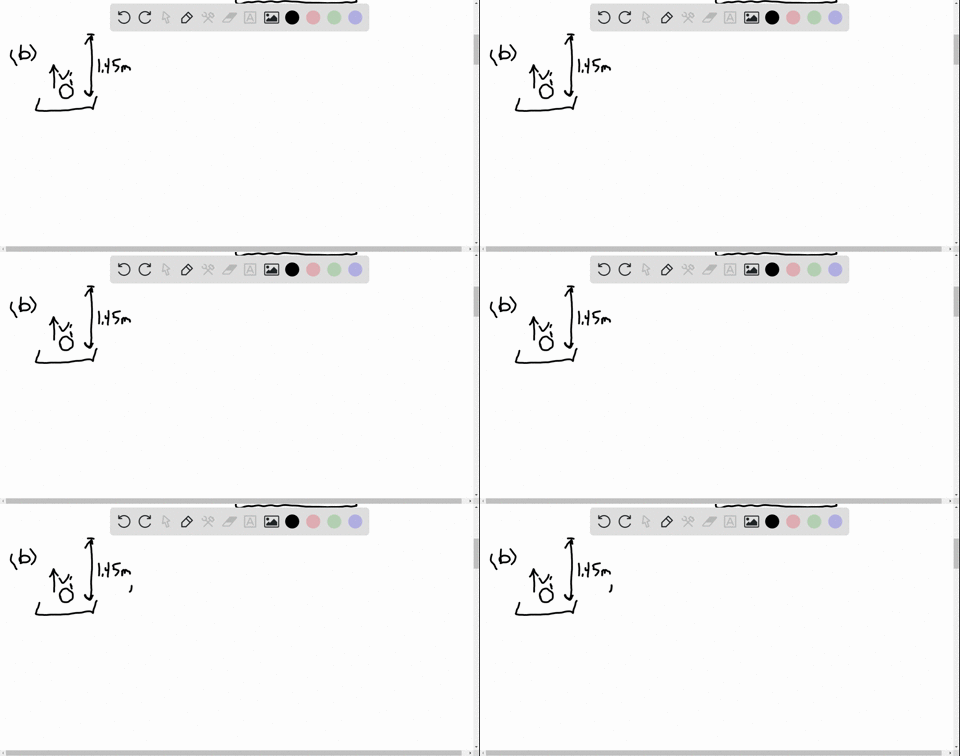
A steel ball is dropped onto a hard floor from a height of 1.50 m and rebounds to a height of 1.45 m. (a) Calculate its velocity just before it strikes the floor. (b) Calculate its velocity just after it leaves the floor on its way back up. (c) Calculate its acceleration during contact with the floor if that contact lasts 0.0800 $\mathrm{ms}\left(8.00 \times 10^{-5} \mathrm{s}\right)$ . (d) How much did the ball compress during its collision with the floor, assuming the floor is absolutely rigid?

Chapter 2: Kinematics
Lance Atkinson
1

LANCE's Quick Ask Videos

09:26
Geometry

pls solve the following problem

Lance Atkinson
02:29
Calculus 1 / AB

Please, help

Lance Atkinson
08:33
Calculus 2 / BC

2) Evaluate using geometry and/or symmetry; use a graph to explain your answer:

3. Evaluate the definite integral in problem 2 by applying the Fundamental Theorem of Calculus.

Lance Atkinson
12:53
Calculus 2 / BC

4 and 5

Lance Atkinson
05:53
Physics 101 Mechanics

A 55 g ice cube can slide up and down a frictionless 30∘ slope. At the bottom, a spring with a spring constant 20 N/m is compressed 10 cm and used to launch the ice cube up the slope. How high does it go above its starting point?

Lance Atkinson
03:31
Physics 103

Two 1.00 kg masses have their centers 1.00 m apart. What is the force of attraction between them?

Lance Atkinson
1 2