I taught at the college level from 1999-2013. I'm currently teaching at an independent school
Radioactive tracer The radioactive tracer $^{51} \mathrm{Cr}$ can be used to locate the position of the placenta in a pregnant woman. Often the tracer must be ordered from a medical laboratory.If $A_{0}$ units (microcuries) are shipped, then because of the radioactive decay, the number of units $A(t)$ present after $t$ days is given by $A(t)=A_{0} e^{-a n 24 a_{0}}$(a) If 35 units are shipped and it takes 2 days for the tracer to arrive, approximately how many units will be available for the test?(b) If 35 units are needed for the test, approximately how many units should be shipped?
Polonium isotope decay If we start with $c$ milligrams of the polonium isotope $^{210} \mathrm{Po}$, the amount remaining after $t$ days may be approximated by $A=c e^{-0.00495}$ If the initial amount is 50 milligrams, approximate, to the nearest hundredth, the amount remaining after(a) 30 days(b) 180 days(c) 365 days
The effective yield (or effective annual interest rate) for an Investment is the simple interest rate that would yleld at the end of one year the same amount as is ylelded by the compounded rate that is actually applied. Approximate, to the nearest $0.01 \%,$ the effective yield corresponding to an interest rate of $r \%$ per year compounded (a) quarterly and(b) continuously.$$r=12$$
Pollution from a smokestack The concentration $C$ (in units/m' of pollution near a ground-level point that is downwind from a smokestack source of height $h$ is sometimes given by$$C=\frac{Q}{\pi v a b} e^{-y^{2} A 2 \alpha^{2}y\left[e^{\left.-(z-h)^{2} h 2b^{2}\right)}+e^{-(z+h)^{2} N 2 h^{2}}\right]}$$where $Q$ is the source strength (in units/sec), $v$ is the average wind velocity (in $\mathrm{m} / \mathrm{sec}$ ), $z$ is the height (in meters) above the downwind point, $y$ is the distance from the downwind point in the direction that is perpendicular to the wind (the cross-wind direction), and $a$ and $b$ are constants that depend on the downwind distance (see the figure).(a) How does the concentration of pollution change at the ground-level, downwind position $(y=0 \text { and } z=0)$ if the height of the smokestack is increased?(b)How does the concentration of pollution change at ground level ( $z=0$ ) for a smokestack of fixed height $h$ if a person moves in the cross-wind direction, thereby increasing $y ?$CAN'T COPY THE FIGURE
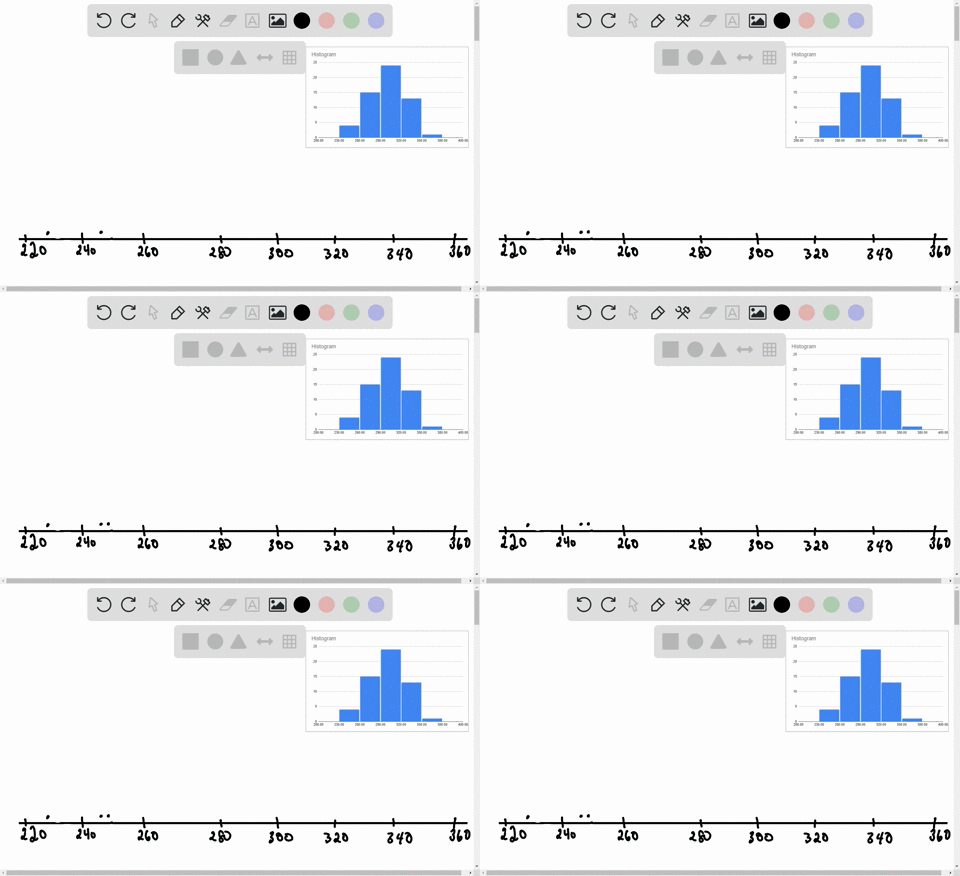
Make a dotplot for the data in Problem 15 regarding the finish time (number of hours) for the Iditarod Dog Sled Race. Compare the dotplot to the histogram of Problem $15 .$
Given a rational function R(x)=p(x)/q(x). What is the biggest consideration in finding the domain of R(x)?
Is it accurate to say that the graph of a function can never intersect an asymptote?