Mahendra Rathore

University of California, Santa Cruz
Tutor

Biography

tutor

Education

BS Phyics
University of California, Santa Cruz

Educator Statistics

Numerade tutor for 5 years
2497 Students Helped

Topics Covered

Atoms, Molecules, and Ions: Understanding the Building Blocks of Matter
Unlocking the Power of Composition: Tips and Techniques
Understanding Electronic Structure: A Comprehensive Guide
Effective Solutions for Your Business Needs
Aqueous Solutions
Discover the Power of Kinetics: Unleash Your Potential
Explore the Fascinating World of Nuclear Chemistry
Understanding Reflection and Refraction of Light: A Comprehensive Guide
Motion
The Laws of Motion
Mastering Motion: Achieving Efficiency Along a Straight Line
Unlocking the Secrets of Thermal Properties: Understanding Matter

Mahendra's Textbook Answer Videos

02:54
Practice Problem in Physics for the JEE Main and Advanced

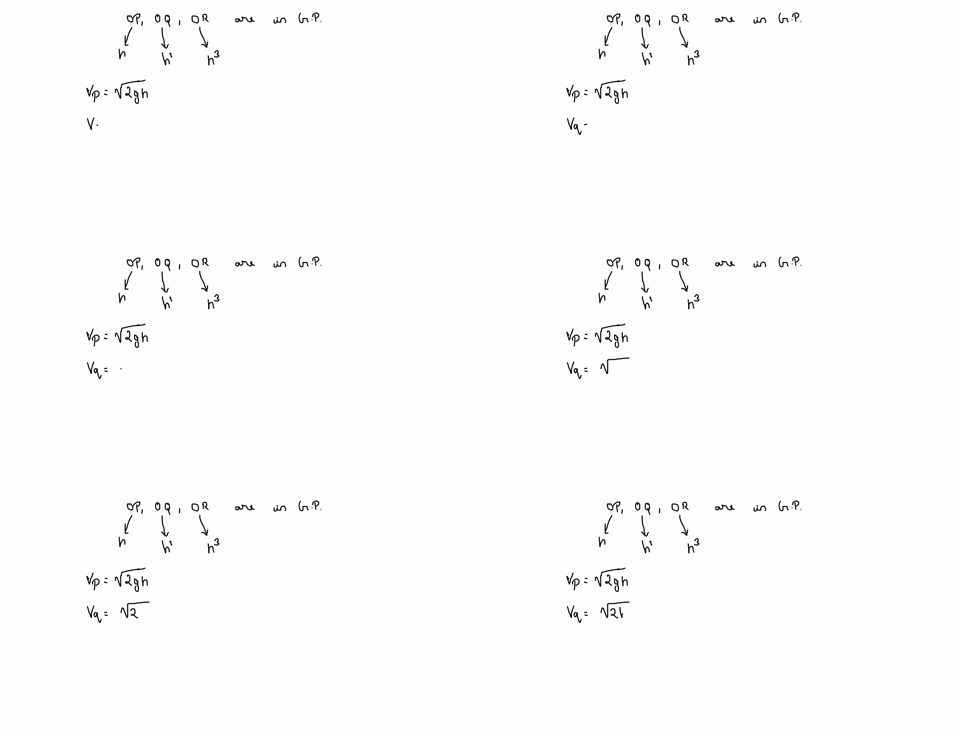
A stonc is dropped from a point $O$. There are points $P, Q, R$ along its paths II $O P, O Q, O R, \ldots$ are in
G.P., then prove the velocities at $P, Q, R, \ldots$ are in G.P.
Solution
Vel at $P-v_{1}-\sqrt{2 g h}, \quad$ Vel. at $Q-v_{2}-\sqrt{2 g h^{2}} ;$ Vel at $R-v_{3}-\sqrt{2 g h^{3}}$
since $O P, O Q, O R, \ldots \ldots \ldots . .$ can be taken as $h, h^{2}, h^{3}, \ldots \ldots \ldots \ldots .$
hence $v_{1}: v_{2}: v_{3}-v_{1}: v_{1} \sqrt{h}: v_{1} h-1: \sqrt{h}: h$
t.e., velocitics are also in G.P.

Chapter 2: Motions in One Dimension
Section 1: Section A
Mahendra Rathore
04:26
Practice Problem in Physics for the JEE Main and Advanced

If $p, q, r$ are the distances covered by a body moving with uniform acceleration during the $l^{\mathrm{hh}}, m^{\mathrm{th}}, n^{\text {lat seconds, respectively, show that } p(m-n)+q(n-l)+r(l-m)}=0$.
Solution
$$
\begin{aligned}
&p-u+a\left(l-\frac{1}{2}\right)-K+a l ; q-u+a\left(m-\frac{1}{2}\right)-K+m a \text { and } r-u+a\left(n-\frac{1}{2}\right)-K+a n \\
&\text { where, } K-u-\frac{1}{2} a \\
&\therefore \quad \begin{array}{l}
p(m-n) \\
(K+a n)
\end{array}+q(n-D)+r(l-m)=(m-n)(K+a l)+(n-l) \times(K+a m)+(l-m) \cdot \\
&\quad=K(m-n+n-l+l-m)+a\{a(m-n) l+(n-l) m+(l-m) n\} \\
&=K .0+a\{m l-n l+m n-m l+n l-m n\}=0
\end{aligned}
$$

Chapter 2: Motions in One Dimension
Section 1: Section A
Mahendra Rathore
02:40
Practice Problem in Physics for the JEE Main and Advanced

Given that $P$ is a point on a whecl rolling on a horizontal ground. The radius of the wheel is $R$ Initially if the point $P$ is in contact with the ground. The whecl rolls through half the revolution. Whal is the displacement ol point $P$ ?
(a) $R \sqrt{\pi^{2}+1}$
(b) $R \sqrt{\pi^{2}+4}$
(c) $\pi R$
(d) $2 \pi R$
Solution Displacement of point $P-(\pi R) \hat{i}+(2 R) \hat{j}$
$\therefore$ value $-\sqrt{(\pi R)^{2} \mid(2 R)^{2}}-R \sqrt{\pi^{2} ? 4} \quad$

Chapter 2: Motions in One Dimension
Section 1: Section A
Mahendra Rathore
02:55
Practice Problem in Physics for the JEE Main and Advanced

An escalator takes a man to his destination in 1 minute. 1 le can cover the distance if he walks with uniform speed in 3 minutes. If he walks on the escalator, in how many minutes can he reach the destination?
Solution Let $s$ be the distance. $t_{1}=$ time taken by escalalor to cover the distance with its speed $v_{1}-\left(\frac{s}{v_{1}}\right)$;
$t_{2}=$ time taken by the man to cover the distanec with his sped $v_{2}-\left(\frac{s}{v_{2}}\right)$;
$t=$ time taken if the man walks on the moving csealator $-\left(\frac{s}{v_{1} \mid v_{2}}\right)$; Hence $v_{1}-\left(\frac{s}{t_{1}}\right) ; v_{2}-\left(\frac{s}{t_{2}}\right),\left(v_{1}+v_{2}\right)=\frac{s}{t}$
$\therefore \frac{s}{t_{1}}+\frac{s}{t_{2}}-\frac{s}{t} ; \frac{1}{t_{1}}+\frac{1}{t_{2}}-\frac{1}{t} \quad \therefore \quad t-\left(\frac{t_{1} t_{2}}{t_{1}+t_{2}}\right)-\frac{3}{4} \min$

Chapter 2: Motions in One Dimension
Section 1: Section A
Mahendra Rathore
02:25
Practice Problem in Physics for the JEE Main and Advanced

$\Lambda$ particle moves according to the equation $\frac{d v}{d t}-\alpha \quad \beta v$, where $\alpha$ and $\beta$ are constants. Find velocity as a function of time. $\Lambda$ ssume body starts from rest.
(a) $v=\frac{\beta}{\alpha}\left(1 \quad e^{-\beta t}\right)$
(b) $v=\frac{\alpha}{\beta}\left(1 \quad e^{-\hat{\beta} t}\right)$
(c) $v-\frac{\beta}{\alpha} e^{-\beta_{r}}$
(d) $v-\frac{\alpha}{\beta} e^{-\beta s}$
Solution $\frac{d v}{d t}-\alpha \quad \beta v \Rightarrow \int_{0}^{\infty} \frac{d v}{\alpha}-\int_{0}^{1} d t$
$\Rightarrow\left[\frac{\ln (\alpha-\beta v}{\beta}\right]_{0}^{v}-t \quad \Rightarrow \quad \ln \left(\frac{\alpha-\beta v}{\alpha}\right)-\beta t$
$\Rightarrow \frac{\alpha \beta \beta v}{\alpha}-e^{\beta \mathrm{r}} \Rightarrow v-\frac{\alpha}{\beta}\left(1 \quad e^{-\beta_{r}}\right) \quad$

Chapter 2: Motions in One Dimension
Section 1: Section A
Mahendra Rathore
1 2 3 4 5 ... 33

Mahendra's Quick Ask Videos

03:51
Chemistry 101

1. What is the molarity of a solution made by mixing
5.25 g of potassium chlorate, KClO3, in enough water
to make 285.00 mL of solution?
a) 0.177 M
b) 18.4 M
c) 0.0122 M
d) 0.150 M
e) 2.26 M

2. Which of the following molecules would have
trigonal bipyramidal electron geometry?
a) SbF5
b) XeF5+
c) IF3
d) NO3-
e) SiBr4

3. Which of the following molecules would a central
atom have sp2 hybridization?
a) NH3
b) PO3-
c) IBr2-
d) C2H2
e) SeF2

Mahendra Rathore
02:31
Chemistry 101

(a) A KCl solution is prepared by mixing 8g of NaCl (MW=58.5g/mol) with 250mL of H2O. Calculate the molarity.
(b) A KCl solution is prepared by mixing 5g of KCl with 200g of H2O. Calculate the percent (m/m) of the solution.

Mahendra Rathore
02:30
Chemistry 101

1. A gas mixture of oxygen, nitrogen, and helium exerts a total pressure of 950 mmHg. If the partial pressure of oxygen is 425 mmHg and helium is 75 mmHg, what is the partial pressure of nitrogen in atm?
2. How many grams of NaNO3 are needed to prepare a 75.00 mL solution that is 6.5% (m/v)?

Mahendra Rathore
03:35
Chemistry 101

a. NH3
b. CHCl3
c. S2Cl2
d. KCl

Mahendra Rathore
03:26
Chemistry 101

10. What type of chemical reaction is below?

HBr + CaCl2 -----> HCl + CaBr2

A. Single displacement
B. Double displacement
C. Neutralization (acid-base)
D. Decomposition

11. Which has the weakest interaction?

A. Dispersion
B. Hydrogen bonding
C. Dipole-dipole
D. All the same

12. What is the geometry of the molecule NH3?

A. Tetrahedral
B. Linear
C. Trigonal planar

13. Which will have the highest vapor pressure: Compound A (boiling point 40°C) or compound B (boiling point 80°C)?

A. Compound A
B. Compound B
C. Same
D. Cannot determine

Mahendra Rathore
02:30
Chemistry 101

Which of these statements is true?
Group of answer choices
A)The atomic number of an atom is the number of valence
electrons outside the nucleus.
B)In an ion, the number of electrons must be equal to the number
of protons.
C)The number of electrons outside the nucleus is the same as the
number of neutrons in the nucleus.
D)The mass number of an atom is the number of protons plus the
number of neutrons.

Mahendra Rathore
1 2 3 4 5 ... 375