Marietjie Lutz

Stellenbosch University
Dr

Biography

I'm a first-year General Chemistry lecturer at my university and also has experience as a high-school Maths teacher. I am currently busy developing an online Physical Science question bank for Grade 12 students in my spare time.

Education

Phd Chemistry
Stellenbosch University

Educator Statistics

Numerade tutor for 5 years
210 Students Helped

Topics Covered

Atoms, Molecules, and Ions: Understanding the Building Blocks of Matter
Understanding Electronic Structure: A Comprehensive Guide
Understanding Chemical Bonding: The Key to Molecular Structure
Mastering Chemical Reactions and Stoichiometry for Optimal Results
Unlocking the Power of Chemical Reactions: A Comprehensive Guide
Effective Solutions for Your Business Needs
Aqueous Solutions
Understanding Acids and Bases: A Comprehensive Guide
Acids and bases
Exploring the Fascinating World of Electrochemistry | Learn More Now
Understanding Chemical Equilibrium: A Comprehensive Guide

Marietjie's Textbook Answer Videos

03:17
Chemistry: Structure and Properties

Determine whether each molecule is polar or nonpolar.
a. SiCl4
b. CF2Cl2
c. SeF6
d. IF5

Chapter 5: Chemical Bonding I
Marietjie Lutz
04:32
Introductory Chemistry: Concepts and Critical Thinking

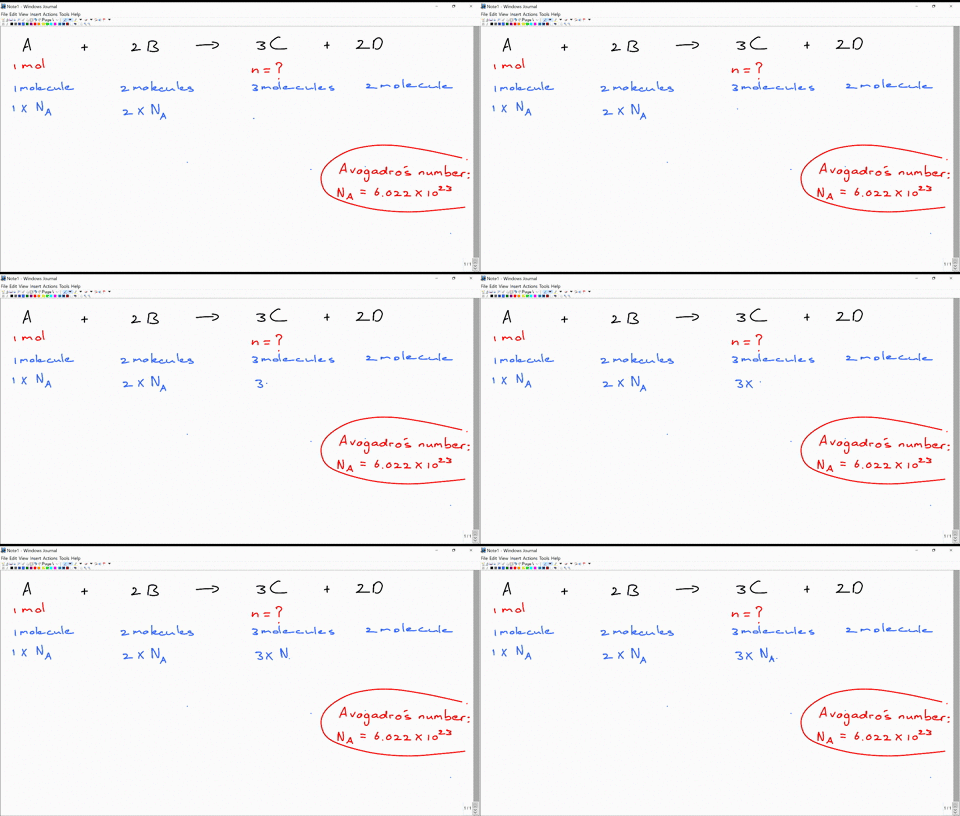
Consider the general chemical equation $A+2 B \longrightarrow 3 C+2 D$
(a) How many moles of $\mathrm{C}$ are produced from $1 \mathrm{~mol}$ of $\mathrm{A}$ ?
(b) How many liters of gas B must react to give $2 \mathrm{~L}$ of gas $\mathrm{D}$ at the same temperature and pressure?

Chapter 10: Chemical Equation Calculations
Marietjie Lutz
04:29
Introductory Chemistry: Concepts and Critical Thinking

Consider the general chemical equation $2 \mathrm{~A}+3 \mathrm{~B} \longrightarrow 2 \mathrm{C}+\mathrm{D}$
(a) How many moles of $\mathrm{C}$ are produced from $2 \mathrm{~mol}$ of $\mathrm{A} ?$
(b) How many liters of gas $\mathrm{B}$ must react to give $1 \mathrm{~L}$ of gas $\mathrm{D}$

Chapter 10: Chemical Equation Calculations
Marietjie Lutz
02:01
Introductory Chemistry: Concepts and Critical Thinking

Consider the general chemical equation $2 \mathrm{~A}+3 \mathrm{~B} \longrightarrow \mathrm{C}$.
(a) If $1.00 \mathrm{~g}$ of A reacts with $1.50 \mathrm{~g}$ of $\mathrm{B}$, what is the mass of $\mathrm{C}$ ?
(b) If $2.00 \mathrm{~g}$ of A reacts to produce $5.00 \mathrm{~g}$ of $\mathrm{C},$ what is the mass of B?

Chapter 10: Chemical Equation Calculations
Marietjie Lutz
02:46
Introductory Chemistry: Concepts and Critical Thinking

Consider the general chemical equation $3 \mathrm{~A}+\mathrm{B} \longrightarrow 2 \mathrm{C}$
(a) If $1.50 \mathrm{~g}$ of A reacts with $1.65 \mathrm{~g}$ of $\mathrm{B}$, what is the mass of $\mathrm{C}$ ?
(b) If $4.50 \mathrm{~g}$ of $\mathrm{A}$ reacts to produce $9.45 \mathrm{~g}$ of $\mathrm{C},$ what is the mass of B?

Chapter 10: Chemical Equation Calculations
Marietjie Lutz
02:11
Introductory Chemistry: Concepts and Critical Thinking

Consider the general chemical equation $3 \mathrm{~A}+\mathrm{B} \longrightarrow 2 \mathrm{C}$
(a) If $1.50 \mathrm{~g}$ of A reacts with $1.65 \mathrm{~g}$ of $\mathrm{B}$, what is the mass of $\mathrm{C}$ ?
(b) If $4.50 \mathrm{~g}$ of $\mathrm{A}$ reacts to produce $9.45 \mathrm{~g}$ of $\mathrm{C},$ what is the mass of B?

Chapter 10: Chemical Equation Calculations
Marietjie Lutz
1 2 3 4 5 ... 35

Marietjie's Quick Ask Videos

14:34
Chemistry 101

Hypochlorous acid (HClO) is a weak acid
with Ka = 3.0 x
10-8. If 0.100 moles of hypochlorous acid are dissolved
in 1.00 liter of solution at 25°C, what would be the resulting pH
of the solution?

Marietjie Lutz
03:46
Chemistry 101

Consider the reaction that occurs between aqueous solutions of sodium chromate and aqueous zinc chloride. which of the following species are the spectator in this reaction? a. Zn^+2 and CrO4^-2 b. Na +1 only c. Zn^+2 and Cl^-1 D. Na^+1 and Cl^-1

Marietjie Lutz
1