Second-Year student in South Africa, currently pursuing a Bachelors of Science in Computer Science and Mathematics. I've had a passion for maths since I was young, and it has also always been my best subject. Recently, I've been doing some tutoring at university, and I've come to learn that I quite enjoy teaching. Given these two things, it should come as no surprise that I'm very excited about this opportunity.
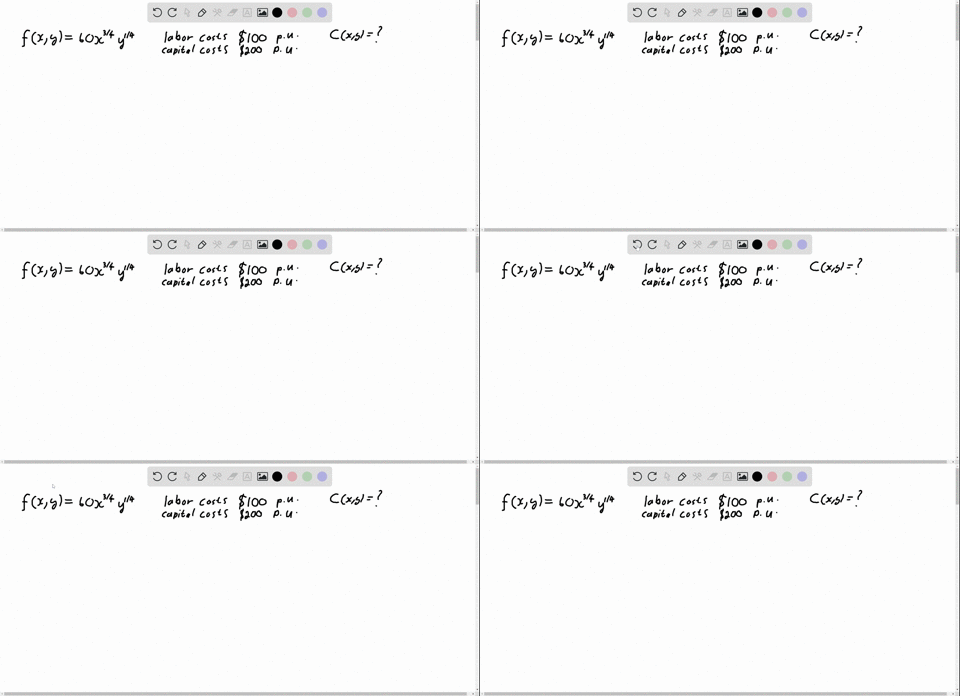
Refer to Example 3. If labor costs $\$ 100$ per unit and capital costs $\$ 200$ per unit, expressed as a function of two variables, $C(x, y),$ the cost of utilizing $x$ units of labor and $y$ units of capital.
The value of residential property for tax purposes is usually much lower than its actual market value. If $v$ is the market value, the assessed value for real estate taxes might be only $40 \%$ of $v .$ Suppose that the property $\operatorname{tax}, T,$ in a community is given by the function$$T=f(r, v, x)=\frac{r}{100}(.40 v-x)$$where $v$ is the market value of a property (in dollars), $x$ is a homeowner's exemption (a number of dollars depending on the type of property), and $r$ is the tax rate (stated in dollars per hundred dollars).(a) Determine the real estate tax on a property valued at $\$ 200,000$ with a homeowner's exemption of $\$ 5000,$ assuming a tax rate of $\$ 2.50$ per hundred dollars of net assessed value.(b) Determine the tax duc if the tax rate increases by $20 \%$ to $\$ 3.00$ per hundred dollars of net assessed value. Assume the same property value and homeowner's exemption. Does the tax due also increase by $20 \% ?$
Let $f(r, v, x)$ be the real estate tax function of Exercise 13.(a) Determine the real estate tax on a property valued at $\$ 100,000$ with a homeowner's exemption of $\$ 5000,$ assuming a tax rate of $\$ 2.20$ per hundred dollars of net assessed value.(b) Determine the real estate tax when the market value rises $20 \%$ to $\$ 120,000 .$ Assume the same homeowner's exemption and a tax rate of $\$ 2.20$ per hundred dollars of net assessed value. Does the tax due also increase by $20 \% ?$
Let $f(x, y)=x e^{y}+x^{4} y+y^{3} .$ Find $\frac{\partial^{2} f}{\partial x^{2}}, \frac{\partial^{2} f}{\partial y^{2}}, \frac{\partial^{2} f}{\partial x \partial y},$ and $\frac{\partial^{2} f}{\partial y \partial x}.$
A farmer can produce $f(x, y)=200 \sqrt{6 x^{2}+y^{2}}$ units of produce by utilizing $x$ units of labor and $y$ units of capital. (The capital is used to rent or purchase land, materials, and equipment.)(a) Calculate the marginal productivities of labor and capital when $x=10$ and $y=5.$(b) Let $h$ be a small number. Use the result of part (a) to determine the approximate effect on the production of changing labor from 10 to $10+h$ units while keeping capital fixed at 5 units.(c) Use part (b) to estimate the change in production when labor decreases from 10 to 9.5 units and capital stay fixed at 5 units.