I am pursuing my PhD in Biomedical Engineering at the University of Minnesota - Twin Cities. I have experience in tutoring and TAing post high school, college and graduate school.
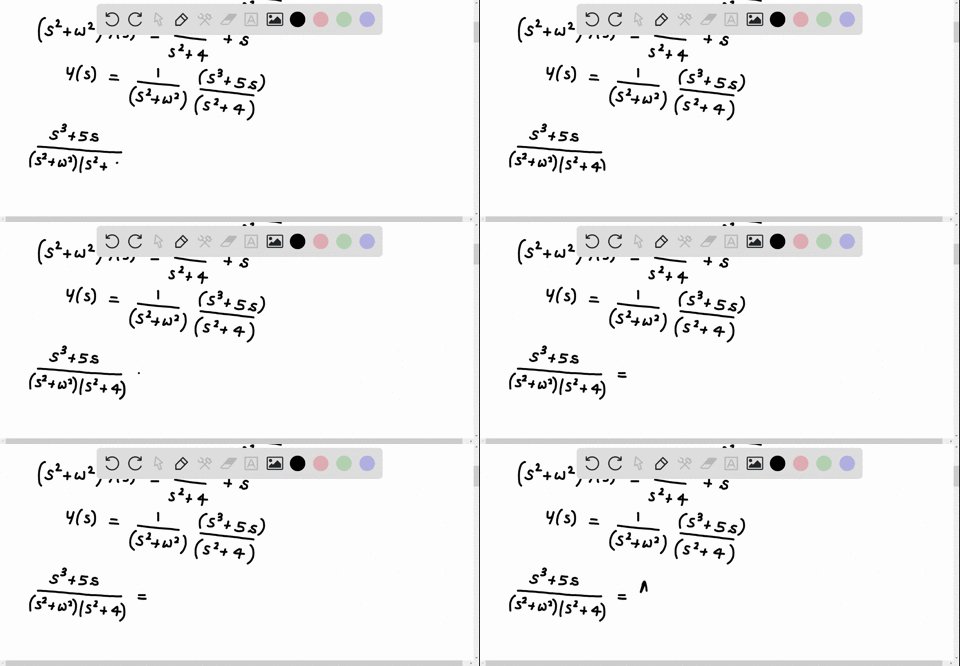
Use the Laplace transform to solve the given initial value problem.$$y^{\prime \prime}+\omega^{2} y=\cos 2 t, \quad \omega^{2} \neq 4 ; \quad y(0)=1, \quad y^{\prime}(0)=0$$
Use the Laplace transform to solve the given initial value problem.$$y^{\prime \prime}+2 y^{\prime}+y=4 e^{-t} ; \quad y(0)=2, \quad y^{\prime}(0)=-1$$
Suppose that$$g(t)=\int_{0}^{t} f(\tau) d \tau$$If $G(s)$ and $F(s)$ are the Iaplace transforms of $g(t)$ and $f(t),$ respectively, show that$$G(s)=F(s) / s \text { . }$$
According to the Ehrenberg relation, the average measurements of heights,$h,$ in centimetres, and masses, $m,$ in kilograms, of children between the ages of 5 and 13 are related by the function $\log m=0.008 h+0.4$a) Predict the height of a 10-year-old child with a mass of $60 \mathrm{kg},$ to the nearest centimetre.b) Predict the mass of a 12 -year-old child with a height of $150 \mathrm{cm},$ to the nearest kilogram.
The graph of $f(x)=\log _{2} x$ has been transformed to $g(x)=a \log _{2} x+k .$ The transformed image passes through the points $\left(\frac{1}{4},-9\right)$ and $(16,-6) .$ Determine the values of $a$ and $k$.
An egg is thrown nearly vertically upward from a point near the cornice of a tall building. The egg just misses the cornice on the way down and passes a point 30.0 m below its starting point 5.00 s after it leaves the thrower's hand. Ignore air resistance. (a) What is the initial speed of the egg? (b) How high does it rise above its starting point? (c) What is the magnitude of its velocity at the highest point? (d) What are the magnitude and direction of its acceleration at the highest point? (e) Sketch $a_y-t, v_y-t$, and $y-t$ graphs for the motion of the egg.
Consider the shapes. The diameter of the sphere is equal to 1 mm and the side of the cube is also equal to 1 mm . What is the ratio of the surface to volume ratios for the sphere and the cube?a. 3 : 1b. 4 : 1c. 1 : 1d. 2 : 1
A farm truck moves due east with a constant velocity of 9.50 $\mathrm{m} / \mathrm{s}$ on a limitless, horizontal stretch of road. A boy riding on the back of the truck throws a can of soda upward (Fig. P4.42) and catches the projectile at the same location on the truck bed, but 16.0 $\mathrm{m}$ farther down the road. (a) In the frame of reference of the truck, at what angle to the vertical does the boy throw the can? (b) What is the initial speed of the can relative to the truck? (c) What is the shape of the can's trajectory as seen by the boy? An observer on the ground watches the boy throw the can and catch it. In this observer's frame of reference, (d) describe the shape of the can's path and (e) determine the initial velocity of the can.
In a women's 100 -m race, accelerating uniformly, Laura takes 2.00 s and Healan 3.00 s to attain their maximum speeds, which they each maintain for the rest of the race. They cross the finish line simultaneously, both setting a world record of 10.4 s. (a) What is the acceleration of each sprinter? (b) What are their respective maximum speeds? (c) Which sprinter is ahead at the 6.00 -s mark, and by how much? (d) What is the maximum distance by which Healan is behind Laura, and at what time does that occur?
Let $W=f(t)$ represent wheat production in Argentina, in millions of metric tons, where $t$ is years since 2006. Interpret the statement $f(4)=14$ in terms of wheat production.
How do you solve these i am stuck