Patrick Delos Reyes

Numerade Educator
Tutor

Biography

Hello! I am Patrick Delos Reyes, currently a student at Northwestern University and member of the Class of 2023. I am pursuing a dual degree in Engineering Sciences and Applied Mathematics (ESAM) and Industrial Engineering and Management Sciences (IEMS). Mathematics is a wonderful tool that I think everyone can benefit from having under their belt; so, Numerade is a perfect platform for me to share what I've learned so far. In my free time I enjoy cooking, making music, and playing video games.

Education

Patrick has not yet added their education credentials.

Educator Statistics

Numerade tutor for 5 years
60 Students Helped

Topics Covered

Unlocking the Power of Functions: Boost Your Programming Skills
Exploring the World of Derivatives: A Comprehensive Guide
Applications of the Derivative
Breaking Limits: Unlock Your Potential with Our Expert Solutions
Unlock the Power of Sequences: Boost Your Productivity
Discover the Best Series to Binge-Watch | Your Ultimate Guide
Series Tests
Applications of Integration: Exploring Real-World Solutions
Stand Out with Differentiation Strategies | Boost Your Business
Mastering Integrals: Tips and Tricks for Calculus Success
Integration
Volume

Patrick's Textbook Answer Videos

0:00
Calculus: Early Transcendentals

(a) Graph the function $ f(x) = \sin x - \frac{1}{1000} \sin (1000x) $ in the viewing rectangle
$ [-2 \pi, 2 \pi] $ by $ [-4, 4] $. What slope does the graph appear to have at the origin?

(b) Zoom in to the viewing window $ [-0.4, 0.4] $ by $ [-0.25, 0.25] $ and estimate the value of $ f'(0) $. Does this agree with your answer from part (a)?

(c) Now zoom in to the viewing window $ [-0.008, 0.008] $ by $ [-0.005, 0.005] $. Do you wish to revise your estimate for $ f'(0) $?

Chapter 2: Limits and Derivatives
Section 7: Derivatives and Rates of Change
Patrick Delos Reyes
0:00
Calculus: Early Transcendentals

When a foreign object lodged in the trachea (wind pipe) forces a person to cough, the diaphragm thrusts upward causing an increase in pressure in the lungs. This is accompanied by a contraction in the trachea, making a narrower channel for the expelled air to flow through. For a given amount of air to escape in a fixed time, it must move faster through the narrower channel than the wider one. The greater the velocity of the air-stream, the greater the force on the foreign object. X rays show that the radius of the circular tracheal tube contracts to about two-thirds of its normal radius during a cough. According to a mathematical model of coughing, the velocity $v$ of the air-stream is related to the radius $r$ of the trachea by the equation
$$ v(r) = k(r_o - r) r^2 $$ $$ \frac{1}{2}r_o \leqslant r \leqslant r_o $$
where $k$ is constant and $r_o$ is the normal radius of the trachea.
The restriction of $r$ is due to the fact that the tracheal wall stiffens under pressure and a contraction greater than $ \frac{1}{2}r_o $ is prevented (otherwise the person would suffocate.
(a) Determine the value of $r$ in the interval $ [\frac{1}{2}r_o, r_o] $ at which $v$ has an absolute maximum. How does this compare with experimental evidence?
(b) What is the absolute maximum value of $v$ on the interval?
(c) Sketch the graph of $v$ on the interval $ [0, r_o] $.

Chapter 4: Applications of Differentiation
Section 1: Maximum and Minimum Values
Patrick Delos Reyes
0:00
Calculus: Early Transcendentals

Breathing is cyclic and a full respiratory cycle from the beginning of inhalation to the end of exhalation takes about 5 s. The maximum rate of air flow into the lungs is about 0.5 L/s. This explains, in part, why the function $ f(t) = \frac{1}{2} \sin (2\pi t/5) $ has often been used to model the rate of air flow into the lungs. Use this model to find the volume of inhaled air in the lungs at time $ t $.

Chapter 5: Integrals
Section 5: The Substitution Rule
Patrick Delos Reyes
0:00
Calculus: Early Transcendentals

(a) If $ C(x) $ is the cost of producing $ x $ units of a commodity, then the average cost per unit is $ c(x) = C(x)/x $. Show that if the average cost is a minimum, then the marginal cost equals the average cost.
(b) If $ C(x) = 16,000 + 200x + 4x^{3/2} $, in dollars, find (i) the cost, average costs, and marginal costs at a production level of $ 1000 $ units; (ii) the production leve that will minimize the average cost; and (iii) the minimum average cost.

Chapter 4: Applications of Differentiation
Section 7: Optimization Problems
Patrick Delos Reyes
03:09
Biocalculus Calculus for the Life Sciences

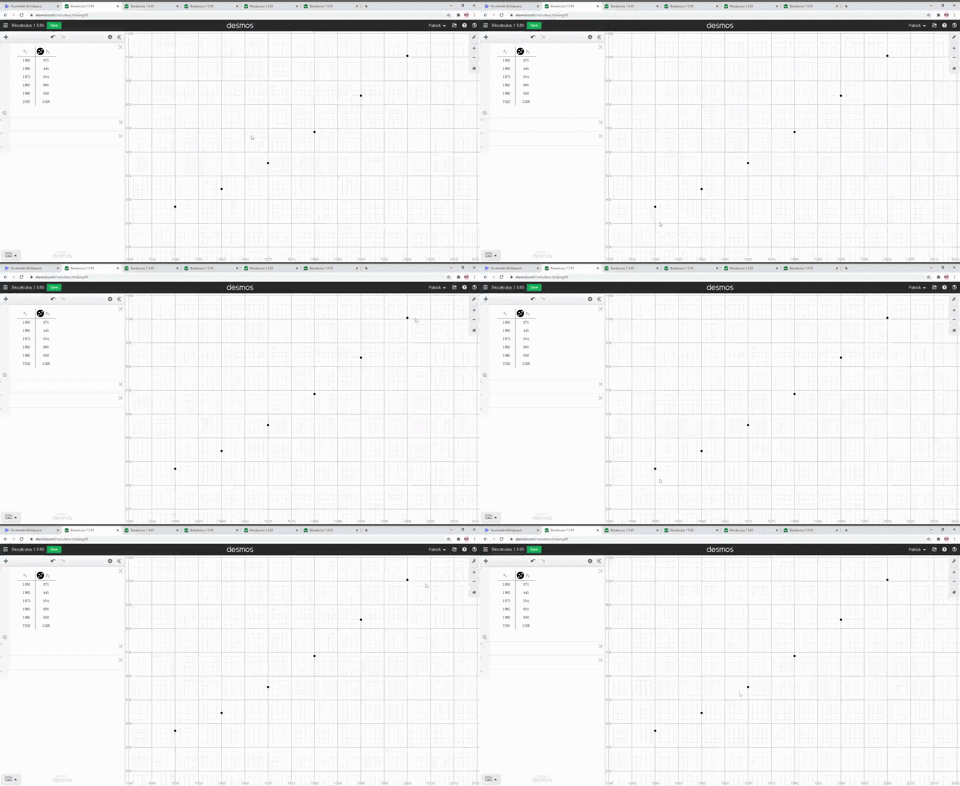
Indian population The table gives the midyear population of India (in millions) for the last half of the 20th century.
(a) Make a scatter plot, semilog plot, and log-log plot for these data and comment on which type of model would be most appropriate.
(b) Obtain an exponential model for the population.
(c) Use your model to estimate the population in 2010 and compare with the actual population of 1173 million. What conclusion can you make?

Chapter 1: Functions and Sequences
Section 5: Logarithms; Semilog and Log-Log Plots
Patrick Delos Reyes
05:04
Calculus

The graph of a function $g$ is shown.
(a) Verify that $g$ satisfies the hypotheses of the Mean Value
Theorem on the interval $[0,8] .$
(b) Estimate the value(s) of $c$ that satisfy the conclusion of the
Mean Value Theorem on the interval $[0,8] .$
(c) Estimate the value(s) of $c$ that satisfy the conclusion of the
Mean Value Theorem on the interval $[2,6] .$

Chapter 3: Applications of Differentiation
Section 2: The Mean Value Theorem
Patrick Delos Reyes
1 2 3 4 5 ... 9

Patrick's Quick Ask Videos

03:38
Calculus 1 / AB

Breathing is cyclic and a full respiratory cycle from the beginning of inhalation to the end of exhalation takes about 5 s. The maximum rate of air flow into the lungs is about 0.5 L/s. This explains, in part, why the function $ f(t) = \frac{1}{2} \sin (2\pi t/5) $ has often been used to model the rate of air flow into the lungs. Use this model to find the volume of inhaled air in the lungs at time $ t $.

Patrick Delos Reyes
02:42
Physics 101 Mechanics

A truck collides with a car, and during the collision, the net force on each vehicle is essentially the force exerted by the other. Suppose the mass of the car is 550 kg, the mass of the truck is 2200 kg, and the magnitude of the truck’s acceleration is 10 m/s2. Find the magnitude of the car’s acceleration.

Patrick Delos Reyes
02:01
Geometry

An architect is designing a garden for a client on a planning sheet. The client requests the relocation of a water fountain by the rule (x,y)—>(x+9,y-8). Later, the client decides that they would prefer the water fountains location moved from this new position 5units left and 3 units down. Find the composition as a single transformation.

Patrick Delos Reyes
07:20
Calculus 1 / AB

When a foreign object lodged in the trachea (wind pipe) forces a person to cough, the diaphragm thrusts upward causing an increase in pressure in the lungs. This is accompanied by a contraction in the trachea, making a narrower channel for the expelled air to flow through. For a given amount of air to escape in a fixed time, it must move faster through the narrower channel than the wider one. The greater the velocity of the air-stream, the greater the force on the foreign object. X rays show that the radius of the circular tracheal tube contracts to about two-thirds of its normal radius during a cough. According to a mathematical model of coughing, the velocity $v$ of the air-stream is related to the radius $r$ of the trachea by the equation
$$ v(r) = k(r_o - r) r^2 $$ $$ \frac{1}{2}r_o \leqslant r \leqslant r_o $$
where $k$ is constant and $r_o$ is the normal radius of the trachea.
The restriction of $r$ is due to the fact that the tracheal wall stiffens under pressure and a contraction greater than $ \frac{1}{2}r_o $ is prevented (otherwise the person would suffocate.
(a) Determine the value of $r$ in the interval $ [\frac{1}{2}r_o, r_o] $ at which $v$ has an absolute maximum. How does this compare with experimental evidence?
(b) What is the absolute maximum value of $v$ on the interval?
(c) Sketch the graph of $v$ on the interval $ [0, r_o] $.

Patrick Delos Reyes
11:09
Calculus 1 / AB

(a) If $ C(x) $ is the cost of producing $ x $ units of a commodity, then the average cost per unit is $ c(x) = C(x)/x $. Show that if the average cost is a minimum, then the marginal cost equals the average cost.
(b) If $ C(x) = 16,000 + 200x + 4x^{3/2} $, in dollars, find (i) the cost, average costs, and marginal costs at a production level of $ 1000 $ units; (ii) the production leve that will minimize the average cost; and (iii) the minimum average cost.

Patrick Delos Reyes
02:41
Calculus 1 / AB

(a) Graph the function $ f(x) = \sin x - \frac{1}{1000} \sin (1000x) $ in the viewing rectangle
$ [-2 \pi, 2 \pi] $ by $ [-4, 4] $. What slope does the graph appear to have at the origin?

(b) Zoom in to the viewing window $ [-0.4, 0.4] $ by $ [-0.25, 0.25] $ and estimate the value of $ f'(0) $. Does this agree with your answer from part (a)?

(c) Now zoom in to the viewing window $ [-0.008, 0.008] $ by $ [-0.005, 0.005] $. Do you wish to revise your estimate for $ f'(0) $?

Patrick Delos Reyes
1 2