12:43
Calculus: Early Transcendentals
True/False: Determine whether each of the statements that follow is true or false. If a statement is true, explain why. If a statement is false, provide a counterexample.
(a) True or False: The domain of a function of the form $f+g$ is equal to the domain of $f$ or the domain of $g$, whichever is smaller.
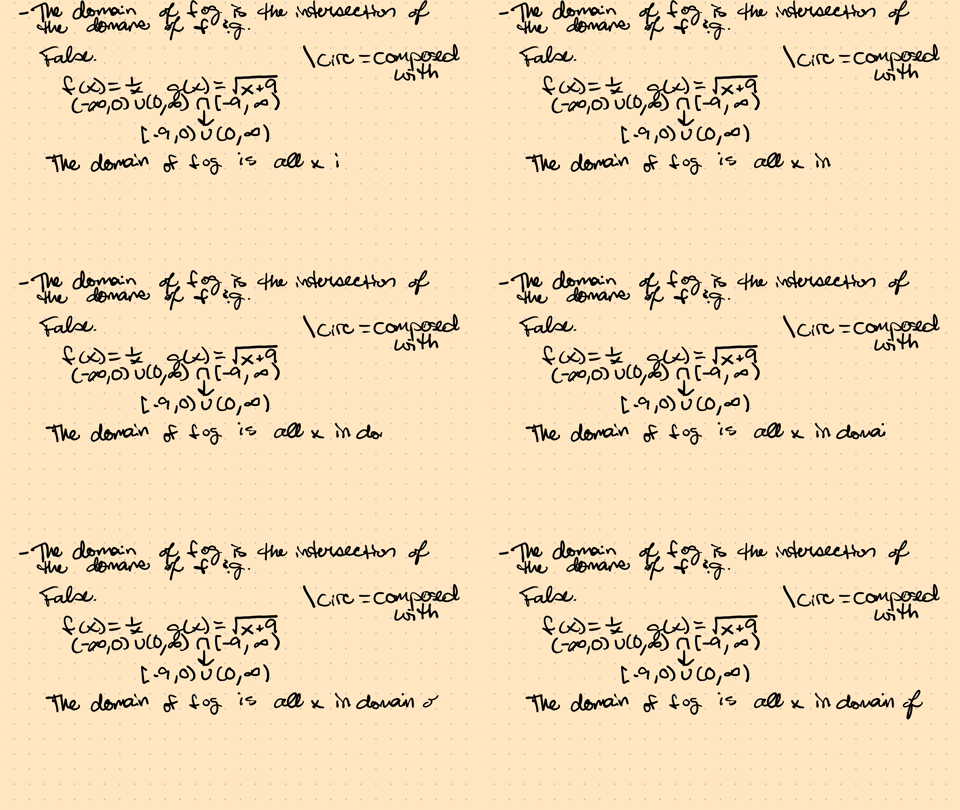
(b) True or False: The domain of a function of the form $f \cdot g$ is equal to the intersection of the domains of $f$ and $g$.
(c) True or False: If the graph of $y=f(x)$ contains the point $(a, b)$, then the graph of $y=f(x)+C$ must contain the point $(a, b+C)$.
(d) True or False: If the graph of $y=f(x)$ contains the point $(a, b)$, then the graph of $y=f(x+C)$ must contain the point $(a+C, b)$.
(e) True or False: The inverse of the one-to-one function $f(x)=x^{5}$ is $f^{-1}(x)=x^{-5}$.
(f) True or False: If $f$ is an invertible function, then $f^{-1}=\frac{1}{f}$
(g) True or False: Every even function is a function that involves only even exponents.
(h) True or False: If $f$ is an even function and $(0, b)$ is a point on the graph of $y=f(x)$, then $(0,-b)$ must also be on the graph of $y=f(x)$.