Teaching college physics is a thrilling journey of exploration. I bring theory to life through experiments, nurturing the next generation of scientists to question, analyze, and contribute.
Imagine a bar of steel $80 \mathrm{~cm}$ long pivoted horizontally at its left end, as depicted in Fig. $5-2$. Find the torque about axis- $A$ (which is perpendicular to the page) due to each of the forces shown acting at its right end.We use $\tau=r F \sin \theta$, taking clockwise torques to be negative while counterclockwise torques are positive. The individual torques due to the three forces areFor $10 \mathrm{~N}: \quad \tau=-(0.80 \mathrm{~m})(10 \mathrm{~N})\left(\sin 90^{\circ}\right)=-8.0 \mathrm{~N} \cdot \mathrm{m}$For 25 N: $\quad \tau=+(0.80 \mathrm{~m})(25 \mathrm{~N})\left(\sin 25^{\circ}\right)=+8.5 \mathrm{~N} \cdot \mathrm{m}$For 20 N: $\quad \tau=\pm(0.80 \mathrm{~m})(20 \mathrm{~N})\left(\sin 0^{\circ}\right)=0$The line of the $20-\mathrm{N}$ force goes through the axis, and so $\theta=0^{\circ}$ for it. Or, put another way, because the line of the force passes through the axis, its lever arm is zero. Either way, the torque is zero for this (and any) force whose line-of-action passes through the axis. If you had trouble seeing which way the torques act, redraw the diagram on a piece of paper and imagine a pin stuck downward at A. Then put your finger at the right end of the rod and push the paper in the direction of the $10-\mathrm{N}$ force. The paper will rotate clockwise around the pin. That's the angular direction of the torque due to that force.
A uniform metal beam of length $L$ weighs $200 \mathrm{~N}$ and holds a $450-\mathrm{N}$ object as shown in Fig. $5-3$. Find the magnitudes of the forces exerted on the beam by the two supports at its ends. Assume the lengths are exact.
Rather than draw a separate free-body diagram, we show the forces on the object being considered (the beam) in Fig. $5-3$. Because the beam is uniform, its center of gravity is at its geometric center. Thus, the weight of the beam ( $200 \mathrm{~N}$ ) is shown acting downward at the beam's center. The forces $F_{1}$ and $F_{2}$ are exerted on the beam by the supports. Because there are no $x$ -directed forces acting on the beam, we have only two equations to write for this equilibrium situation: $\sum F_{y}=0$ and $\sum \tau=0$.$$+\uparrow \sum F_{y}=0 \quad \text { becomes } \quad F_{1}+F_{2}-200 \mathrm{~N}-450 \mathrm{~N}=0$$Before the torque equation is written, an axis must be chosen. We choose it at $A$, so that the unknown force $F_{1}$ will pass through it and exert no torque. The torque equation is then$$\text { \&+ } \sum \tau_{A}=-(L / 2)(200 \mathrm{~N})\left(\sin 90^{\circ}\right)-(3 L / 4)(450 \mathrm{~N})\left(\sin 90^{\circ}\right)+L F_{2} \sin 90^{\circ}=0$$Dividing through the equation by $L$ and solving for $F_{2}$, we find that $F_{2}=438 \mathrm{~N}$.To determine $F_{1}$, substitute the value of $F_{2}$ in the force equation, thereby obtaining $F_{1}=212 \mathrm{~N}$.
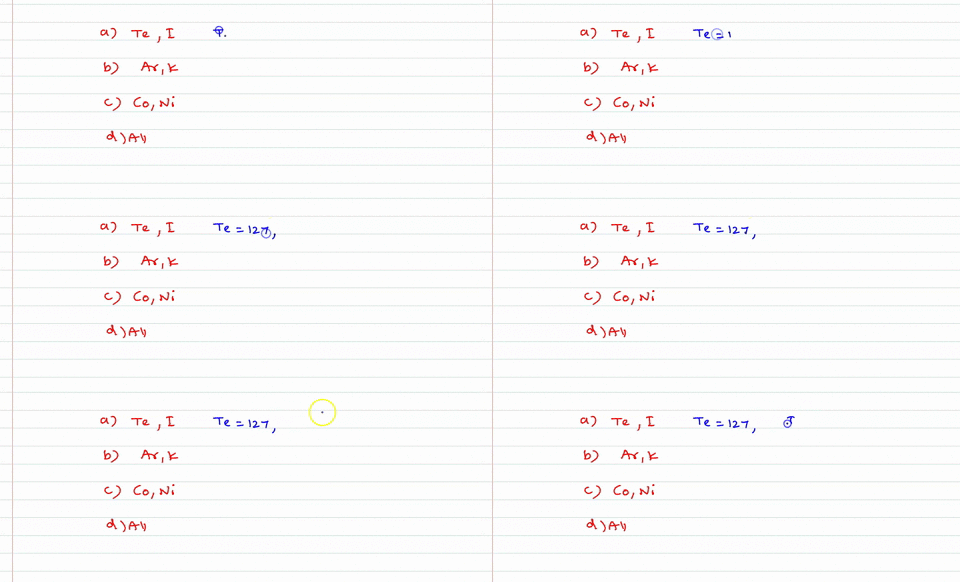
Increasing order of atomic weights was violated (anomalous pairs) in the case of(1) Te, I(2) $\Lambda r, K$(3) Co, Ni(4) $\Lambda \mathrm{ll}$
The wrong statement among the following is(1) Mcndclcev arranged the Elements in a tabular form according to increasing atomic weight.(2) Onc of the dcfects in Mcndclcev's periodic table is position of lanthanides.(3) Maximum number of groups in Bohr's periodic table is 18 .(4) Elements with similar chemical properties occur only within the same period.
Which of the following statement is false?(1) In modern periodic table the elements are arranged in increasing order of atomic number.(2) The number of periods in the long form periodic table is $7 .$(3) The long form periodic table is nothing but just a graphical representation of Paulis principle.(4) Elements of III period are called typical elements.