Sarvesh Somasundaram

Guilford College
Tutored math, physics, English, and computer science at a school in India over the summer.

Biography

I am currently a student pursuing a computer science degree at Guilford College. I love mathematics and I have very strong fundamentals in math, as I was in an accelerated Early College program in high school. That allowed me to take precalculus, AP Calculus AB and BC, AP Statistics and I also took dual-enrolled math courses like Multivariable calculus, vector calculus, and differential equations. I scored 5s and 4s on all my AP exams. I have been tutoring throughout my high school years at various schools and establishments such as ESL and newcomers schools, science centers, and robotics camps.

Education

BA Computer Science
Guilford College

Educator Statistics

Numerade tutor for 5 years
51 Students Helped

Topics Covered

Master Vector Calculus with Our Comprehensive Guide
Mastering Exponential and Logarithmic Functions: Your Ultimate Guide
Maximizing Accuracy with Effective Sampling and Data Analysis
Master Trigonometry with Our Comprehensive Guide
Differential Equations Made Simple: Expert Tips & Resources
Unlock the Power of Logic: Boost Your Critical Thinking Skills
Circles: Exploring the Beauty and Significance of Circular Shapes
Unlock the Power of Vectors: Discover Their Limitless Possibilities
Discover the Properties of Quadrilaterals: A Comprehensive Guide
Lines and Planes in Space
Stand Out with Differentiation Strategies | Boost Your Business
The Cross Product
Taylor Series
Discover the Basics of Trigonometry: Your Introduction to Triangles
Applications of Trigonometric Functions
Graphing Trigonometry Functions
Mastering Integrals: Tips and Tricks for Calculus Success
Integration
Applications of Integration: Exploring Real-World Solutions
Unlocking the Power of Functions: Boost Your Programming Skills
Mastering Partial Derivatives: Essential Techniques and Tips
Exploring the World of Derivatives: A Comprehensive Guide
Functions
Mastering Quadratic Functions: Unlocking Their Power
Unlocking Insights with Descriptive Statistics: A Comprehensive Guide
Mastering Sequences and Series: An Introduction
Introduction to Combinatorics & Probability: Understanding the Basics
Discover the Wonders of Geometry: An Introduction to Shapes and Space
Applications of the Derivative
Exploring the Functions of Multiple Variables

Sarvesh's Textbook Answer Videos

06:58
Calculus: Early Transcendentals

An integral equation is an equation that contains an unknown function $ y(x) $ and an integral that involves $ y(x). $ Solve the given integral equation. [Hint: Use an initial condition obtained from the integral equation.]
$ y(x) = 4 + \int^x_0 2t \sqrt {y(t)} dt $

Chapter 9: Differential Equations
Section 3: Separable Equations
Sarvesh Somasundaram
10:40
Calculus: Early Transcendentals

The wind-chill index is modeled by the function $$ W = 13.12 + 0.6215T - 11.37v^{0.16} + 0.3965Tv^{0.16} $$ where $ T $ is the temperature (in $ ^\circ C $) and $ v $ is the wind speed (in km/h). The wind speed is measured as 26 km/h, with a possible error of $ \pm 2 $ km/h, and the temperature is measured as $ -11^\circ C $, with a possible error of $ \pm 1^\circ C $. Use differentials to estimate the maximum error in the calculated value of $ W $ due to the measurement errors in $ T $ and $ v $.

Chapter 14: Partial Derivatives
Section 4: Tangent Planes and Linear Approximations
Sarvesh Somasundaram
12:24
Fundamentals of Differential Equations

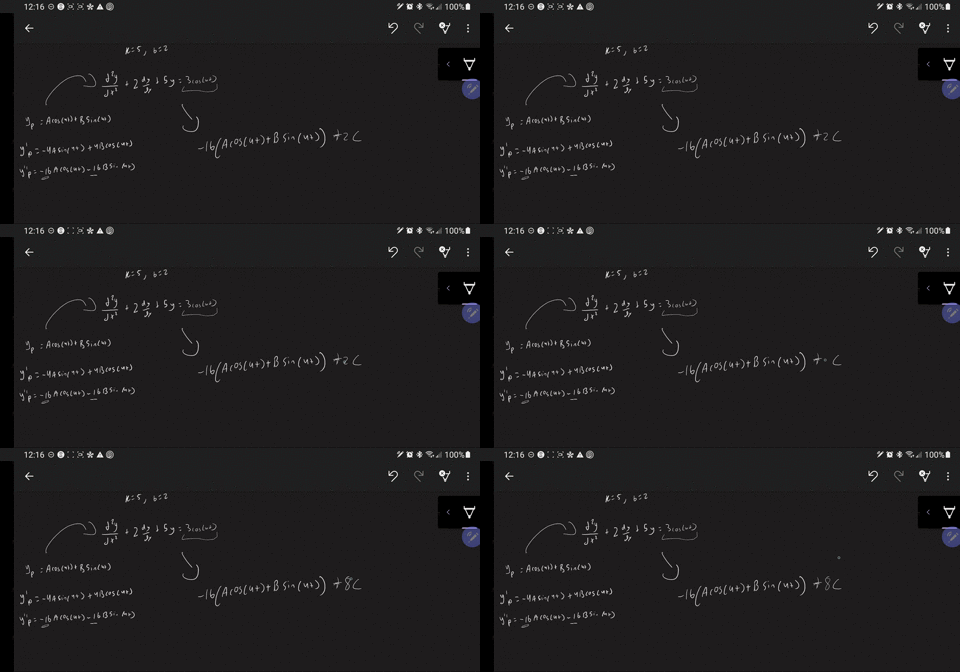
A mass weighing 32 lb is attached to a spring hanging from the ceiling and comes to rest at its equilibrium position. At time t = 0, an external force$ F(t)=3 \cos 4 t \mathrm{lb} $ is applied to the system. If the spring constant is 5 lb/ft and the damping constant is 2 lb-sec/ft, find the steady state solution for the system.

Chapter 4: Linear Second-Order Equations
Section 10: A Closer Look at Forced Mechanical Vibrations
Sarvesh Somasundaram
12:21
Fundamentals of Differential Equations

An 8-kg mass is attached to a spring hanging from the ceiling and allowed to come to rest. Assume that the spring constant is 40 N/m and the damping constant is 3 N-sec/m. At time t = 0, an external force of $ 2 \sin 2 t \cos 2 t \mathrm{N} $ N is applied to the system. Determine the amplitude and frequency of the steady-state solution.

Chapter 4: Linear Second-Order Equations
Section 10: A Closer Look at Forced Mechanical Vibrations
Sarvesh Somasundaram
09:51
Calculus for AP

Prove that the portion of a sphere of radius $R$ seen by an observer located at a distance $d$ above the North Pole has area $A=$ 2$\pi d R^{2} /(d+R) .$ Hint: According to Exercise $46,$ the cap has surface area is 2$\pi R h .$ Show that $h=d R /(d+R)$ by applying the Pythagorean
Theorem to the three right triangles in Figure $19 .$

Chapter 8: FURTHER APPLICATIONS OF THE INTEGRAL AND TAYLOR POLYNOMIALS
Section 1: Arc Length and Surface Area
Sarvesh Somasundaram
1 2 3 4 5 ... 7

Sarvesh's Quick Ask Videos

07:00
Calculus 1 / AB

use L'Hospital's rule.
find the limit. lim x→0 sin(x) / tan(7x)

Sarvesh Somasundaram
02:31
Calculus 1 / AB

Find derivative G(z) = (1 – 4z) ^2 square root of z^2 +1

Sarvesh Somasundaram
29:39
Calculus 1 / AB

Answer the question from the image

Sarvesh Somasundaram
07:49
Intro Stats / AP Statistics

How tall? The heights of young men follow a Normal distribution with mean 69.3 inches and standard deviation 2.8 inches. The heights of young women follow a Normal distribution with mean 64.5 inches and standard deviation 2.5 inches. Suppose we select independent SRSs of 16 young men and 9 young women and calculate the sample mean heights and .

(a) What is the shape of the sampling distribution of ? Why?

(b) Find the mean of the sampling distribution. Show your work.

(c) Find the standard deviation of the sampling distribution. Show your work.

Sarvesh Somasundaram
08:06
Intro Stats / AP Statistics

Please see the attached image.

Sarvesh Somasundaram
10:14
Precalculus

Solve the following recurrence relation using the characteristic equation. Show all work.

an = 10an-1 - 21an-2 , a0=2, a1=1

Sarvesh Somasundaram
1 2