I am a house tutor Helping neighbourhood students with Mathematics questions
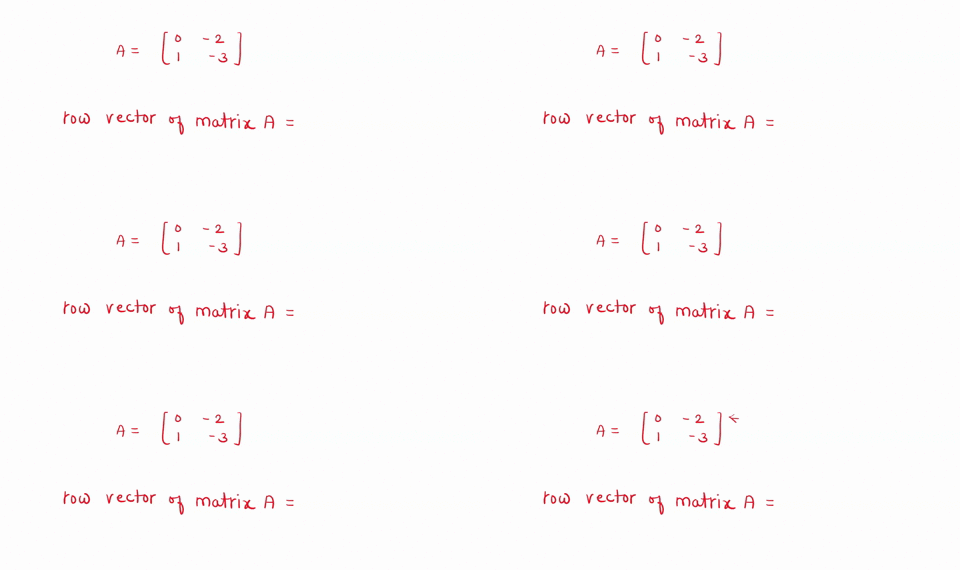
Write (a) the row vectors and (b) the column vectors of the matrix.$$\left[\begin{array}{ll}0 & -2 \\1 & -3\end{array}\right]$$
Write (a) the row vectors and (b) the column vectors of the matrix.$$\left[\begin{array}{rrr}4 & 3 & 1 \\1 & -4 & 0\end{array}\right]$$
Write (a) the row vectors and (b) the column vectors of the matrix.$$\left[\begin{array}{rrr}0 & 3 & -4 \\4 & 0 & -1 \\-6 & 1 & 1\end{array}\right]$$
Finding a Basis for a Row Space and Rank In Exercises $5-12$, find (a) a basis for the row space and(b) the rank of the matrix..$$\left[\begin{array}{ll}1 & 0 \\0 & 2\end{array}\right]$$
Finding a Basis for a Row Space and Rank In Exercises $5-12$, find (a) a basis for the row space and(b) the rank of the matrix.$$\left[\begin{array}{lll}0 & 1 & -2\end{array}\right]$$
Let p0(x) = 1, p1(x) = -1 + x, and p2(x) = 1 - x + x^2. Prove that B = {p0, p1, p2} is a basis of the vector space P2, the polynomials in x of degree 2 or less.
Use the Chain Rule to find dz/dt. (Enteryour answer only in terms of t.)z = cos(x + 4y), x = 5t6, y = 4/tdz/dt = ????
Normalize the following wavefunctions:(a) Ψ(x) = sin(2x) , 0 ≤ x ≤ π (b) Ψ(x) = e(i2 x+1) , 0 ≤ x ≤ π
Let x be a real number such that x + (1/x) is an integer. Show that x^n + (1/x^n) is an integer for all integers n with n ≥ 1.
He–Ne laser cavity has a spacing of 15 cm between the mirrors, and the opticalmode in the cavity has a diameter of 3 mm (a) Determine the frequency difference between adjacent laser modes. (b) Determine the frequency difference between all possible cavity modes contained within the laser cavity volume. (c) TheHe–Ne gas mixture provides optical gain over a frequency width of 1.5 GHz.Compare the number of laser modes that are within this width to the total numberof cavity modes within this width.
Electromagnetic radiation transfers momentum to the surface it strikes. This implies that solar radiation can exert a small force on objects in the solar system. The force is given by F = 2IA / c, where I is the intensity of radiation, A is the area of the object, and c is the speed of light. The possibility of using this radiation pressure to propel spacecraft out of the solar system has been raised. Calculate the force on a 0.5 km square solar sail at the distance from Earth, where I = 1400 Watt/m^2.